




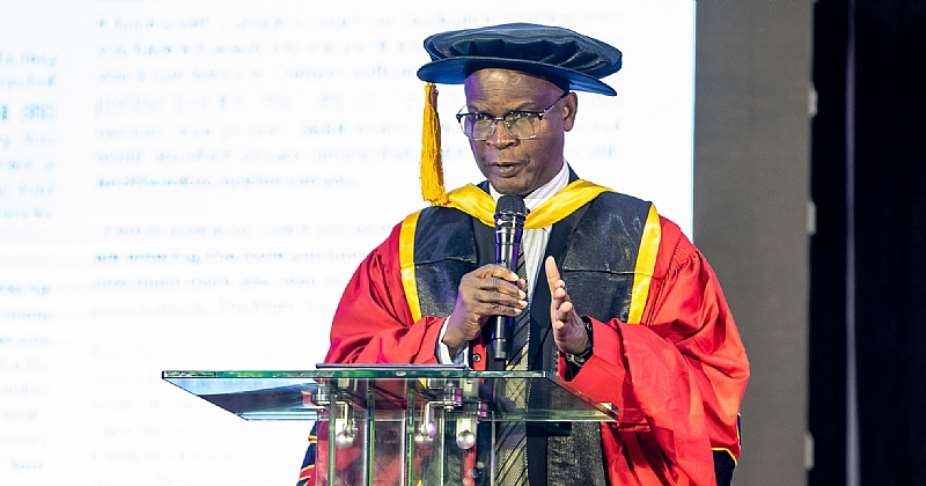
President of the Accra Institute of Technology (AIT), Professor Clement K. Dzidonu, has called for a fundamental shift in how individuals, educational institutions and society approach learning in the age of Artificial Intelligence (AI).
He argues that graduation should no longer be viewed as the end of a person's learning journey, but rather as the beginning of a continuous process of acquiring, renewing and deepening skills and capabilities.
Professor Dzidonu is advocating the concept of the Sovereign Lifelong Learner — the “Sovereign Triple-L”, which he describes as an individual who takes ownership of continuing education and assumes personal responsibility for constantly developing their capabilities throughout their professional and personal lives.
He said the traditional model, under which individuals receive intensive formal education, graduate, enter a profession and depend for years on the knowledge acquired during their studies, is becoming increasingly unsustainable.
“You went to university. You acquired knowledge. You graduated. You entered a profession. And for many years, much of what you had learned remained relevant to what you were called upon to do. That world is disappearing.”
According to the AIT President, the rapid advancement of AI, emerging technologies, changing professional practices and the continuous transformation of industries are reshaping the nature of work and the capabilities required to remain relevant.
Graduation is the beginning, not the end
Professor Dzidonu's central argument is that education and professional development must increasingly be treated as continuous journeys rather than processes that end with the acquisition of a certificate or degree.
While a university qualification remains important as recognition of what an individual has achieved at a particular point in time, he said it cannot guarantee that the knowledge and skills acquired will remain adequate as technology, professions and societal needs evolve.
He therefore believes graduation should mark the beginning of a new phase in which individuals take greater responsibility for directing their own learning and capability development.
“The Sovereign Triple-L is not simply someone who keeps taking courses, accumulates certificates, or waits until an employer sends them for training. The Sovereign Triple-L is a Sovereign Lifelong Learner — a person who takes ownership of continuing learning.”
He said individuals must continually ask themselves what they know, what they can do, what they need to learn, what they must unlearn or relearn, where their capability gaps exist and what they need to become capable of doing in the future.
Professor Dzidonu stressed that responsibility cannot rest entirely with universities, employers or technology providers, insisting that individuals must increasingly become sovereign over their own learning journeys.
The SEEK-Gap challenge
Professor Dzidonu uses the term SEEK to describe an individual's Skills, Expertise, Experience, Knowledge and Know-how.
He identifies the SEEK-Gap as the changing distance between the capabilities an individual currently possesses and those increasingly required to remain competent, relevant and effective.
This, he argues, gives rise to what he calls an important paradox: “The More You Know, the Less You Know.”
He explained that the proposition does not suggest that learning reduces a person's knowledge. Rather, it reflects the fact that the frontier of what professionals can know, do and are expected to accomplish is constantly expanding.
“AI is expanding that frontier. New technologies are expanding it further. New professional practices, tools, problems and possibilities are continually extending it.”
The challenge, therefore, is not merely to accumulate knowledge but to continually transform evolving SEEK into Professional-SEEK-Capabilities — the integrated capabilities needed to perform, solve problems, exercise judgement, adapt, innovate, collaborate, create, lead and make a difference.
For Professor Dzidonu, lifelong learning is consequently becoming more than a desirable personal habit.
“The future will increasingly belong to those who remain capable of learning what tomorrow requires.”
Learning with AI without surrendering human sovereignty
Professor Dzidonu also believes AI should not simply be viewed as a technology capable of making existing knowledge or skills obsolete.
Instead, he wants individuals to rethink what they learn, how they learn and how technology can be used to extend their capabilities.
“The more useful question is not merely, ‘Will AI make what I learned obsolete?’ It is: ‘How will I use AI, technology, experience, reflection and continuous learning to keep renewing what I know and what I am capable of doing?’”
He said becoming a Sovereign Triple-L does not require individuals to surrender human judgement or allow AI to replace learning.
Rather, people should learn with AI, question it, challenge it and use it responsibly while continuing to strengthen their ability to think, create, exercise judgement and learn independently.
From opportunity to meaningful difference
At the centre of Professor Dzidonu's Sovereign Triple-L concept is the Opportunity–Possibility–Difference (OPD) Perspective, which he presents as a practical approach to lifelong learning and continuing capability development.
See the opportunity involves recognising that change, emerging technologies, unfamiliar assignments, mistakes, challenges and disruption can create opportunities for learning and growth.
Explore the possibility requires individuals to consider what new skills, expertise, experiences, knowledge, know-how and capabilities can emerge from those opportunities.
Create the difference, he argues, is the ultimate purpose of continuous learning — applying what one learns and becomes capable of doing to create value, solve problems, improve lives, contribute to organisations and communities, and make a meaningful impact.
Professor Dzidonu's message, therefore, goes beyond a call for people to acquire more knowledge. He is urging individuals to continually transform learning into capability and capability into meaningful impact.
Although his message is framed in the context of university graduation, he said the Sovereign Triple-L mindset extends beyond graduates to students, professionals, entrepreneurs, educators, business leaders, institutions and others seeking to remain capable and relevant in a rapidly changing world.
“What made an individual capable yesterday may not necessarily be sufficient tomorrow,” he said.
He believes the appropriate response should not be fear or passive dependence on technology, but a sustained commitment to learning, developing capabilities and continually becoming better equipped for the future.
His message is ultimately simple: “Do not allow graduation to become the end of your learning journey. Let it become the beginning of a new one.”
The Age of the Sovereign Triple-L, he said, is therefore a call to embrace a new relationship with learning.
" See the opportunity. Explore the possibility. Create the difference. And above all: Never stop learning. Never stop developing your capability. Never stop becoming."
 Govt releases GH¢9.1 billion covering six quarters of DACF to MMDAs - Ayariga
 Manhyia South MP charged over alleged GH¢9.85m loss to SIC Life
 'I didn’t know the process would be that fast' – Nana B explains missing NPP swe...
 'Who is Karbo to defy my orders?' – Buttey fumes over NPP conference clash
 'Kojo Bamba can’t stop NDC' – Gbande warns NPP against shielding anyone from arr...
 Fire destroys property building in Koforidua
 Mahama pardons 863 convicted persons, 11 from death sentence
 National Cathedral site reverts to government as Attorney-General reviews audit
 NDC confirms Dzifa Gunu’s disqualification from La Dadekotopon constituency secr...
 Nigeria's Tinubu confirms 32 dead after military plane crash


