




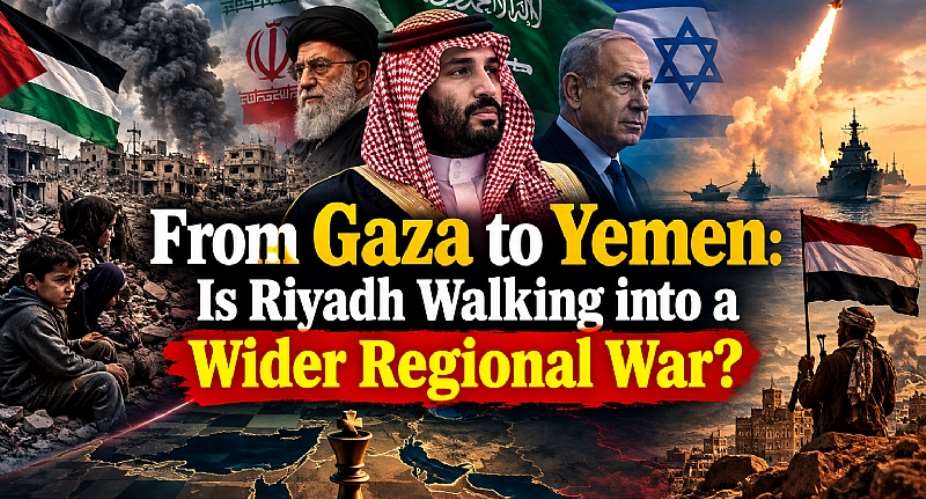
War magnifies fears, and insecurity multiplies those fears until they create countermeasures that can have little to do with diplomatic rights or rational restraint. It becomes a default deficit that perpetuates itself. When a regional conflict crosses borders, its consequences inevitably reach neighbouring states and allies. That is often the point at which escalation becomes difficult to contain—even when negotiations remain on the table.
As the Iran-Israel war continues to reshape the Middle East, its consequences could potentially extend towards South Asia and the region’s western borders. Against this backdrop, when an Axios report by Barak Ravid suggested that Washington was preparing for another possible confrontation with Iran, questions immediately emerged about Riyadh. At the same time, Saudi Arabia, under MBS and closely aligned with Washington, has reportedly been considering stronger action against Yemen’s Houthis, who are widely described as Iran-backed militia. But is the equation really that simple? Let us examine the logic and the chances of another war.
Who is stronger: Iran or Riyadh militarily?
In terms of military technology, weapons systems and combat experience, Iran possesses certain advantages. Its forces have decades of experience operating under pressure, sanctions and asymmetric warfare conditions. Iran has already experienced some of the worst consequences of regional confrontation, meaning that another conflict would not necessarily be an entirely unfamiliar strategic environment.
Saudi Arabia, meanwhile, remains one of the world's largest importers of advanced American military equipment. Yet sophisticated hardware does not automatically translate into battlefield experience, particularly in prolonged asymmetric warfare, insurgency and unconventional combat. Riyadh's strength also lies elsewhere: diplomacy, economic influence, strategic partnerships and its broader regional position. The Mecca framework, relations with Turkey and Pakistan, and American intelligence and military support provide Riyadh with significant strategic depth.
Therefore, neither side may find a new war affordable while the region is already experiencing an expanding conflict.
Saudi Arabia's political position is equally complicated. The reported landing of an Israeli flight in Tabuk, Riyadh's hospitality towards passengers requiring medical assistance, and the UAE's established relationship with Israel under the Abraham Accords all point towards a changing regional landscape. Riyadh appears to be carefully balancing two strategic directions—one hand extending towards the emerging Mecca framework and the other cautiously navigating the Abraham Accords environment. Yet this balancing act carries risks. Iran's reaction could become increasingly severe if Gulf states are perceived as facilitating an Israeli or American campaign. Saudi Arabia, therefore, would have strong reasons to seek credible American security guarantees before entering any direct confrontation.
How are the US-Iran negotiations progressing?
So far, there appears to be no decisive breakthrough. The deadlock remains, while time continues to pass and Iran's conditions remain difficult for Washington to accept. Meanwhile, the Houthis' alleged links with Iran raise another fundamental question: If Iran does not have complete control over Houthi decision-making, can Houthi attacks on Riyadh legitimately become a justification for striking Iran?
This is where the regional equation becomes particularly dangerous. Pressure is already accumulating on Turkey and Pakistan. Would either country become directly involved in a Saudi-led campaign against the Houthis, or would they continue to resist becoming parties to another regional war? Their current diplomatic consultations will be closely watched because the choices made today could determine whether the conflict remains geographically contained or develops into a broader regional confrontation.
How are Trump and Israel building the case for another war?
The repeated breakdown of ceasefire arrangements has already damaged confidence in regional diplomacy. Israel's continuing military operations in Gaza, amid a mounting humanitarian death toll, have intensified international criticism and created a wider environment of mistrust.
The central concern is the precedent such escalation could create. If the Houthis attack Saudi Arabia while Tehran maintains that it does not control every decision taken by the group, on what basis would Iran itself become the target? By the same logic, if Iran were to respond against Gulf states because of their perceived links with Israel or the United States, the conflict could rapidly expand beyond its original battlefield.
Oman has traditionally maintained a mediating role, while Qatar has pursued a relatively independent diplomatic position. Kuwait and the UAE would also face difficult strategic calculations in any wider confrontation. The danger is that the region could move from one conflict to a chain reaction in which every ally becomes both a potential shield and a potential target.
Washington cannot expect its regional partners to absorb unlimited strategic risks, while regional governments cannot assume that American protection will eliminate the consequences of their own decisions.
The real question for MBS and MBZ is therefore not whether they possess the military capacity to participate in another confrontation. The real question is whether they can afford the geopolitical consequences of doing so.
The Middle East has already crossed too many thresholds. Opening another front in Yemen could turn a fragile regional balance into a much wider strategic crisis. For Riyadh, restraint may not represent weakness; it may be the most sophisticated form of deterrence available.


 Wontumi’s lawyers want Exim Bank case treated as civil, not criminal
 Mahama to cut sod for Accra Convention Centre project – Kwakye Ofosu
 Mahama administration committed to stamping out cybercrime – Sam George
 Ghana joins International Big Cat Alliance to strengthen wildlife conservation
 Africa must strengthen strategic positioning amid global power shifts – ECOWAS
 PAC grills GHS over transport officer who allegedly sold seven state vehicles wi...
 Pentecost Church elder was arrested over GH¢200,000 fraud case, not kidnapped – ...
 Banning preaching in vehicles will not succeed, we will even preach at the back ...
 Banks threaten to suspend new loans to public sector workers over Controller rep...


