




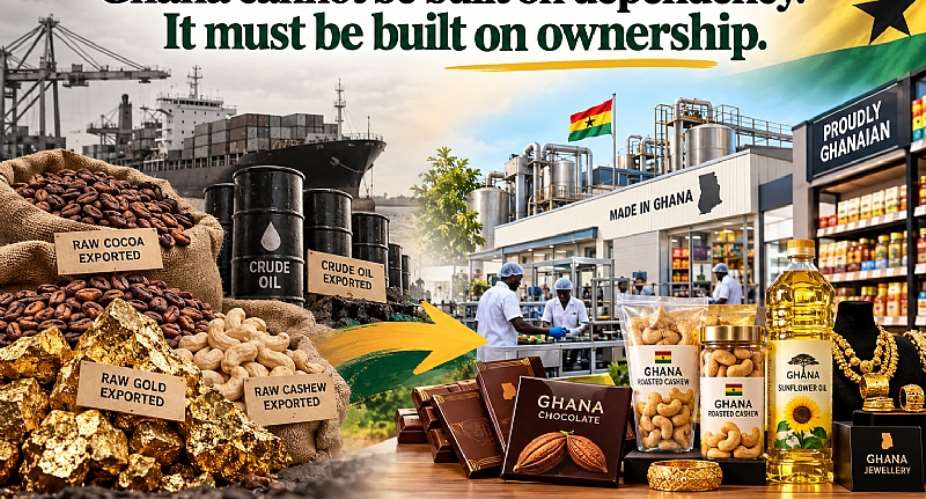
Ghana’s economic story presents one of the most troubling contradictions of our development journey. We produce cocoa, yet much of the chocolate on our shelves carries foreign brands. We mine gold, yet much of the higher-value jewellery and finished products are manufactured elsewhere. We produce crude oil but continue to depend significantly on imported petroleum products.
Walk through supermarkets in Accra, Kumasi, Takoradi or Tamale and the contradiction becomes visible. Many products we consume are made from raw materials that Ghana can produce, yet much of the processing, packaging, branding and distribution takes place elsewhere.
We proudly say Ghana is rich in natural resources. But resources alone do not make a country prosperous. The more important question is: how much of the value created from those resources do Ghanaians actually capture and own?
For decades, we have supplied raw materials while capturing too little of the value created from them. We export cocoa and import chocolate. We export gold and import jewellery. We grow cashew, export it raw and sometimes buy it back processed, packaged and branded.
Ghana cannot build lasting prosperity on this model.
When we do not own processing, we lose opportunities for industrial jobs. When we do not own brands, we surrender relationships with consumers. When we do not develop technology, we weaken our ability to shape our industrial future. Producing a commodity is not the same as controlling its value chain.
Ownership does not mean rejecting foreign investment. Ghana needs international capital, technology, expertise and access to global markets. But foreign partnerships should strengthen Ghanaian productive capacity rather than leave us permanently dependent on others.
Imagine a different economic chain:
GHANAIAN FARM → GHANAIAN FACTORY → GHANAIAN BRAND → GHANAIAN SHELF → GHANAIAN AND PARTNER CAPITAL.
If Ghana produces cocoa, our ambition should extend beyond exporting beans to processing cocoa, manufacturing chocolate and building globally competitive Ghanaian brands. If we grow cashew, tomatoes, cassava, fruits and other crops, we should develop commercially viable industries around them. Wherever Ghana possesses or can develop a competitive advantage, value addition should become a national priority.
This requires entrepreneurs willing to move beyond trading into manufacturing, financial institutions prepared to finance productive enterprises, and governments committed to reliable infrastructure and predictable policies. Our universities and technical institutions must train people capable not only of operating imported machines but also of designing, adapting and eventually manufacturing technology.
Consumers also have a role. Choosing competitive Ghanaian-made products supports farmers, factory workers, engineers, transporters, retailers and entrepreneurs while helping money circulate through our economy.
The choice is not between Ghana and the rest of the world. Ghana must trade globally and welcome responsible investment. The challenge is ensuring that Ghanaians increasingly participate as producers, processors, innovators, manufacturers, brand owners and investors rather than primarily as suppliers of raw materials and consumers of finished goods.
For too long, we have celebrated what lies beneath our soil and what grows on our farms. The next generation must also celebrate what comes from our factories, laboratories, workshops and innovation centres.
No country transforms itself simply by exporting its potential.
Ghana must convert resources into industries, industries into brands, brands into markets, and markets into lasting prosperity.
Dependency may sustain consumption for a season. Ownership can build prosperity for generations.
Make the Ghana-specific opening more forceful
Add practical actions for Ghana’s transformation
Strengthen the conclusion with a call to action


 Creative Arts Agency Board Engages Lands Minister Over Welfare Project for Aged...
 I will rebuild demolished La Pleasure Beach if elected in 2028 to save jobs — Ba...
 Free primary healthcare requires recruitment of more nurses – GRNMA
 Ethiopia's Tigray rebels abandon regional capital as govt advances
 Mahama in Egypt for AU Mid-Year Summit
 SSNIT defends La Beach demolition, cites encroachment and security concerns
 Russia strikes another major bridge across Kyiv's Dnipro river
 Co-pilot on Flydubai flight was banned from flying by Oman for holding extremist...
 Spanish lawmakers vote down affordable housing bills in blow to Sanchez’s govern...


