




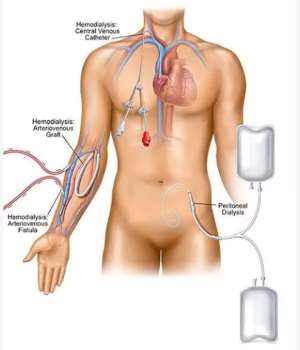
Kidney disease is quietly becoming one of Ghana's serious public health problems, and experts say everyday habits are part of the cause. At a University of Ghana School of Biomedical and Allied Health Sciences lecture, speakers pointed to poor hydration, the misuse of herbal medicines and unhealthy diets as drivers of the rise.
What the experts said
Dr Rebecca K. Steele-Dadzie, a Senior Lecturer in the University of Ghana's Department of Dietetics, described a worrying trend of kidney conditions, including acute kidney injury and kidney stones. She linked them to poor hydration, excess vitamin C intake and unsafe traditional practices.
She also said dehydration is a key risk in tropical regions, where climate change makes even basic access to enough drinking water harder, and that persistent dehydration can eventually lead to acute kidney injury. Her advice was to adopt healthier diets, cut back on processed foods and herbal concoctions, and put hydration first.
The event's theme was how dietary habits affect kidney disease. The Principal Dietitian at the University of Ghana Hospital, Maxwell Bisala Konlan, used two clinical case studies to show that diet plays a critical role in the development, progression and possible reversal of kidney disease, especially when combined with medication and early medical intervention.
Speakers also named excessive processed and fatty foods and frequent eating out as factors. Graphic Online has reported a specialist's estimate that chronic kidney disease affects 13% of people in Ghana, compared with 10% globally.
What the research shows
The concern about herbal products is backed by wider medical literature, though most of it is not specific to Ghana. A case report from Nigeria says herbal remedies are reported to account for about 30% to 35% of acute kidney failure cases in Africa.
A Ghanaian case report from Komfo Anokye Teaching Hospital in Kumasi described acute kidney injury after a patient used naphthalene, an insecticide, as an unorthodox treatment, and the authors warned about treating simple conditions with complementary medicines.
A study of three popular herbal antimalarials sold in Kumasi noted that safety data on commonly used herbal products in Ghana are scarce. It also notes that consumers can buy herbal medicine without a prescription from herbal centres, roadside sellers, markets and bus stations.
A separate study points to a regulatory gap, because some herbal products dispensed only within prescribing facilities are exempt from regulatory oversight.
A longstanding warning
The concern is not new. Years ago, reports from the Komfo Anokye Kidney Centre in Kumasi and Saint Joseph's Hospital in Koforidua pointed to complications linked to herbal medicines whose safety had not been confirmed.
What this means
The experts are not condemning all traditional medicine. They are warning about unregulated, unmeasured and unsupervised use, especially of concoctions sold without safety data. The practical advice is simple: drink enough clean water, limit processed food, and tell a doctor about any herbal product you take, particularly if you have diabetes, high blood pressure or existing kidney problems.
For policymakers, the lesson is that herbal products need stronger testing, labelling and oversight, so that a remedy does not become the cause of dialysis.
Mustapha Bature Sallama
Medical/ Science Communicator,
Private Investigator, Criminal Investigation and Intelligence Analysis,
International Conflict Management and Peacebuilding. (USIP)
[email protected]
+233555275880
Sources
University of Ghana SBAHS, "Herbal concoctions, dehydration fuel rise in kidney diseases Expert": https://sbahs.ug.edu.gh/news/herbal-concoctions-dehydration-fuel-rise-kidney-diseases-expert
GhanaWeb, "Herbal remedies and dehydration putting kidneys at risk Expert warns": https://www.ghanaweb.com/GhanaHomePage/NewsArchive/Herbal-remedies-and-dehydration-putting-kidneys-at-risk-Expert-warns-2003208
GhanaWeb, "Herbal Drugs Causing Heart & Kidney Failures": https://www.ghanaweb.com/GhanaHomePage/NewsArchive/Herbal-Drugs-Causing-Heart-Kidney-Failures-202270
Pan African Medical Journal, "Naphthalene induced acute kidney injury in an African patient in Ghana: a case report": https://www.ncbi.nlm.nih.gov/pmc/articles/PMC6620055/
Bioscience Reports, "Sub-chronic toxicity evaluation of top three commercial herbal antimalarial preparations in the Kumasi metropolis, Ghana": https://www.ncbi.nlm.nih.gov/pmc/articles/PMC7276653/
"Acute Renal Failure Induced by Chinese Herbal Medication in Nigeria" (case report): https://www.ncbi.nlm.nih.gov/pmc/articles/PMC4496464/
medRxiv, "Antidiabetic Activity of
Ghanaian Herbal Product, DBT-57A" (preprint): https://www.medrxiv.org/content/10.1101/2025.05.14.25327662.full.pdf


 I will rebuild demolished La Pleasure Beach if elected in 2028 to save jobs — Ba...
 Free primary healthcare requires recruitment of more nurses – GRNMA
 Ethiopia's Tigray rebels abandon regional capital as govt advances
 Mahama in Egypt for AU Mid-Year Summit
 SSNIT defends La Beach demolition, cites encroachment and security concerns
 Dame criticises Baffour Awuah’s EOCO detention, alleges abuse of state power
 Russia strikes another major bridge across Kyiv's Dnipro river
 Co-pilot on Flydubai flight was banned from flying by Oman for holding extremist...
 Spanish lawmakers vote down affordable housing bills in blow to Sanchez’s govern...


