




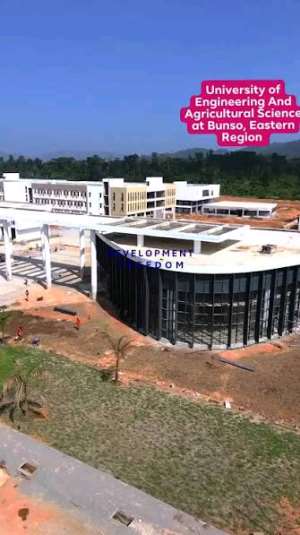
Ghana’s drive to connect university education more closely with agriculture, industry and technological innovation has received a major boost with the unveiling of the University of Engineering and Agricultural Sciences at Bunso.
The newly established public university, known as UEAS, is preparing to admit its first cohort of students for the 2026/2027 academic year. Images of the campus reveal an expansive academic complex equipped with lecture blocks, engineering and agricultural laboratories, a central library, student accommodation, staff housing, a cafeteria, an exhibition hall and facilities for research and innovation.
Unlike universities established primarily around classroom instruction, UEAS has been designed to combine engineering, agricultural science, entrepreneurship and practical problem-solving. It is the first fully fledged public university in Ghana deliberately structured around the integration of these disciplines. �
Graphic Online
This distinction is important for a country that continues to import significant quantities of food, machinery and processed products despite possessing abundant agricultural land, raw materials and a large youthful population. Ghana does not merely need more graduates. It needs engineers who understand agriculture, agricultural scientists who can work with technology and entrepreneurs capable of converting research into commercially viable products.
Construction of the Bunso campus began in April 2022 with financial support from the Republic of Korea. Government reports have placed the project cost at approximately US$90 million, while other published accounts describe it as a US$92 million Korean-funded facility. The project was reported to be about 95 per cent complete in January 2026. �
Ghanaian Times +2
The university was initially conceived as part of the University of Environment and Sustainable Development. It subsequently evolved into an independent institution with its own specialised mandate.
That transition was formalised when President John Dramani Mahama assented to the University of Engineering and Agricultural Sciences Act, 2026—Act 1169—on March 31, 2026. The law establishes UEAS as a public university and mandates it to provide higher education in engineering, agriculture, agro-entrepreneurship, emerging digital disciplines and the built environment. It also requires the institution to maintain strong connections with industry and surrounding communities. �
Information Services Department +1
Under the Act, the university will ultimately operate through three campuses: its main campus at Bunso in the Eastern Region and additional campuses at Ohawu and Acherensua. �
Information Services Department +1
The Bunso campus has been constructed to support two initial academic divisions: the School of Engineering and the School of Agricultural Sciences. Its facilities include student hostels designed to accommodate approximately 800 students, as well as staff accommodation and specialised teaching and research infrastructure.
One of the most important components is the Innovation Centre, where students are expected to design, test and develop machinery, industrial tools and technologies capable of solving practical problems. The centre could help move university training beyond lectures and PowerPoint presentations into experimentation, fabrication and commercial product development.
The institution will initially offer Bachelor of Science programmes in Electrical and Electronic Engineering, Computer Engineering, Mechanical Engineering and Industrial Engineering.
The School of Agricultural Sciences will offer programmes in Agronomy, Animal Science, Agricultural Economics and Agribusiness, and Food Technology and Nutrition Science. �
NoticeboardGH
The agricultural curriculum is expected to depart from the common model under which students spend their early university years studying broad subjects before specialising later. At UEAS, students are expected to receive concentrated instruction in their chosen fields from the beginning of their programmes. The aim is to produce graduates with greater technical depth and stronger professional competence. �
Graphic Online
Professor Mark Adom-Asamoah, a former Provost of KNUST’s College of Engineering and a Professor of Civil Engineering, has been appointed the foundation Vice-Chancellor. His professional background includes academic leadership, structural engineering and university administration. �
knust.edu.gh
The university’s Governing Council is chaired by Professor Kweku Danso Boafo. The council and core management team were inaugurated by the Minister of Education, Haruna Iddrisu, on May 12, 2026, with instructions to make the institution operational for the 2026/2027 academic year. The government subsequently granted financial clearance for the recruitment of at least 150 academic and non-academic employees. �
Graphic Online
UEAS is expected to begin with approximately 800 students divided between engineering and agricultural sciences. The university’s admissions announcement set October 11, 2026, as the application deadline. However, prospective students should check the official admissions portal directly because, as of October 1, the portal displayed a notice stating that applications were closed and voucher registration had been paused. �
apply.ueas.edu.gh +1
The choice of Bunso is strategically significant. The area lies within Ghana’s cocoa and oil-palm belt and is close to the Bunso Cocoa College and the Council for Scientific and Industrial Research’s Plant Genetic Resources Research Institute. This gives UEAS an opportunity to turn the Eastern Region into a centre for agricultural research, machinery development, food processing and agro-industrial entrepreneurship. �
Graphic Online
However, impressive buildings alone will not guarantee the university’s success. Engineering laboratories and agricultural research facilities are expensive to operate. Equipment must be maintained, consumables regularly supplied and qualified lecturers and technicians properly supported.
The institution must also avoid becoming another university that produces graduates for jobs that do not exist. Farmers, manufacturers, engineering firms, agribusinesses and industry associations should participate in curriculum development, research planning and student training. Industrial attachment must become an essential part of every programme rather than a short administrative requirement completed merely for graduation.
UEAS represents an important national opportunity. If properly funded and protected from excessive political interference, it could help Ghana develop locally manufactured agricultural machinery, climate-resilient farming systems, improved food-processing technologies and new businesses capable of employing young people.
The modern campus at Bunso is therefore more than another addition to Ghana’s growing list of public universities. It is a test of whether the country can build a new kind of institution—one that trains graduates not only to seek employment, but also to design, manufacture, cultivate, process and create.
Ghana has invested heavily in the physical infrastructure. The greater task now is to ensure that what happens inside those laboratories, workshops, farms and innovation centres justifies that investment.


 ‘We treat galamsey with kid gloves compared to other situations’ – A Rocha Ghana
 Ghana ‘missed the boat’ in galamsey fight under President Akufo-Addo – Senyo Hos...
 Judiciary to employ 127 magistrates to fill vacancies
 Government to suspend GH¢1 D-Levy on diesel for two months
 Russia launches major attack on Ukraine’s energy grid, causing power cuts
 EU talks deportations as five nations seek migrant centre in Africa
 Trump renews calls for former Federal Reserve chief Jerome Powell's resignation
 Paramount takeover of Warner Bros. Discovery clears legal hurdle
 Marsh hails improvements after Australia win final one-day international
 British PM alleges there are 'strong indications' Iran was involved in Fairford ...


