




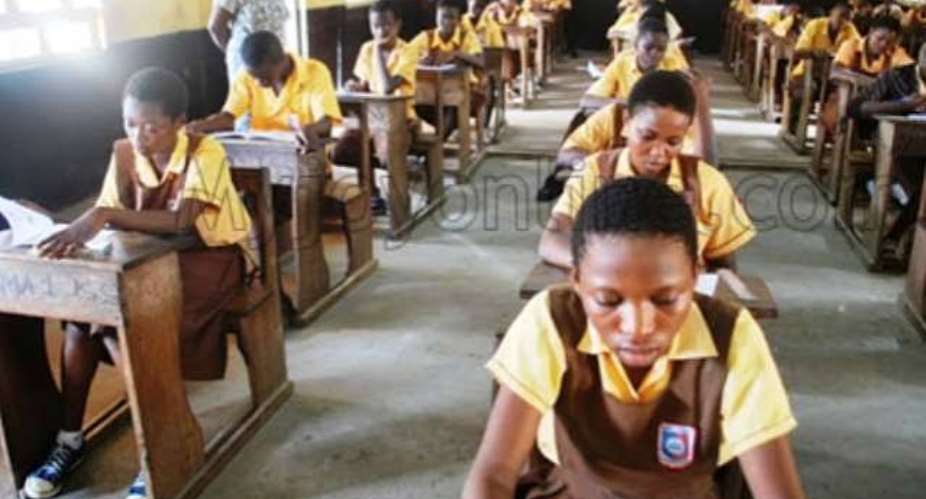
In Ghana, we have become very good at sending children to school. The more difficult question is whether we are preparing them for life.
Every year, families celebrate BECE, WASSCE and university results. We announce grades, positions, distinctions and degrees with pride. Parents make enormous sacrifices to pay school fees, buy textbooks and provide extra classes. Government invests heavily in classrooms, teachers and educational programmes.
Yet after all these efforts, employers still complain that some graduates lack practical skills. Young people leave school searching for jobs they were never taught how to create. Students can sometimes reproduce definitions from textbooks but struggle when confronted with ordinary problems requiring initiative, creativity and independent thinking.
Something is missing.
The problem is not that Ghanaian children are incapable of learning. The problem is that we have too often reduced education to schooling and schooling to passing examinations.
A child may spend roughly six hours of the day in school. What happens during the rest of the day? What does the child learn from the home, market, farm, workshop, community, church, mosque, playing field, internet and workplace?
Education should not stop when the school bell rings.
We must begin to recognise that the classroom provides knowledge, but life provides the opportunity to understand and apply it.
A student can memorise the definition of photosynthesis and reproduce it perfectly in an examination. But take that student to a cocoa farm, vegetable garden or greenhouse and suddenly biology becomes something alive.
We teach agriculture while many students rarely visit farms.
We teach business management while students may complete school without ever learning how to price a product, calculate a basic profit margin, keep simple business records or understand a customer.
We teach environmental science while drains around some communities remain filled with plastic waste.
We teach citizenship while children watch adults litter public spaces, disregard queues and sometimes treat public property as though it belongs to nobody.
We teach ICT, but in an age of artificial intelligence, robotics and automation, too many young people remain primarily consumers of technology rather than creators of solutions with it.
There is a dangerous gap between what we teach and how we live.
Consider Makola, Kejetia and countless markets across Ghana. They are not officially called educational institutions, yet every day they teach negotiation, inventory management, customer relations, pricing, credit management, risk and entrepreneurship.
Walk into a fitting shop, carpentry workshop, welding shop or mechanic's garage and you will find young people learning through observation and practice. They measure, calculate, diagnose problems, make mistakes, correct them and gradually master a skill.
Go to a farm and you will encounter practical lessons in biology, chemistry, economics, climate, soil science and business.
Visit a functioning factory and mathematics, engineering, quality control, safety, chemistry, logistics and management suddenly stop being examination subjects and become tools of production.
Why should these worlds remain largely separated from our schools?
Ghana needs to rethink the idea that teachers alone educate children.
Teachers perform an indispensable role, but they cannot carry the entire responsibility for preparing the next generation.
The farmer is also a teacher.
The carpenter is a teacher.
The nurse is a teacher.
The engineer is a teacher.
The market woman is a teacher.
The entrepreneur is a teacher.
The retired professional with 30 or 40 years of experience is potentially a teacher.
Our communities contain an enormous library of knowledge, yet much of it never enters the education of our children.
Imagine if every Junior High School student spent even a few structured days each year learning from a local enterprise, farm, health facility, workshop, technology company or community organisation.
A student working with a carpenter would discover that mathematics is not merely something written on a blackboard. Measurement must be accurate because a mistake wastes wood and money.
A student spending time with a trader would quickly discover that arithmetic has consequences. If your calculations are wrong, your business loses money.
A student observing a farmer would understand that rainfall patterns, soil fertility, pests, market prices and transportation are connected to food security and livelihoods.
A student visiting a manufacturing company would see that science can become a product, a job and an industry.
These experiences do not replace teachers or classrooms. They make classroom learning meaningful.
Parents also need to reconsider how we measure educational success.
Too often, the first question after examinations is: "What position did you get?"
Perhaps we should sometimes ask different questions.
What did you learn?
What can you now do that you could not do before?
What problem can you solve?
What have you created?
What mistake did you make, and what did it teach you?
What idea do you have?
These questions develop a different kind of child.
Ghana's future economy will demand more than people who can remember information. Artificial intelligence can already retrieve information, generate text, analyse data and perform tasks that once required considerable human effort. Automation will continue changing workplaces. Climate change will create new challenges for agriculture, water, energy and communities.
The young Ghanaian entering school today may eventually work in an occupation that looks very different from the jobs we know today.
What, then, should education give that child?
Curiosity. Creativity. Character. Digital literacy. Practical competence. Communication skills. Entrepreneurship. Teamwork. Adaptability. Critical thinking. The confidence to identify a problem and attempt a solution.
These qualities cannot be developed through chalk and examinations alone.
Ghana should therefore deliberately connect schools with the communities around them. Local businesses, artisans, farmers, health professionals, universities, traditional authorities and retired professionals should become partners in education.
Every student should have opportunities to complete practical projects connected to real problems. A group could investigate waste management in its community. Another could establish a school garden. Students could develop a simple business idea, design a water-saving system, document local history, build a basic digital application or identify a problem affecting their community and propose a solution.
Assessment should also recognise practical achievement.
Examinations remain important, but a child's future should not depend almost entirely on the ability to remember information under timed conditions.
We should be interested in what students can build, design, repair, grow, organise, investigate, communicate and improve.
There is another reason this matters.
Ghana cannot continue educating millions of young people primarily to search for jobs that the economy cannot produce fast enough.
Education must also create problem-solvers, entrepreneurs, innovators and producers.
When young people see agriculture only as an occupation for those who did not succeed academically, something has gone wrong.
When technical and vocational skills are treated as alternatives for supposedly weaker students rather than important foundations of an industrial economy, something has gone wrong.
When a graduate considers unemployment preferable to learning a productive skill because certain forms of work are considered beneath someone with a degree, we must question what our education system and society have taught.
A certificate should never become a barrier between education and productive work.
Ghana does not need certificates sitting in bedrooms waiting indefinitely for employment. The country needs educated minds capable of turning knowledge into solutions, resources into products and problems into opportunities.
The true test of education comes when there is no invigilator, no marking scheme and no examination question telling us exactly what problem to solve.
Can the young person identify a problem?
Can he think independently?
Can she work with others?
Can they create value?
Can they adapt when circumstances change?
Can they continue learning after the teacher is gone?
Those are questions that should concern every parent, teacher, policymaker, employer and community leader.
The transformation Ghana seeks will not come simply from building more classrooms or producing more graduates. Those things matter, but we must also broaden our understanding of what education is supposed to achieve.
We must tear down the invisible wall separating the classroom from the community, the textbook from the workshop, science from production and education from everyday life.
Let our children learn mathematics in the classroom and see it applied in a workshop.
Let them study biology and experience agriculture.
Let them learn business and interact with entrepreneurs.
Let them study technology and build something with it.
Let them learn citizenship and practise service to their communities.
Let them understand that education is not merely preparation for the next examination. It is preparation for responsibility, work, innovation and life.
A school can enrol a child.
A teacher can impart knowledge.
An examination can measure part of what that child remembers.
But building a capable, responsible and productive human being requires something much bigger.
If Ghana wants an education system capable of producing the innovators, entrepreneurs, scientists, farmers, technicians, professionals and responsible citizens who will build the country we desire, then education must no longer stop at the classroom door.
The whole of Ghana must become a classroo


 Baffour Awuah didn’t help his case if he ignored EOCO’s invitation – Appiah Danq...
 Arrest warrant against Manhyia South MP does not mean conviction – Kwasi Kwarten...
 October 1: Cedi sells at GHS12.25 on forex market, GHS11.72 on BoG interbank
 Institutions, public policy must remove barriers facing women – Vice President
 Ghana has lost the fight against galamsey — Barker-Vormawor
 Fire outbreak at Avenor disrupts power supply in parts of Accra
 Accra: Fire breaks out at Avenor Industrial Area; two feared dead
 Carlos Queiroz leaves Black Stars role after poor AFCON qualifying start
 Russia launches major attack on Ukraine’s energy grid, causing power cuts
 EU talks deportations as five nations seek migrant centre in Africa


