




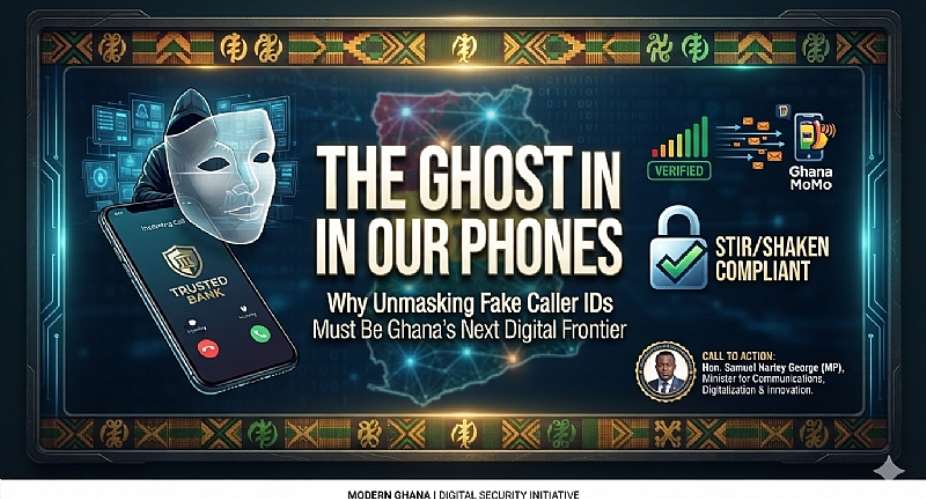
Every single day, thousands of Ghanaians look down at their mobile screens and make a dangerous, trust-based assumption. You see an incoming call explicitly labelled with the official name of your trusted commercial bank, the logo of a major telecom provider, or even the title of a law enforcement agency. You answer it in good faith, only to find yourself talking to a ruthless cybercriminal. Within minutes, your mobile wallet is emptied, your sensitive credentials are stolen, or you are blackmailed under a manufactured threat of arrest.
The alarming reality is that the phone screen is actively lying to us. This tactic, known as Caller ID Spoofing, has become the primary weapon driving an explosive surge in digital financial crime across the country. According to the INTERPOL African Cyberthreat Assessment Report, Ghanaians lost a staggering US$1.3 million to mobile money (MoMo) fraud in just the first quarter of 2025 alone. Furthermore, the Bank of Ghana's recent Fraud Report revealed that electronic fraud incidents within the Payment Service Provider (PSP) sector skyrocketed by 98%, hitting over 24,124 reported cases as fraudsters aggressively target everyday consumers.
To halt this digital bleeding, Ghana can no longer rely solely on educating citizens to "stay vigilant." We must urgently confront the foundational architectural flaw in our telecommunications infrastructure. The ultimate responsibility to enforce international identity authentication standards falls squarely on the country's technology leadership—specifically the Ministry for Communication, Digital Technology and Innovations, under the aggressive direction of its sector minister, Hon. Samuel Nartey George (Sam Dzata George).
How the System Works (And Why It’s Exploited)
To understand why our networks are currently exposed to these predatory syndicates, we must dismantle how the global phone system functions.
The core of our global telecommunications network was engineered decades ago on a framework of absolute, implicit trust. Legacy signaling protocols (like SS7) were built under the assumption that only trusted state-owned network operators could route calls. Therefore, whatever caller information arrived with the call package was treated as gospel.
The arrival of modern internet calling—known as Voice over IP (VoIP)—completely shattered this dynamic. Today, a scammer anywhere in the world can set up a cheap virtual calling application. Within the software settings, there is a manual, unverified field titled "Outbound Caller ID". A fraudster can quite literally type in "MTN Customer Service," "Ghana Police Service," or your local bank's customer helpline number.
When that call passes from an overseas internet server into Ghana’s local telecommunication gateways, non-compliant local telecom providers act as completely passive pipes. Because they do not perform a true authentication check, they accept the data blindly and flash that forged corporate name straight onto your handset. The network literally takes a criminal at their word.
Real-World Spoofing Examples Terrorizing Ghanaians
Cybercriminals have expertly weaponized this lack of a "true identity" check to engineer highly localized psychological traps:
- The Mobile Money Reversal Scam: Fraudsters spoof official customer service numbers of networks like MTN, Telecel, or AT. Because the phone screen authenticates the name, victims readily believe the agent on the other side claiming a "wrong mobile money transaction needs to be reversed," subsequently giving up their secret MoMo PIN numbers.
- The Fake Law Enforcement/Court Threat: Scammers spoof the phone numbers of prominent police stations or state agencies. They call unsuspecting citizens, claiming a close relative has been arrested or is facing immediate prosecution, demanding an instant emergency wallet transfer to "settle" the case.
- Neighbor Spoofing: Attackers use automated software to match the first few digits of your specific network prefix (e.g., 024, 055, 020). When you see a number that looks just like yours or a neighbor's, your psychological guard drops, making you far more likely to pick up.
International Best Practices: Global Models of Defense
Operating telecom networks on "implicit trust" is a global liability. International regulatory authorities have proven that telecom fraud can only be mitigated when telecom companies are legally mandated to actively verify who is initiating a call.
- The North American Framework (STIR/SHAKEN): Enforced by the United States Federal Communications Commission (FCC), this architecture mandates that providers assign digital, encrypted fingerprints to calls. It evaluates identity using strict Attestation Levels. Level A (Full Attestation) means the carrier verifies both the caller's identity and their legal right to use that specific phone number. If an incoming call lacks this signature, it is either instantly blocked or flagged as unverified.
- The European Response (The French MAN Framework): In Europe, regulatory bodies like France's ARCEP have taken an aggressive approach. French telecom laws enacted strict rules requiring operators to completely block calls with a domestic caller ID if they are received via international interconnections from an operator that does not serve end-users within their secure zone. This completely cuts off international spoofing syndicates trying to mirror local numbers.
- The ASEAN Protocol (Hardware Enforcement): Regions in Southeast Asia have formalized anti-scam guides that go beyond software. They legally control and restrict the import of unregulated SIM boxes—hardware setups used by fraudsters to dump international spoofed VoIP traffic onto local SIM networks to mask international locations.
- The "Know Your Upstream Provider" (KYUP) Standard: Global best practice dictates that telecom networks cannot simply blame cross-border carriers. Regulations now require intermediate providers to perform deep compliance reviews and verification on the commercial networks they buy traffic from, cutting off rogue upstream operators who profit off illegal robocalling.
Strategic Recommendations and Suggestions for Ghana
Securing our digital economy requires a hard structural transition from passive transmission to active network policing.
- Mandate Cryptographic Call Signatures via the NCA: The National Communications Authority (NCA) must phase in an IP-based caller authentication standard modeled after STIR/SHAKEN for all local Mobile Network Operators (MNOs).
- Implement Strict Border Rewrite Rules (The French Model): The NCA must mandate that any incoming international call attempting to carry a local Ghanaian country code (+233) or local network prefixes (024, 020, etc.) through an international gateway must be dropped or stripped of its header immediately.
- Enforce Strict "Know Your Upstream Provider" (KYUP) Liabilities: Ghanaian telecom operators must be held legally and financially responsible for the traffic they contract from international wholesale transit networks. Telcos must vet their upstream partners to ensure they are not rubber-stamping fraudulent traffic.
- Synchronize with the Central Equipment Identity Registry (CEIR): Integrate caller ID authentication failures with device hardware tracking. If specific international VoIP pathways or gateway channels consistently transmit unauthenticated spoof calls, those channels must be systematically blocked at the network firewall layer.
- Impose Financial Penalties for Non-Compliant Telcos: Telecom giants must stop profiting from unverified network traffic while subscribers lose millions of Cedis. If an unverified, spoofed call bypasses an operator's gateway due to poor screening and results in consumer fraud, the operator must face severe regulatory penalties and compensate the victim.
A Call to Action for Hon. Sam George
Ghana has repeatedly proven that it is capable of grand digital restructuring. From the foundational biometric synchronization led by the National Identification Authority to the aggressive anti-fraud raids orchestrated by the Cyber Security Authority (CSA), we have the talent and the institutions necessary to protect our digital frontiers.
However, leaving our telecom routing networks completely blind to identity forgery undermines every single security milestone we have achieved.
Minister for Communication, Digital Technology and Innovations, Hon. Samuel Nartey George, has built a public reputation for taking an uncompromising stance on digital lawlessness and pushing forward critical legislative cleanups. The minister has previously noted that protecting Ghana's digital reputation is absolutely non-negotiable. We now call upon his office to turn its legislative teeth directly toward the telecom gateways.
By setting a strict regulatory deadline for local telcos to adopt international caller validation standards, the ministry can effectively strip cybercriminals of their anonymity. It is time to unmask the anonymous ghosts in our phones, enforce global standards, and ensure that a phone call in Ghana can be trusted once again.
✍️ Submitted by:
Retired Senior Citizen
For and on behalf of all Senior Citizens of the Republic of Ghana 🇬🇭
Teshie-Nungua
[email protected]

 'The cacophony of noises surrounding my comments were pure mischief' — Chief Jus...
 ‘Judges must not abandon their humanity because of their judicial office’ – Chie...
 BoG personnel costs more than double to GH¢3.29bn in three years as staff number...
 GTEC flags over 100 tertiary institutions as unrecognised
 Political protection may be behind decline in visible cocaine trafficking in Gha...
 Ghana identified as source of explosives used in Sahel conflicts — Crime Index r...
 EOCO could have written to Speaker Bagbin instead of seeking arrest warrant for ...
 Reduce unnecessary remands, utilise Community Service Act – Chief of Staff urges...
 Ablakwa reaffirms Ghana’s support for ICC at UN racism anniversary
 Accra needs a new transport plan, not Ayalolo contra-flow – Akim Swedru MP


