




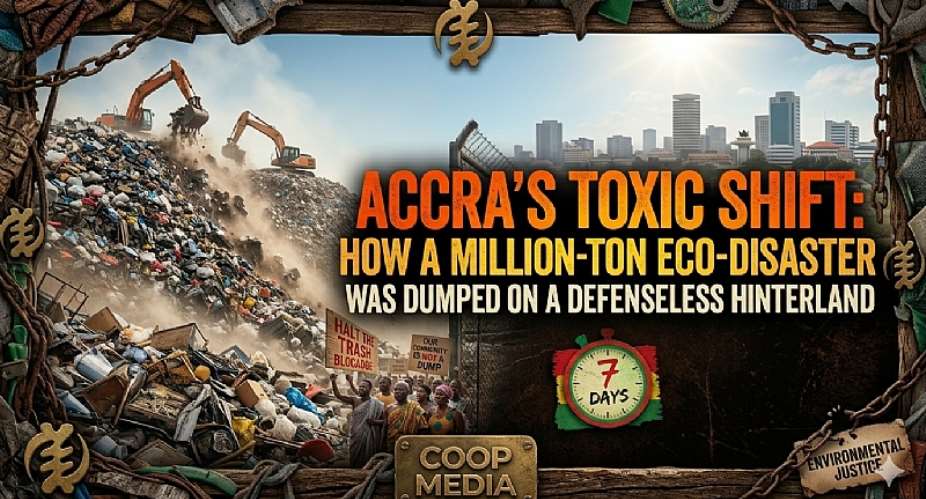
For decades, the Agbogbloshie enclave in Accra stood as a stark international symbol of environmental degradation—a toxic, sprawling expanse of domestic and electronic waste choking the capital’s central waterways. Yet, the central government’s highly publicized initiative to finally clear this historical blight has triggered an explosive crisis of local governance. By quietly transporting one million tonnes of evacuated waste into the Adipa landfill site within the Nsawam-Adoagyiri Municipality, central authorities have effectively relocated an environmental disaster rather than resolving it.
The ensuing uproar, led by local Member of Parliament Hon. Frank Annoh-Dompreh and furious residents who have issued a seven-day ultimatum to block access roads, underscores a systemic pathology in Ghanaian public administration. It reflects a top-down, executive high-handedness that treats peri-urban and rural communities as dispensable dumping grounds for the capital. To find an objective path forward, the discourse must shift away from partisan finger-pointing—such as debating whether waste should be sent to a political opponent's home region—and strictly interrogate the core breakdowns in institutional consultation, environmental engineering, and sustainable development.
The Historical Burden and Institutional Breakdown
To evaluate this escalating standoff objectively, the crisis must be analyzed through its historical, environmental, and administrative dimensions:
- The Agbogbloshie Legacy: For more than a generation, the Agbogbloshie dump and the adjacent Korle Lagoon acted as Accra's primary waste sink, centralizing the capital's municipal debris and drawing international infamy as a severe public health hazard. The current 90-day decommissioning and evacuation scheme commissioned by President Mahama was intended as a monumental step toward flood prevention and urban renewal. However, by treating the removal process as a simple relocation exercise, the state has merely shifted the ecological liability across regional borders.
- Bypassing the Decentralized Machinery: Under Ghanaian law, municipal and district assemblies are the supreme local planning authorities. Yet, the central government initiated the transfer of hundreds of heavy truckloads of waste per night without formally consulting the Nsawam-Adoagyiri Municipal Assembly, local traditional leaders, or the affected population. This blatant omission directly subverts national decentralization policies, rendering local governance structurally obsolete.
- The Ministry's Technical Defense: Facing a severe community backlash, the Ministry of Local Government, Decentralization, and Rural Development issued a formal apology to the people of Adipa for the disruptions caused. The Ministry defended the aggressive timeline, citing the sheer scale of the operation which requires 150 to 200 truck trips every single night. Ministry officials promised that "within a month or so, we would have finished the evacuation exercise," pledging that the site will eventually be properly engineered, compacted, and safely decommissioned to prevent long-term environmental hazards.
- Immediate Environmental and Societal Distress: Despite ministerial assurances, the operational reality on the ground remains dire. The local community has been engulfed by overwhelming odors and massive housefly infestations that have disrupted local schools and daily life. As former Accra Mayor Mohammed Nii Adjei Sowah warned on Channel One TV's Face to Face, the generation of hazardous leachate poses a severe risk of contaminating local groundwater tables during heavy rainfall, turning a temporary sanitation drive into a long-term public health crisis.
Objective Recommendations for Structural Resolution
Resolving the Adipa crisis requires replacing emergency damage control with sustainable, transparent, and modern environmental standards:
- Enforce Continuous Soil Cover and Vector Management: The contracted waste management firm must immediately halt the raw, open-air piling of refuse. Standard sanitary landfill protocols—including daily soil compacting, top-layer capping, and intense chemical fumigation—must be implemented instantly to suppress the fly infestation and mitigate the overpowering stench.
- Deploy the EPA for Rigorous Environmental Auditing: The Environmental Protection Agency (EPA) must independently step in to test Adipa’s water table and local streams for chemical and biological contaminants. The EPA must establish strict daily volumetric limits on incoming waste to ensure the site’s structural containment thresholds are not entirely overwhelmed.
- Establish a Legal Framework for Trans-Regional Waste Transfers: The Ministry of Local Government must institutionalize a strict statutory requirement for written inter-district agreements. No metropolitan area should ever be permitted to export solid waste across regional boundaries without a joint oversight board, public hearings, and a formal sign-off from the receiving assembly.
- Mandate Robust Host Community Compensation: Communities serving as national landfill repositories endure severe social and environmental depreciation. A dedicated portion of the national sanitation budget must be legally funneled into Adipa to fund immediate healthcare upgrades, sustainable clean water infrastructure, and extensive rehabilitation of roads pulverized by nightly heavy truck traffic.
- Transition from Dump Sites to Integrated Waste-to-Energy Infrastructure: Moving mass backlogs from one pit to another is an obsolete approach to sanitation. The Greater Accra Region must prioritize and fast-track the construction of engineered recycling and waste-to-energy facilities inside its own regional borders, taking full structural responsibility for the waste its economy generates.
The localized rebellion brewing in Nsawam-Adoagyiri is a symptom of a larger, systemic governance failure. Cleaning the clogged arteries of Accra to prevent seasonal urban flooding is an important objective, but doing so by suffocating a peri-urban community in the Eastern Region is an unacceptable trade-off. The Ministry's official apologies and promises of a one-month operational wrap-up mean little to a community dealing with immediate ecological distress.
Ghana must outgrow the primitive practice of shifting its garbage from one backyard to another. True development requires treating waste management as a rigorous scientific and collaborative discipline rather than a top-down relocation directive. Only when central authorities respect the constitutional right of all citizens—whether in the core of the capital or the rural valleys of Adipa—to a safe, transparent, and healthy environment can the nation achieve sustainable progress.
✍️ Submitted by:
Retired Senior Citizen
For and on behalf of all Senior Citizens of the Republic of Ghana 🇬🇭
Teshie-Nungua
[email protected]


 EOCO could have written to Speaker Bagbin instead of seeking arrest warrant for ...
 Reduce unnecessary remands, utilise Community Service Act – Chief of Staff urges...
 Ablakwa reaffirms Ghana’s support for ICC at UN racism anniversary
 Accra needs a new transport plan, not Ayalolo contra-flow – Akim Swedru MP
 Ghana’s legal profession must not be divided by politics – Bobby Banson
 Court authorises EOCO to arrest Manhyia South MP, conduct searches
 Chief Justice Baffoe-Bonnie is Mahama's surrogate to control the judiciary — Mar...
 Court gives OSP four more weeks to serve Ofori-Atta, Akore in US
 Dangote's $16bn Kenya refinery 'new chapter' for Africa
 September 30: Cedi sells at GHS12.20 on forex market, GHS11.70 on BoG interbank


