




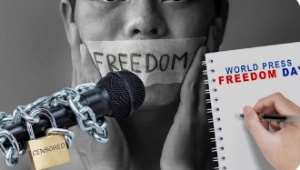
At the end of August, Ghana's National Security Coordinator, COP Osman Abdul-Razak, told journalists at a workshop in Accra that the media is part of the country's security architecture. He also said the training was not meant to restrict press freedom.
Days later in Niamey, a veteran journalist vanished. Read together, the two stories show what the job now involves.
Information as a security matter
Abdul-Razak's message was about verification, accountability over sensationalism, and care when reporting on chieftaincy and ethnic disputes, which he warned can turn into wars.
Anyone who has watched a rumour outrun the facts on WhatsApp will not find that unreasonable. But it does mean information is increasingly treated as a security issue. Framed well, that makes reporters more careful. Framed badly, it makes them quieter. The difference lies in who decides what counts as irresponsible.
A new frontline is synthetic
A Timbuktu Institute report published in September found that all sides in Mali's conflict are experimenting with generative AI.
JNIM's use is still limited, pro-separatist networks use AI-generated personas presented as real people, and Russia-linked and state actors operate on a far more sophisticated scale. For reporters, verification used to mean checking a video's place and date. Now it can mean asking whether the person in it exists.
The price of reporting in the Sahel
In the Sahel, the greater danger is often the true story. Moussa Kaka, director of Radio Télévision Saraounia and a former RFI correspondent, left his Niamey office around 7 p.m. on 31 August. Colleagues and family have had no news of him since, and CPJ, RSF and HRW have called for an investigation.
It happened days after the military quelled an attempted coup, and Kaka had been arrested with five other journalists in October 2025 under the cybercrime law.Former defence minister Kalla Moutari was arrested on 1 September too, though no public evidence links the two cases.
In Mali, Abdrahamane Kéita, editor of Le Témoin, was sentenced on 14 September to two years in prison after saying on television that Kidal was run by JNIM. In Niger, lawyer Lirwana Abdourahamane was remanded on 22 September under the cybercrime law for allegedly disseminating data likely to disturb public order.
The uncomfortable link
The vocabulary is the same across the region: security, stability, cyber-threats, false information. It is used to fight real disinformation, and also to jail people. What differs is the institutions around it: independent courts, a free regulator, and a public that notices when a journalist goes missing. Ghana is better placed than most, but freedom that depends on an official's goodwill is fragile.
So, what does it mean?
It means working inside a contradiction. We should check twice, correct openly, and refuse to amplify hate. But our first duty is to the public, not to power. It means verifying faster than machines can fake, standing with colleagues in Niamey and Bamako, and asking readers to share less in haste and to notice when a journalist disappears.
Mustapha Bature Sallama
Medical/ Science Communicator,
Private Investigator, Criminal Investigation and Intelligence Analysis,
International Conflict Management and Peacebuilding. (USIP)
[email protected]
+233555275880
References
Graphic Online, "Journalists undergo training on responsible security reporting," 2 Sep 2026. https://www.graphic.com.gh/news/general-news/ghana-news-journalists-undergo-training-on-responsible-security-reporting.html
The Ghanaian Chronicle, "National Security Seeks Stronger Partnership With Media." https://thechronicle.com.gh/national-security-seeks-stronger-partnership-with-media/
allAfrica/RFI, "AI Deepfakes and Fake Fighters Reshape Mali's Information War," 10 Sep 2026. https://allafrica.com/stories/202609100123.html
Timbuktu Institute, "Artificial intelligence, a new propaganda lever for JNIM in Mali?" Sep 2026. https://timbuktu-institute.org/index.php/toutes-l-actualites/item/1735-artificial-intelligence-a-new-propaganda-lever-for-jnim-in-mali
CPJ, "In Niger, prominent journalist Moussa Kaka missing since August 31," 9 Sep 2026. https://cpj.org/2026/09/in-niger-prominent-journalist-moussa-kaka-missing-since-august-31/
Human Rights Watch, "Niger: Prominent Journalist Feared Forcibly Disappeared," 3 Sep 2026. https://allafrica.com/stories/202609040055.html
Journal du Niger, on Kaka and Kalla Moutari. https://www.journalduniger.com/disparition-moussa-kaka-interpellation-kalla-moutari-niamey-2026/
RSF, "Criminalisation of journalism in Mali: Abdrahamane Kéita." https://rsf.org/en/criminalisation-journalism-mali-abdrahamane-k%C3%A9ita-le-t%C3%A9moin-sentenced-two-years-prison
Human Rights Watch, "Another Journalist in Mali Sentenced to Prison," 21 Sep 2026. https://www.hrw.org/news/2026/09/21/another-journalist-in-mali-sentenced-to-prison
allAfrica/RFI, "Niger: Un avocat poursuivi en vertu de la loi sur la cybercriminalité." https://fr.allafrica.com/stories/202609230513.html


 Enforce surcharges, modernise audits to curb GHS100bn losses — Ghana Audit Servi...
 One third of world population exposed to harmful air pollution: monitor
 US forces leave Iraq, raising fears of Iran-backed militias amid power vacuum
 US Supreme Court lifts restrictions on third-country deportations
 'EOCO attempted arrest of Baffour Awuah was unprofessional' — James Agalga
 'Building a congregation of 20,000 will kill you' – Duncan-Williams tells young ...
 Shamima Muslim defends constitutional rights of women facing court over hate spe...
 September 29: Cedi finishes day selling at GHS12.20 on forex market, GHS11.67 on...
 ‘We’ll explore another constitutional option for narcotics probe’ – Minority on ...
 Speaker Bagbin adjourns Parliament indefinitely after rejecting narcotics probe ...


