




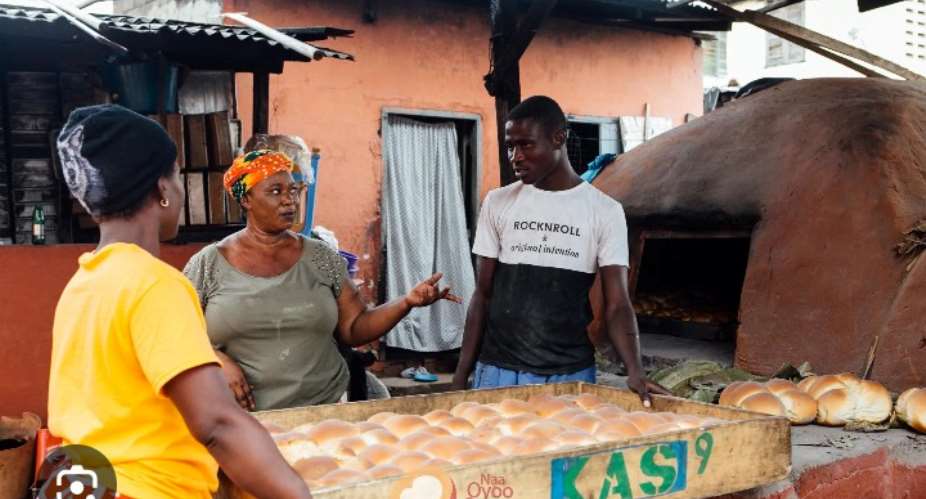
Ghana grows no wheat. Yet every morning, tea bread fills our kiosks and school bags. Where does the flour come from? Increasingly, from the Black Sea.
In the first half of 2026 alone, Russia shipped about 10.2 million tonnes of wheat to Africa.
That was more than 90 percent of its agricultural exports to the continent, which rose 35 percent in value to $2.9 billion. Egypt took the largest share, and Kenya's purchases jumped nearly ninefold. Ghana will import around 1.12 million tonnes this season, according to the US Department of Agriculture's Accra office.
Meanwhile, Africa holds close to 60 percent of the world's uncultivated arable land, an estimate long attributed to the FAO and the African Union.
A habit we cannot grow
Wheat consumption in Ghana has roughly doubled since the early 2000s as cities have grown and tastes have changed. Bread accounts for about 70 percent of wheat flour use, and wheat imports cost well over $200 million a year. The USDA describes Ghana as producing no wheat at all, though it notes that field trials are yielding 4.7 tonnes per hectare. That is promising, but it is a trial, not a harvest.
A note on where Ghana's flour really comes from
The Black Sea story is clearest at the continental level. Across North Africa, former Soviet Union suppliers provided more than 40 percent of wheat imports in 2024/25. For Ghana, the picture is more mixed.
Earlier USDA reporting listed Canada, Turkey, France, Poland and Lithuania as the main suppliers, and UN trade data recorded only a few million dollars of Russian wheat and flour imports in 2023.
That may be changing, but I did not find current figures showing a large Russian share of Ghana's supply. What Ghana shares with the rest of Africa is exposure: whoever the supplier, our bread price follows shipping lanes, exchange rates and events far from Accra.
Ukraine has also moved into the market, opening a "Food from Ukraine" processing hub in Ghana in April, and Russian poultry has reached Ghanaian shops. Grain, like energy, is now part of the competition for influence in Africa.
Why dependence is a security issue
As a security analyst, I see three risks:
Supply shocks: War, sanctions, port closures or export bans can disrupt shipments quickly.
Price shocks: A weaker cedi or higher freight costs reach the kiosk within weeks.
Leverage: When a few exporters supply the staple of urban diets, they gain influence, whether or not they choose to use it.
The land is there. The system is not.
The 60 percent figure is often quoted as proof of Africa's potential, but it hides real constraints: degraded land, weak storage and roads, limited irrigation, and farmers who earn more from crops like cocoa than from grain. Nor does Ghana's climate suit wheat everywhere.
The lesson is not that Ghana should grow all of its own wheat, but that it should stop treating dependence as inevitable.
What Ghana should do
Scale the trials: Publish results, expand testing in suitable northern and highland zones, and set a realistic import-substitution target.
Blend local flours: Encourage composite flour using cassava, sorghum, millet and maize, with tax incentives for bakers.
Diversify suppliers and stock: Build strategic reserves and avoid relying on any one exporter or route.
Protect the poor: Watch flour and bread prices and shield low-income consumers when shocks hit.
The bread in a schoolchild's bag is a small thing. But what fills it is decided at far-off ports and in far-off capitals, and that is a strategic vulnerability worth naming.
Mustapha Bature Sallama
Medical/ Science Communicator,
Private Investigator, Criminal Investigation and Intelligence Analysis,
International Conflict Management and Peacebuilding. (USIP)
[email protected]
+233555275880
Sources
Ecofin Agency / TV BRICS: "Russia Expands African Agri-Footprint with $2.9 Billion First-Half Sales Surge" (July 2026)
Milling Middle East & Africa: "Russia expands agricultural sales across Africa as exports rise 35%" (August 2026)
USDA Foreign Agricultural Service: "Ghana: Grain and Feed Annual" (April 2026)
Milling Middle East & Africa: "Ghana's grain imports to hit 1.2MT in 2024/2025 amid drought crisis" (December 2024)
The Business & Financial Times: "Wheat imports to grow 6%" (April 2024)
UN COMTRADE via Trading Economics: Ghana imports of wheat or meslin flour from Russia
Inter Press Service: "Africa's Vast Arable Land Underutilized for Both Cash and Food Crops" (January 2023)
The Business & Financial Times: "Around 60% of the world's uncultivated arable land in Africa" (April 2026)
NaturalNews / SHTF Plan (Ukraine agro-hub in Ghana, April 14, 2026). Low-quality aggregators, so verify with a primary source before citing.
Before you publish, confirm Ghana's supplier mix in current customs or Trade Data Monitor figures. If Russia's share is small, the headline works better as "Ghana's bread is hostage to global grain" than as a Black Sea story. Want a version with that framing?


 New road rules: Police explain tyre age, tint, parking rules ahead of October 1 ...
 Circle phone dealer murder: Suspect allegedly sold victim’s iPhone 12 for GH¢100...
 Police arrest three suspects over kidnapping, murder of Circle phone dealer
 Adipa residents tell gov’t to halt Agbogbloshie waste transfer
 Mahama says listing 10 state-owned enterprises will curb political interference
 Ghana Jollof saga: Baffour Awuah sues Blakk Rasta, Akwatia MP over alleged false...
 6,079 promoted teachers processed and paid — Controller clarifies
 “We need payment, not meetings” – Striking teacher unions tells Education Minist...
 NPP challenges GH¢2,650 cocoa producer price for 2026/27 season
 Mahama explains why 'humiliating' US, Ghana health deal was thrown out with spee...


