




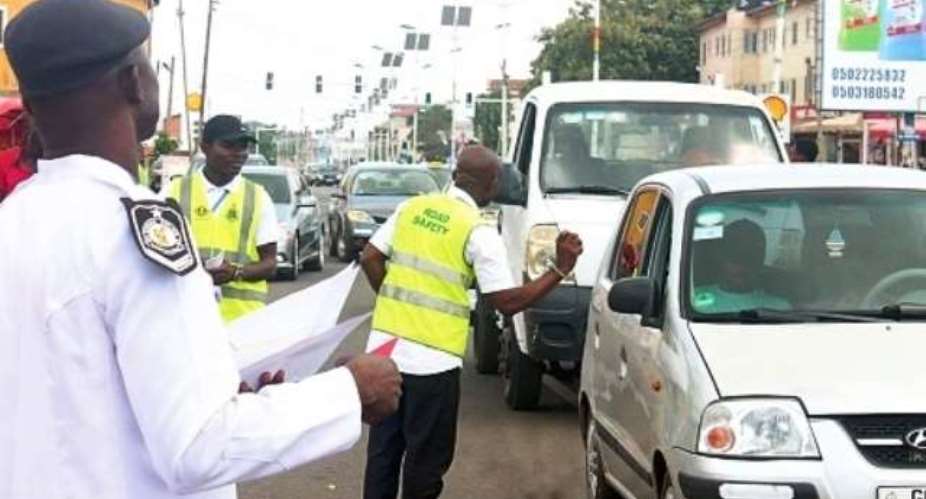
The Motor Traffic and Transport Department (MTTD) of the Ghana Police Service has outlined key provisions of the Road Traffic Regulations, 2026 (L.I. 2519), ahead of the introduction of full automated traffic enforcement from October 1, 2026.
The regulations, which are already in effect, introduce requirements covering areas including tyre safety, windscreen tint, parking, roadside vehicle repairs, seat belts, vehicle registration and reflective markings.
The Police Service is set to begin full enforcement through its TRAFFITECH-GH programme, which will rely on cameras and handheld devices to identify traffic violations. Motorists found in breach of the regulations will receive electronic notices through SMS.
The Director of Education, Research and Training at the MTTD, ACP Alexander Kwaku Obeng, explained the requirements during an interview on Joy FM on Monday, September 28.
He said the regulations establish standards that motorists and vehicle owners must meet while also outlining responsibilities for institutions tasked with enforcing the rules.
Tyre requirements
ACP Obeng said Regulation 87 requires vehicles to be fitted with tyres that are safe for use and stipulates that tyres must not be more than six years old from their date of manufacture.
He explained that the manufacturing date can be found on the tyre sidewall in a four-digit code indicating the week and year it was produced. A tyre manufactured during the 40th week of 2026, for instance, would carry the code 4026.
He advised motorists to check the manufacturing dates of tyres before purchasing them and cautioned against buying old stock, even where the tyres have never previously been used.
He also noted that tyres imported into Ghana must have a temperature rating of either A or B, while tyres with a C rating are not permitted for importation.
ACP Obeng warned that tyres worn down to the canvas could increase the risk of punctures and make vehicles more susceptible to hydroplaning on wet roads.
Windscreen tint rules
The MTTD Director said Regulation 92 prohibits tinting on a vehicle's front windscreen.
He explained that vehicle windows are required to allow at least 70 per cent of light through, enabling a person approximately 60 metres away to see into the vehicle.
According to him, the requirement is based on the principle of “see and be seen”.
He said exemptions would apply to security and emergency service providers.
Seat belts and vehicle registration
ACP Obeng said vehicle owners have a responsibility to ensure that seats are equipped with seat belts and that drivers must ensure passengers below 18 years use them.
He further stressed that vehicles must be properly registered before they are owned or operated.
Vehicle owners and drivers are also required to ensure that their vehicles are regularly serviced and maintained in a roadworthy condition, with the Driver and Vehicle Licensing Authority (DVLA) responsible for periodic roadworthiness certification.
He added that vehicle registration requirements include number plates fitted with RFID-compliant chips to facilitate traceability, with the DVLA expected to provide further details later in the year.
Parking and roadside repairs
The MTTD Director said parking wholly or partially on road verges, shoulders and footways constitutes an offence under the regulations.
He also explained that the regulations do not permit mechanics to undertake vehicle repairs on road shoulders.
According to him, enforcement teams will have to collaborate with metropolitan, municipal and district assemblies to address the practice, including towing vehicles where necessary.
He further warned motorists against blocking entrances and exits to properties, describing the practice as a serious offence.
Commercial drivers, he said, also contribute to congestion when they stop buses and taxis at locations that have not been designated as loading or stopping points.
Reflective markings
ACP Obeng said vehicles must have standard reflective stickers, with white reflectors at the front and red ones at the rear.
He explained that some reflective-looking fittings installed on new vehicles are intended for aesthetic purposes and do not meet the standards required for approved retro-reflectors.
Vehicles weighing 1.5 tonnes or more are also required to carry reflective bands to improve their visibility when they break down.
Commercial motorcycles
On commercial motorcycle operations, ACP Obeng said the police expect training requirements for operators aged 21 and above, alongside the introduction of a new commercial motorcycle licence and dedicated number plates in the coming months.
Enforcement and road infrastructure
The implementation of the regulations has generated concerns from some members of the public, including questions about vehicles parked on road verges, malfunctioning traffic lights and potholes.
ACP Obeng said enforcement was already ongoing but acknowledged that effective traffic management would require cooperation between the police, assemblies and other relevant authorities.
He explained that road engineers are responsible for infrastructure such as traffic lights, footbridges, road markings and bus lay-bys, while the police can report defects to the appropriate authorities for action.
He supported calls for faulty traffic lights to be repaired promptly, noting that functioning traffic infrastructure is important for road safety and effective enforcement.
ACP Obeng also referred to Regulation 242, which permits the police to use digital sensors to collect evidence against motorists who park their vehicles on road verges.
He said the technology would allow offending motorists to be identified and issued with traffic tickets.

 New road rules: Police explain tyre age, tint, parking rules ahead of October 1 ...
 Circle phone dealer murder: Suspect allegedly sold victim’s iPhone 12 for GH¢100...
 Police arrest three suspects over kidnapping, murder of Circle phone dealer
 Adipa residents tell gov’t to halt Agbogbloshie waste transfer
 Mahama says listing 10 state-owned enterprises will curb political interference
 Ghana Jollof saga: Baffour Awuah sues Blakk Rasta, Akwatia MP over alleged false...
 6,079 promoted teachers processed and paid — Controller clarifies
 “We need payment, not meetings” – Striking teacher unions tells Education Minist...
 NPP challenges GH¢2,650 cocoa producer price for 2026/27 season
 Mahama explains why 'humiliating' US, Ghana health deal was thrown out with spee...


