




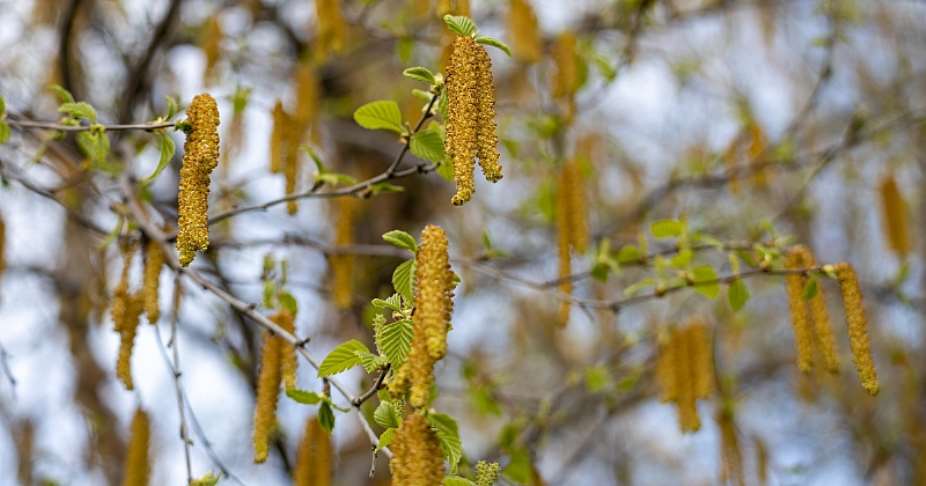
For some South Africans, the beginning of the flower season is met not with the joys of spring but rather with a sniffy nose, itchy eyes and a cacophony of sneezing.
In South Africa, allergic rhinitis (hayfever) affects an estimated 20% to 30% of the population – children and adults. Asthma affects around 20% of children and 10% of adults. Air pollution can worsen asthma and eczema symptoms and cause eczema.
Most people recognise that pollen, despite being invisible to the naked eye, is a dominant airborne allergen driving conditions like hayfever. Sufferers are acutely aware that pollen in the air changes seasonally, depending on what is flowering.
But South Africans still know too little about when pollen seasons begin and end, or how they differ across the country. This is because there's been very little consistent, long-term pollen monitoring. Without local records showing when different plants release pollen, it's hard for doctors to identify what is causing a patient's allergy. People with allergies are also left guessing when to start taking medicines that could prevent their symptoms.
Now, a pioneering scientific initiative is changing that. The South African Pollen Monitoring Network, set up seven years ago, sourced equipment and built research teams in different cities. The network has now produced South Africa's first five-year pollen calendars for several different natural regions. These calendars show which plants release pollen in each region, when they release it and how pollen levels change during the year.
Previously, pollen was measured in only a few African cities, and researchers used different methods, making it difficult to compare the results. The new network uses the same method to collect pollen from the air at all its sites. However, many pollen grains look so similar that scientists can identify only the plant family, such as grasses, rather than the exact species.
The network covered inland grassland sites in Johannesburg and Bloemfontein, and savanna sites in Pretoria and Kimberley. Its coastal sites represented fynbos in Cape Town, the Indian Ocean coastal belt in Durban and Albany thicket in Gqeberha.
We are medical and environmental researchers who have studied pollen for more than 50 years collectively. Together with MSc candidate Yolanda Makgale, we formed a team that constructed these pollen calendars.
We found that grass was the most common pollen everywhere, Bloemfontein had the highest overall pollen levels, Johannesburg had the most tree pollen, and Kimberley the most grass pollen.
This research is important because these calendars could help doctors diagnose and manage allergies and support warnings about periods of high pollen exposure.
The pollen causing allergies in inland cities
Over five years, South African Pollen Monitoring Network researchers identified 103 types of pollen across seven South African cities. Grass produced the most pollen and was the main cause of pollen allergies. Inland cities had much higher pollen levels than coastal cities, and their grass pollen seasons lasted for more than 200 days a year.
Bloemfontein (grassland biome): highest total amount of pollen recorded over a year, mainly because of its high levels of grass and tree pollen. Grass released pollen for an average of 246 days each year – about eight months.
Kimberley (savanna biome): highest average concentration of grass pollen, with an open, grassy landscape and a grass season lasting, on average, 247 days a year.
Johannesburg (grassland biome): highest average tree pollen, probably due to its large “urban forest” of planted exotic trees.
Pretoria (savanna biome): high tree pollen counts, dominated by the exotic Morus (mulberry) tree, which contributed 25% to the total pollen catch.
Coastal cities
In contrast to the inland cities, coastal cities recorded lower overall pollen loads and shorter grass seasons, often under 100 days a year. This difference is likely due to coastal rainfall washing the pollen out of the atmosphere, combined with strong coastal winds.
Cape Town (fynbos biome): the longest tree pollen season in the country, lasting 297 days a year, starting early in July. The pollen profile is dominated by exotic trees, with Cupressaceae (cypress) accounting for 30% of the five-year average, followed by Myrtaceae (eucalyptus) at 11%, and Pinus (pine) at 9%.
Durban (Indian Ocean coastal belt): low overall pollen catch, with the shortest grass season in the study, lasting just 71 days and starting late in summer.
Gqeberha (Albany thicket biome): lowest overall annual pollen load among all seven cities, alongside the shortest tree (116 days) and grass (92 days) seasons.
Climate change impact on pollen allergies
Between 2019-2021 and 2022-2024, pollen levels fell across most regions. Grass pollen nearly halved, while tree pollen doubled in inland cities. Researchers now need to examine whether rainfall, weather, flowering seasons or changes in land use caused this shift.
Climate change may play a part by changing pollen levels and seasons. It can also increase the risk of “thunderstorm asthma”. During some storms, moisture bursts grass pollen into tiny pieces that winds push towards the ground. When inhaled, they can cause sudden and dangerous asthma attacks.
What this means for allergic patients
For people suffering from hay fever or asthma, calendars tailored to South Africa's specific regions can act as an early warning system. Knowing exactly when pollen season starts lets patients begin preventive treatments, such as antihistamines or nasal sprays, before their symptoms start.
The new data revealed surprising allergy triggers. For instance, birch tree pollen, a major cause of hay fever in the northern hemisphere, was detected across South Africa where it is an ornamental, non-indigenous tree planted in gardens.
The general public may underestimate the dominant role of exotic trees in driving pollen load in big cities like Cape Town, Johannesburg and Pretoria. This finding should feed into decisions about what to plant.
What needs to happen next
Five years of pollen data show why year-round monitoring matters for public health. Researchers want to extend monitoring into rural areas and include pollen warnings in the national health system. They also hope to use DNA testing to identify allergy-causing plants that look identical under a microscope.
For now, the calendars help South Africans see which pollen is in the air, when levels are highest and when they may need to take precautions.
Funding came from Wellcome Trust (grant number: 311673), Cipla, Twinsaver, UCT Lung Institute Postdoctoral Research Fellow Award, a CSIR Parliamentary Grant, Novartis, University of Cape Town, Thermo Fisher Scientific, Clicks, Glenmark Pharmaceuticals, Dr Reddy's, SA Natural Products, and Zeiss Africa.
Frank Neumann receives funding from Grand Challenge Canada (GCC) and South African Medical Research Council (SAMRC).
Jonny Peter receives funding from all the entities listed under SAPNET in this article, taking responsibility for these a principal investigator of this project .
Andriantsilavo Hery Isandratana Razafimanantsoa, Caryn Upton, Dilys Berman, Jemma Finch, Takudzwa Matuvhunye, and Trevor Hill do not work for, consult, own shares in or receive funding from any company or organisation that would benefit from this article, and have disclosed no relevant affiliations beyond their academic appointment.
By Trevor Hill, Professor, Department of Geography, University of KwaZulu-Natal And
Andriantsilavo Hery Isandratana Razafimanantsoa, Postdoctoral Research Fellow at the UCT Lung Institute, University of Cape Town And
Caryn Upton, Medical Research Officer, Division of Allergology and Clinical Immunology, University of Cape Town And
Dilys Berman, Lecturer and aerobiologist in the division of Allergology and Clinical Immunology, Department of Medicine and UCT Lung Institute, University of Cape Town And
Frank Neumann, Professor of Geology, North-West University And
Jemma Finch, Associate Professor of Geography and Palaeoecologist, University of KwaZulu-Natal And
Jonny Peter, Associate Professor, Unit Head and also serves as Head of the Division of Allergology and Clinical Immunology at Groote Schuur Hospital, University of Cape Town And
Takudzwa Matuvhunye, Postdoctoral Researcher at the UCT Lung Institute, University of Cape Town

 “We need payment, not meetings” – Striking teacher unions tells Education Minist...
 NPP challenges GH¢2,650 cocoa producer price for 2026/27 season
 Mahama explains why 'humiliating' US, Ghana health deal was thrown out with spee...
 Education Minister meets teacher unions today for threatening strike
 Galamsey: 'Either Mahama is lying or suffering amnesia for denying promise to de...
 Adu-Boahen’s lawyer files no-case submission in GH¢49.1m trial
 BoG Governor Dr Johnson Asiama explains why he exited from GoldBod Board about f...
 Akuapem Odwira @200: 'Don’t abuse power, Ghanaians are watching us' — Osahen Afe...
 GES says NCPTA has no authority to impose prospectus purchases on schools
 2nd Deputy BoG Governor Matilda Asante-Asiedu replaces Dr. Asiamah on GoldBod bo...


