




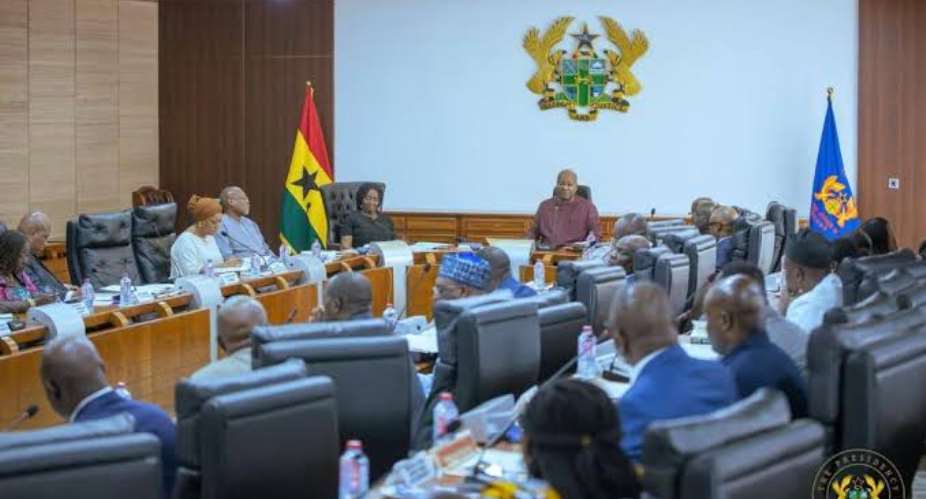
President John Dramani Mahama has defended Ghana’s decision to reject a proposed health compact from the United States intended to replace funding previously provided through the United States Agency for International Development (USAID).
The President said some of the conditions attached to the proposed agreement were unacceptable and raised concerns about Ghana’s sovereignty.
Speaking at a session titled “A Conversation with President John Dramani Mahama” at the Council on Foreign Relations (CFR) in New York last Friday, President Mahama said the proposal had been subjected to the appropriate review processes before Cabinet reached its decision.
He explained that the Ministry of Health examined the document and submitted an Information Paper to Cabinet, highlighting several provisions that raised concerns.
"It states that we shall give the United States our pathogen profile. It also says we should give our medical records. I mean, who takes another country's medical records?" the President said quizzically.
According to President Mahama, the proposed compact also required Ghana to provide a specified amount in counterpart funding. He further said the agreement would have prevented the Food and Drugs Authority (FDA) from inspecting certain medicines and medical products supplied under the programme.
"It was humiliating," President Mahama said, explaining that the concerns led Cabinet to reject the proposal shortly after it was presented.
"It was the compact that was thrown out in record time in our Cabinet. I've never seen anything thrown out as fast as that. And so, of course, we rejected it," he stated.
He said the Minister of Health was subsequently instructed to communicate Ghana’s position to the US Ambassador.
"We said 'no, we don't want it' and we're doing fine," President Mahama added.
Accra Reset
President Mahama said the decision to develop the Accra Reset initiative was partly influenced by the abrupt withdrawal of US development assistance.
He explained that $174 million that had been factored into Ghana’s national budget was withdrawn, leaving funding gaps in critical sectors, particularly health and education.
He said the health sector alone faced an annual shortfall of about $74 million, affecting areas such as medical research, HIV and AIDS testing laboratories, the administration of the President's Emergency Plan for AIDS Relief (PEPFAR) programme and the supply of antiretroviral medicines.
The government, he said, had to make emergency allocations to address the immediate funding gaps, while the development also renewed discussions about Africa’s ability to achieve greater health sovereignty.
"That set the whole ball rolling and led to the whole issue of the Accra Reset," he explained.
According to the President, the initiative seeks to reduce external dependence by strengthening Africa’s capacity to manufacture medicines and vaccines locally.
He pointed to the COVID-19 pandemic as an important lesson, noting that African countries were often at the back of the queue for vaccines because much of the global production capacity was concentrated in Western countries.
President Mahama said Africa therefore needed to develop the capacity to produce essential medicines and vaccines to better prepare for future health emergencies.
He said the Accra Reset was also intended to improve health outcomes and make healthcare a more central component of Africa’s broader development agenda.
Ghana declined to proceed with the proposed bilateral health agreement with the United States in April 2026, after the government raised concerns about conditions attached to the arrangement.
Similar concerns over data governance were raised by some other African countries during their negotiations with the United States. Zimbabwe was also reported to have raised related issues, while a Kenyan court temporarily suspended implementation of its agreement pending the hearing of a case brought by a consumer protection group.
Council on Foreign Relations
The event was hosted by the Council on Foreign Relations, a non-profit and nonpartisan American think tank focused on US foreign policy and international relations.
Founded in 1921, the organisation is headquartered in New York City and also maintains an office in Washington, D.C.
The CFR provides a platform for discussions, research and analysis on international affairs, with a focus on informing debates about US engagement with the rest of the world.
 “We need payment, not meetings” – Striking teacher unions tells Education Minist...
 NPP challenges GH¢2,650 cocoa producer price for 2026/27 season
 Mahama explains why 'humiliating' US, Ghana health deal was thrown out with spee...
 Education Minister meets teacher unions today for threatening strike
 Galamsey: 'Either Mahama is lying or suffering amnesia for denying promise to de...
 Adu-Boahen’s lawyer files no-case submission in GH¢49.1m trial
 BoG Governor Dr Johnson Asiama explains why he exited from GoldBod Board about f...
 Akuapem Odwira @200: 'Don’t abuse power, Ghanaians are watching us' — Osahen Afe...
 GES says NCPTA has no authority to impose prospectus purchases on schools
 2nd Deputy BoG Governor Matilda Asante-Asiedu replaces Dr. Asiamah on GoldBod bo...


