




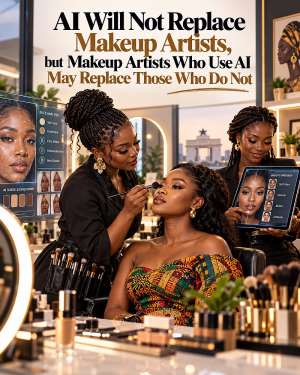
The beauty industry has always changed with fashion, culture, technology, and consumer expectations. Makeup artistry is no exception. For decades, professional makeup artists have relied on creativity, experience, product knowledge, facial analysis, colour matching, and personal interaction to serve clients. Today, however, artificial intelligence is introducing a new set of tools that are beginning to influence how beauty professionals work.
Some makeup artists may see this development as a threat. There is a growing fear that digital tools, virtual makeup applications, automated beauty recommendations, and smart beauty platforms could reduce the demand for human professionals. This fear is understandable, but it may not reflect what is actually happening.
Artificial intelligence is unlikely to eliminate professional makeup artistry because makeup remains a deeply human service. What is more likely is that makeup artists who learn how to use new technologies effectively will have an advantage over those who ignore them.
Makeup artistry involves far more than applying foundation, lipstick, or eye shadow. A professional makeup artist must understand facial structure, skin tone, skin type, occasion, lighting, clothing, personal preference, and even the emotional expectations of the client.
A bride preparing for her wedding day, for example, does not simply need a computer to recommend a lipstick colour. She needs someone who understands the importance of the occasion, listens to her concerns, manages her anxiety, and creates a look that makes her feel confident and comfortable.
These are qualities that technology cannot easily replace. Human judgement, empathy, creativity, trust, and personal connection remain at the centre of professional beauty services.
At the same time, technology is becoming increasingly useful in supporting these human skills. Artificial intelligence can now analyse facial features, recommend makeup shades, simulate different looks, and allow customers to preview products before they are applied physically. Virtual makeup tools can show how different lipstick colours, foundations, eye shadows, or hairstyles may appear on a person through a smartphone or computer screen.
For a professional makeup artist, these tools should not be viewed as competitors. They can become assistants.
Imagine a client entering a beauty studio without knowing exactly what type of makeup she wants for an event. Instead of spending a long period trying several products and colours, the makeup artist could use a digital tool to help the client preview different styles. The client may compare natural, glamorous, bridal, or evening looks before making a decision. The artist can then use professional experience to improve the selected look and adapt it properly to the client's face and skin.
This can save time and improve customer satisfaction.
Technology can also help makeup artists provide more personalized services. One of the most important parts of makeup application is selecting products that match a client's skin tone and complexion. Choosing the wrong foundation shade can affect the entire appearance of the makeup. Smart beauty applications can assist with shade matching and product recommendations based on images or skin characteristics.
However, the final decision should still remain with the professional. Lighting conditions, camera quality, skin texture, undertones, allergies, product behaviour, and environmental conditions can affect how makeup appears. A trained artist can consider these factors in ways that an automated system may not fully understand.
The bigger issue, therefore, is not whether technology will replace makeup artists. The real question is whether makeup professionals are prepared to work in an industry where customers are becoming more digitally informed.
Today's beauty customer often arrives at a salon after watching makeup tutorials, viewing social media trends, experimenting with beauty filters, and researching products online. Some clients may even show the makeup artist a digital image and say, "I want something like this."
This means the modern makeup artist is dealing with a different type of customer from the one of twenty years ago. Clients are more exposed to trends, more aware of products, and more demanding about the results they expect.
A makeup artist who refuses to understand digital tools may gradually struggle to meet these expectations.
Social media is another important example. Platforms such as Instagram, TikTok, Facebook, and YouTube have already changed how beauty professionals attract clients. In the past, a makeup artist depended mainly on referrals, physical location, or printed advertisements. Today, a single well presented makeup transformation posted online can reach thousands of potential customers.
Artificial intelligence can strengthen this advantage. Beauty professionals can use digital tools to improve photographs, organize content, generate marketing ideas, analyse customer engagement, schedule appointments, and communicate more efficiently with clients.
A makeup artist may still be extremely talented with brushes and cosmetics, but talent alone may no longer be enough to grow a competitive beauty business.
Business management is another area where technology can make a difference. Makeup professionals often handle appointments, customer enquiries, payments, product inventory, and marketing alongside their creative work. Digital systems can simplify many of these responsibilities.
Online booking platforms can reduce missed appointments. Customer databases can help artists remember previous services and client preferences. Inventory systems can alert professionals when certain products are running low. Digital payment systems can also make transactions easier and more convenient.
These tools allow the makeup artist to spend more time focusing on the actual service.
There is also an important opportunity for young makeup professionals in Ghana and other African countries. The beauty industry continues to create employment and entrepreneurship opportunities for young people. However, competition is also increasing. Many talented makeup artists are entering the market every year.
The professionals who stand out may not necessarily be those with the most expensive equipment or the largest studios. They may be those who combine technical beauty skills with digital knowledge.
A young makeup artist who understands both professional makeup and technology may be able to serve clients physically while also offering virtual consultations, online bookings, personalized beauty recommendations, digital portfolios, and social media content.
This creates more opportunities for growth.
Of course, there are concerns that must not be ignored. Beauty technology must be used responsibly. Facial images and personal information should be treated carefully. Clients should understand when their images or data are being stored or processed. Technology should also not encourage unrealistic beauty standards or make people feel that natural facial features must always be altered.
Professional makeup artists have an important role in maintaining balance. Beauty should remain about expression, confidence, creativity, and personal choice rather than pressure to achieve an artificial idea of perfection.
Training institutions also have a responsibility. Makeup artistry programmes should not focus only on traditional practical skills. Students should be introduced to digital marketing, online customer management, virtual beauty tools, photography, content creation, and basic digital business skills.
The beauty professional of the future will likely need both artistic ability and technological confidence.
The history of work shows that new technologies often change professions rather than completely destroy them. Photographers adapted to digital cameras. Designers moved from drawing boards to computer software. Businesses shifted from paper records to digital systems. In each case, professionals who adapted gained new opportunities.
Makeup artistry is likely to follow the same path.
Artificial intelligence cannot fully understand the excitement of a bride preparing for her wedding, the confidence someone gains before an important event, or the creativity involved in transforming a face while preserving the personality of the person behind it. These experiences remain human.
But technology can help the makeup artist work faster, market better, communicate more effectively, and offer more personalized services.
The message for makeup professionals is therefore simple. There is little value in fighting technology simply because it is new. The better approach is to understand it, use it wisely, and make it part of professional growth.
AI may never hold the brush with the sensitivity, judgement, and creativity of a skilled makeup artist. But the makeup artist who learns how to combine human talent with intelligent digital tools may become more competitive, more efficient, and more valuable to clients.
The future of makeup artistry will not belong to machines alone. It will belong to professionals who understand that technology works best when it strengthens human skill rather than trying to replace it.
Philipa Serwaa
University of Energy and Natural Resources P.O. Box 214 Sunyani, Bono Region
E-mail: [email protected]


 Death toll in South Africa bar shooting rises to 18
 Appiah Adomako Writes: Why DVLA Must Stop Treating Every Expired Licence Holder ...
 Ghana renews solidarity with Cuba, calls for unconditional lifting of sanctions
 Ethiopia accuses Eritrea, Sudan of backing Tigray rebels amid clashes
 Israel revokes credentials of Dutch diplomats in West Bank over settlement goods...
 Russian attacks kill eight in Ukraine after Moscow vows to continue war
 Trump expects Iran talks next week after rejecting seven-day truce proposal
 Gov’t to develop policy for Ghanaian sign language in education
 Two Ada SHS students plead guilty to assault, slapped with 12-month bond
 Enlistment: GAF begins documentation, body selection from September 28


