




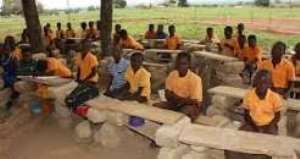
A child should not need a new set of textbooks every year when the same books can serve younger siblings. There is something fundamentally wrong when educating three children in the same family becomes unnecessarily expensive simply because they attend a private basic school.
Consider this simple example. Alex is in Primary Six. His sister, Doreen is in Primary Four. Another sibling, Dora is in Primary Two. Alex finishes Primary Six. If his textbooks are still in good condition, why should those books not be passed down to his younger siblings when they eventually reach the same level?
The mathematics is simple. One textbook bought today should ideally serve one child, then another, and perhaps another. The book becomes an educational asset of the family rather than a disposable commodity. Unfortunately, this principle appears increasingly difficult in parts of Ghana's private-school system. Some textbooks are designed as workbooks. Pupils are expected to write directly into them. Others are bundled with exercise books and supplementary materials. Some schools prescribe their own combinations of books and materials. Some schools change textbooks every academic year. When the academic year ends, the books cannot easily be passed on to younger siblings. For families with three or four children, the financial consequences can be considerable.
Recent reports from Tema illustrate the problem. Parents told the Ghana News Agency that they were spending hundreds, and in some cases nearly GH¢2,000 per child, on learning materials before school fees were even considered. One parent reported spending GH¢895 for a Class One child, GH¢996 for a Class Five child and GH¢1,990 for a child in junior high school. Parents also complained about being required to obtain materials through schools rather than sourcing comparable materials elsewhere.
In Sunyani, other families similarly complained about the rising cost of textbooks and exercise books, particularly where several children were attending school.
This is no longer simply a question of whether parents should pay school fees. It is a question of how much it costs to educate a Ghanaian child. And it is time for Ghana to ask a more uncomfortable question: Are we making education unnecessarily expensive?
Private Education is Necessary --- but Private Does Not Mean Unregulated
Nobody should misunderstand this argument. Private schools perform an important function in Ghana. The public-school system does not have enough places everywhere, and public schools themselves face serious challenges involving classrooms, teachers, learning materials and infrastructure. Ghana's Education Strategic Plan has long recognized the substantial role played by private schools. At one point, private schools accounted for about one-third of basic schools and more than 20% of basic-school enrolment nationally, although the distribution varies considerably by region. Private schools therefore cannot simply be wished away. They are part of Ghana's education system.
But once a private institution provides education to Ghanaian children, it operates within a national regulatory framework. Indeed, Ghanaian law is clearer on this matter than one might imagine. The Education Act, 2008 (Act 778), required private educational institutions to meet standards concerning curricula, syllabi and facilities established by the Ministry and to operate under educational supervision. The Pre-Tertiary Education Act, 2020 (Act 1049), went further in establishing the current framework. A private basic or senior high school must operate in accordance with the law and regulations and is subject to approval by the National Schools Inspectorate Authority. Private schools must also meet standards set by the regulatory bodies concerning physical, academic and other requirements. In other words, private schools do not exist in a regulatory vacuum. The law does not say: "You are private, therefore do whatever you want." The law already gives Ghana powerful institutions to regulate education.
This is where an important distinction needs to be made. If we want to reform the system, we should ask the right institution to do the right job. The National Council for Curriculum and Assessment (NaCCA) is mandated under the Education Regulatory Bodies Act, 2020 (Act 1023), to develop national curriculum and assessment standards for pre-tertiary education. Its functions include developing, assessing, reviewing and improving curriculum standards; developing assessment standards; approving teaching and learning materials; and reviewing the quality and quantity of textbooks and other educational materials.
NaCCA itself says its Instructional Resources Directorate is responsible for the submission, assessment, approval and continuous review of textbooks and other instructional materials. There is even an official Approved Books Registry through which parents, teachers, learners and publishers can verify whether instructional materials have been approved. In May 2025, NaSIA and NaCCA jointly reminded all pre-tertiary schools, public and private, that only NaCCA-approved textbooks and instructional materials should be used. This is important. It means the problem is not necessarily that Ghana has no rules. The problem may be enforcement, consistency, transparency and implementation.
What about the Curriculum of Private Schools?
Here again, we should be precise. It would be inaccurate to suggest that private schools in Ghana have unlimited freedom to create whatever curriculum they want. NaSIA states that schools offering the Ghanaian curriculum and schools offering international curricula have different registration routes. It also maintains a licensing system covering private schools and identifies the curriculum under which schools operate. Ghana therefore recognizes that some private schools may operate international curricula. That is reasonable. But where a school claims to be offering Ghana's national curriculum, there should be no ambiguity about what that curriculum requires.
The question is whether the regulatory system should go further in demanding that every private basic school clearly disclose:
- the curriculum it follows;
- the subjects taught;
- the learning outcomes expected at each level;
- the textbooks and supplementary materials used;
- the publishers and authors of those materials;
- whether the materials have NaCCA approval;
- the total cost of compulsory learning materials;
- which materials can be reused by younger siblings; and
- which materials are genuinely compulsory and which are merely supplementary.
Parents should not have to discover these things after paying admission fees.
The Textbook Jungle
There is another problem. Walk into different private schools and one can encounter an astonishing variety of textbooks covering essentially the same subject and grade. Different authors. Different publishers. Different approaches. Different terminology. Different exercises. Different sequences. Different levels of difficulty. Yes, competition can be healthy. Variety can be useful. But education is not the same thing as selling koko or ricewater. There must be a common national educational foundation. The child moving from one school to another should not suddenly discover that mathematics in School A bears little resemblance to mathematics in School B. Fortunately, Ghana's Standards-Based Curriculum already provides a common framework.
NaCCA's curriculum covers subjects including English, Mathematics, Science, History, Computing, Ghanaian Language, Creative Arts, Religious and Moral Education, Physical Education and others across the relevant basic-school phases. The problem, therefore, is not the absence of a national curriculum. The question is whether every classroom is faithfully translating that curriculum into meaningful learning. One curriculum. Many books. One national standard. Ghana does not necessarily need one textbook for every subject. That could create its own problems.
What Ghana needs is one national standard with a controlled range of high-quality textbooks. If ten publishers produce ten different Primary Six Mathematics textbooks, all ten should demonstrate that they cover the required national learning outcomes. The issue should not be who wrote the book.
The issue should be whether the book is:
- accurate;
- age-appropriate;
- linguistically clear;
- culturally relevant;
- inclusive;
- free from serious factual errors;
- aligned with the national curriculum;
- pedagogically sound;
- appropriately illustrated;
- accessible to children with different learning needs; and
- capable of helping children develop the competencies the curriculum requires.
NaCCA says its textbook approval system is designed precisely around such alignment and quality considerations. The challenge is to make parents confident that approval means something meaningful.
We Must Also Rethink the Economics of the Textbook
A textbook should not automatically become a single-use product. Ghana should seriously consider a Textbook Reuse and Family Learning Materials Policy for basic education. The principle would be simple: If a textbook can be reused safely and academically, it should be reusable. A Primary Six Mathematics textbook should not become worthless merely because the child has completed Primary Six. Schools could be required to distinguish between consumable materials (workbooks, examination papers and materials where writing directly into the book is integral to its purpose) and non-consumable materials (textbooks, dictionaries, atlases, reference books and other resources that can reasonably be passed from one child to another.). A school should not turn a non-consumable textbook into a consumable product merely because that increases the number of books parents have to buy. The distinction would protect both families and the environment. It would also encourage a culture of stewardship.
Ghana is Not the Only Country Wrestling with This
Other African education systems offer useful lessons.
Kenya has pursued a policy aimed at a one-learner, one-textbook ratio, with the government continuing textbook distribution under its Competency-Based Curriculum. In 2024, the Kenyan government reported the distribution of Grade 9 and other textbooks as part of efforts to maintain that ratio.
Rwanda has also invested heavily in textbook provision. Its education statistics report an average primary textbook-to-child ratio of about 2:1, with 1:1 ratios reported in Kinyarwanda, English and Mathematics, although some subjects still have higher sharing ratios.
South Africa provides another interesting lesson. Its CAPS (Curriculum and Assessment Policy Statements) provides detailed national guidance on what should be taught and assessed by subject and grade. The country's textbook approval system is explicitly connected to CAPS. One of the objectives of the system was to provide teachers with clearer guidance and improve consistency in what is taught.
These examples do not mean Ghana should copy Kenya, Rwanda or South Africa. They demonstrate something more fundamental: Successful education systems do not leave the quality and availability of learning materials entirely to individual schools.
UNESCO Has Already Warned Us
This is not merely a Ghanaian complaint. UNESCO's Global Education Monitoring work has repeatedly drawn attention to the regulation of non-state education. UNESCO has warned that weak regulation of private education can contribute to inequality, particularly where the cost of private education becomes excessive. It argues that private education should be properly regulated and meet appropriate quality standards. More recently, UNESCO and the Association for the Development of Education in Africa emphasized the importance of providing children with appropriate textbooks and teachers with proper guides. Their argument is straightforward: teachers cannot effectively implement a curriculum if they lack appropriate, up-to-date and curriculum-aligned materials. This should concern Ghana. Because a beautiful curriculum sitting inside a government document does not educate a child. A teacher does. A textbook supports the teacher. A child interacts with both.
And This Brings Us to Rote Learning
For decades, many African education systems have struggled with an examination culture in which remembering the "correct answer" becomes more important than understanding the question. The child memorizes. The child reproduces. The child passes. Then the child forgets. What has been known as the “Chew- Pass-Forget” syndrome. We should be careful here. Memorization itself is not the enemy. Children must memorize multiplication facts, vocabulary, mathematical rules, historical dates, scientific terms and many other pieces of foundational knowledge. The problem is rote learning without understanding.
There is a major difference between a child who remembers that the area of a rectangle is length multiplied by breadth and a child who can use that knowledge to calculate how much paint is required for a classroom wall. There is a difference between memorizing the definition of inflation and being able to explain how rising prices affect a family. There is a difference between memorizing a passage about environmental pollution and being able to investigate why a local stream has become polluted and propose solutions. Bloom's revised taxonomy gives educators a useful way of thinking about this progression: remember, understand, apply, analyze, evaluate and create. Remembering is part of learning. But it should be the beginning, not the destination.
The Science of Learning Supports a Different Approach
Educational psychology provides another important insight. Cognitive Load Theory reminds us that working memory is limited. Instruction therefore needs to be structured carefully so that pupils are not overwhelmed by unnecessary information while they are trying to understand something new. Research on retrieval practice also shows that actively recalling information can strengthen long-term retention more effectively than simply rereading material. Roediger and Karpicke's influential experiments found that testing can improve delayed retention, not merely measure it.
This gives us a more sophisticated alternative to rote learning. The teacher teaches. The child recalls. The teacher asks why. The child explains. The teacher presents a new situation. The child applies the knowledge. The child discusses it with classmates. The child makes mistakes. The teacher gives feedback. The child tries again. That is learning.
We Should Teach Children How to Think about Learning
Metacognition is another concept Ghanaian schools should take seriously.
A child should gradually learn to ask:
What do I already know?
What don't I understand?
How can I find the answer?
Why did I get this question wrong?
What strategy should I try next?
Research reviewed by the Education Endowment Foundation identifies metacognition and self-regulated learning as important approaches to improving pupil learning. Its evidence synthesis draws on hundreds of studies and emphasizes teaching children strategies for planning, monitoring and evaluating their own learning. Imagine a Ghanaian classroom in which pupils are not simply asked: "Who can give me the answer?" But also: "How did you arrive at that answer?" "Why do you think it is correct?" "Can you solve the problem another way?" "What would happen if we changed this figure?" "Can you explain it to your friend?" That classroom is producing thinkers rather than examination machines.
Private Schools should be Partners, Not Adversaries
This article should not be interpreted as an attack on private schools. Far from it. Many private schools in Ghana are doing excellent work under difficult circumstances. They employ teachers, provide infrastructure, absorb demand that the public system cannot fully accommodate and give parents additional educational choices. Private-school proprietors also face rising costs. So the answer is not to regulate private schools out of existence. The answer is to establish fair, transparent and enforceable rules.
Indeed, the Ghana National Council of Private Schools has disputed claims that private schools generally force parents to buy textbooks directly from schools, arguing that there is no such blanket policy. It has also explained that schools may sell books as a convenience to parents. That position should be part of the discussion. The objective should not be to accuse all private schools. It should be to identify practices that unnecessarily increase the cost of education and eliminate them wherever they occur.
What Ghana Should Do Now
The country needs a national conversation involving the Ministry of Education, NaCCA, NaSIA, GES, private-school associations, publishers, teachers, parents, educationists and, importantly, children themselves. Several reforms deserve consideration.
- Every private basic school should publish its curriculum pathway and identify whether it follows the Ghanaian national curriculum or an approved international curriculum.
- Every textbook and instructional resource used in Ghanaian-curriculum schools should be readily verifiable through the NaCCA approved-materials system.
- Schools should provide parents with a transparent list of textbooks, authors, publishers and prices before enrolment or the beginning of the academic year.
- Parents should be free, subject to reasonable safeguards, to obtain approved textbooks from legitimate vendors rather than being unnecessarily restricted to a school-controlled source.
- Schools should distinguish consumable from reusable learning materials.
- Reusable textbooks should be deliberately designed for reuse. There is little educational wisdom in printing a perfectly good textbook with pages that make it impossible for another child to use.
- Ghana should establish a maximum reasonable number of compulsory textbooks and supplementary materials per subject and grade, subject to educational justification.
- NaCCA should periodically review not only whether a textbook is approved but whether it remains appropriate as curricula evolve.
- NaSIA's inspections should include a stronger learning-quality component, not simply buildings, facilities and administrative compliance.
- Assessment should increasingly test understanding, application, analysis, reasoning and problem-solving, alongside essential factual knowledge.
Perhaps the Biggest Reform is Cultural
Parents must also change the way they measure education. A child who comes home with 20 pages of homework is not necessarily receiving a better education than the child who comes home with five meaningful questions. A school that requires 15 textbooks is not necessarily better than one that uses six excellent books effectively. A child who can recite 100 facts is not necessarily better educated than one who can use ten facts intelligently. And examination results, important as they are, should not be the only measure of educational success.
Ghana needs children who can read with understanding. Children who can write clearly. Children who can calculate. Children who can reason. Children who can ask questions. Children who can distinguish evidence from assertion. Children who can solve problems. Children who can work with others. Children who can use technology intelligently. Children who can learn without always waiting for somebody to tell them what to learn. That is what the country's Standards-Based Curriculum itself aspires to achieve. NaCCA says the current curriculum was designed to move education beyond merely passing examinations towards building character, nurturing values and producing literate, confident and engaged citizens, with emphasis on core competencies. The challenge is turning that philosophy into the daily experience of millions of children.
Education should not Impoverish the Family
This is ultimately an economic argument as much as an educational one. For a family with one child, GH¢1,000 spent on learning materials is already significant. For a family with three children, it can become overwhelming. For a family with four children, it can become punitive. And when school fees, uniforms, transport, feeding, examination charges, ICT charges, extra classes and other expenses are added, education can consume an enormous proportion of household income. This is particularly troubling in a country where many families are already struggling with food, rent, utilities, healthcare and transportation.
We cannot tell parents that education is free or affordable while quietly transferring enormous costs into textbooks, workbooks and compulsory learning materials. Nor can we solve the problem simply by blaming private schools. Ghana needs more public schools of good quality. It needs better-equipped public schools. It needs better teachers and stronger teacher support. It needs properly regulated private schools. It needs transparent textbook markets. It needs high-quality instructional materials. And it needs a national commitment to learning rather than merely schooling.
One book should be allowed to teach more than one child. Perhaps this should become a national principle. If Alex finishes Primary Six with a Mathematics textbook that is still in excellent condition, his younger sister should be able to use it when she reaches Primary Six. If she finishes with the same book intact, the youngest sibling should be able to use it too. Three children. One book. Three years of learning. That is not a small reform. Multiply it by thousands of families and millions of textbooks, and the economic implications become enormous. The family saves money. The child learns to value books. The school reduces unnecessary consumption. The environment benefits. The textbook becomes an investment rather than a disposable commodity. And education becomes a little less expensive. Ghana has already built much of the institutional architecture required to regulate its education system. NaCCA has the mandate to develop curriculum and approve instructional materials. NaSIA has the mandate to register, license and inspect schools. The law requires private schools to meet national standards. What we need now is the political will, administrative discipline and educational imagination to make those institutions work together effectively. Education is too important to be left to chance. And it is too expensive to allow unnecessary costs to become normal. A Ghanaian child deserves a good education. But the Ghanaian parent also deserves an education system that does not make the cost of obtaining that education unnecessarily unbearable.
FUSEINI ABDULAI BRAIMAH
+233208282575 / +233550558008
[email protected]


 Serbian President Aleksandar Vucic resigns
 Swiss reject plan to toughen neutrality
 Inside the business of gony bags, Madagascar's ubiquitous plastic sacks
 Caucus Warns: ‘If We Lose Our Teachers, We Lose Our Nation’ as Education Crisis ...
 Boeing Projects 18‑Month Timeline for Ghana’s National Airline Revival Under New...
 Legal Expert Questions EOCO’s Conduct, Says MP Had Right to Resist Unlawful Arre...
 Gunmen kill 27 in two shootings in South Africa
 'We shall hold govt feet to the fire of accountability' — Anyidoho on €225m coca...
 ‘Russian sleeper cell’: Can Germany’s far-right AfD be barred from sensitive int...
 Pope Leo XIV visits Lourdes after giant Paris mass to meet clergy abuse victims


