




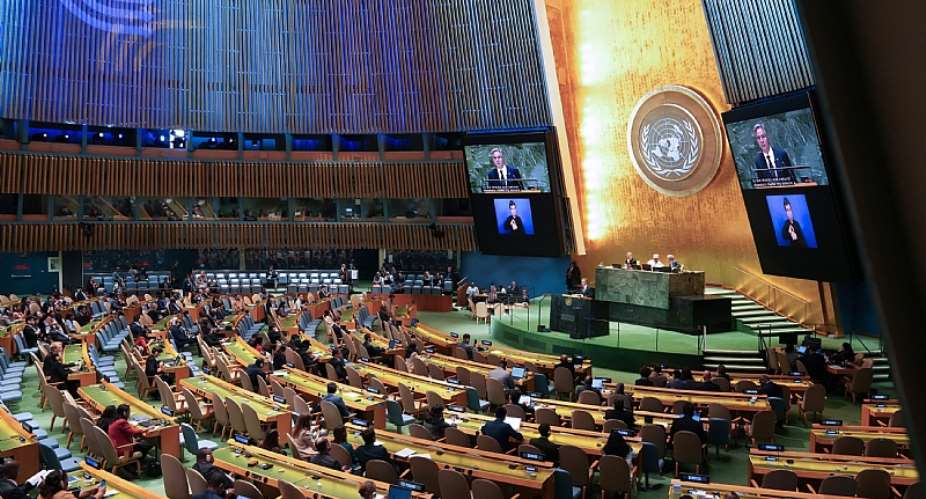
UN General Assembly week often produces an impressive parade of speeches about peace, security, climate change, terrorism, artificial intelligence, development and the future of humanity. But beneath the diplomatic language is a more primitive and more urgent question for millions of Africans: “What will they eat tomorrow?” This is why the headline of this piece needs to be asked bluntly: “Who will tell world leaders at UNGA that hunger is Africa’s biggest challenge?”
The foregoing question is not intended to diminish the continent’s other crises. Africa faces armed conflicts, terrorism, unemployment, weak institutions, climate shocks, public-health emergencies, infrastructure deficits and a persistent struggle for economic transformation. But hunger sits dangerously at the intersection of many of these problems. A hungry population is more vulnerable to disease, displacement, exploitation, violence and political instability. And the numbers are difficult to ignore.
According to the 2026 State of Food Security and Nutrition in the World report, about 309 million Africans faced hunger in 2025, representing 20 per cent of the continent’s population. Africa had more hungry people than Asia, which recorded about 292 million. More than half of Africa’s population, 56.6 per cent, experienced moderate or severe food insecurity.
There is, importantly, a small piece of good news. Africa’s hunger rate fell from 20.3 per cent in 2024 to 20 per cent in 2025, the first interruption of the continent’s upward trend since 2017. But the Food and Agriculture Organization (FAO) has warned that this is not yet a decisive reversal. With Africa’s population growing rapidly, the absolute number of hungry people could still rise. That warning ought to occupy a central place in the conversations taking place around the United Nations General Assembly. Instead, hunger can easily become another statistic buried beneath grand diplomatic declarations. That would be a mistake. Hunger is more than an empty stomach
Hunger is not merely a humanitarian problem requiring bags of rice, emergency feeding centres and international donations. It is an economic problem.
The reason for the foregoing view cannot be farfetched as a child who goes to school hungry cannot be expected to learn at the same level as a properly nourished child. A farmer who cannot afford fertiliser, machinery or transportation cannot produce at the scale required to feed a growing population. A family that spends most of its income on food has little left for education, healthcare, housing or investment.
Hunger therefore perpetuates poverty, while poverty makes hunger harder to defeat. The irony is that Africa is not a continent without agricultural potential. It possesses enormous expanses of arable land, a large youthful population and diverse climatic zones capable of supporting the production of numerous crops and livestock. So why does a continent with such potential continue to import food and struggle to feed millions of its people? That is one of the questions African leaders should be taking to the UN.
In fact, it is high time we stopped treating Africa as a permanent emergency. This is as there is an uncomfortable tendency in international conversations to treat African hunger principally as a humanitarian emergency. Humanitarian assistance is necessary when people are starving. But emergency food aid cannot become the permanent economic model for a continent with the resources to produce much of what it consumes.
The 2026 Global Report on Food Crises found that acute hunger has doubled globally over the past decade and that funding for humanitarian responses is increasingly under pressure. Ten countries, including Nigeria, accounted for two-thirds of people facing high levels of acute hunger.
Without a doubt, the message for UNGA should therefore go beyond asking wealthy nations to send more food. Africa needs partnerships that help Africans produce, process, store and distribute food profitably. That means investment in irrigation, rural roads, electricity, storage facilities, agricultural research, mechanization, financing and modern food-processing industries. It also means confronting insecurity. A farmer cannot cultivate a field that he fears returning to. A community cannot maintain food production when violence repeatedly forces its inhabitants from their homes. In Nigeria, for instance, the World Food Programme says nearly 35 million people are facing acute food insecurity, with conflict, climate shocks, displacement and the weakening of local food systems among the drivers.
Consequently, the fight against hunger must also be a fight for peace. Africa must look beyond the next harvest. There is another uncomfortable reality. African governments themselves cannot outsource responsibility for feeding their people to the United Nations, donor agencies or international charities.
In fact, the international community has a role, but African governments must provide the policy environment that makes food production commercially viable.
Farmers need access to affordable credit. Agricultural policies must be predictable. Governments must stop announcing programmes that disappear when political administrations change. Investments in agriculture should not be reduced to ceremonial tractor distributions or short-lived fertiliser schemes. The continent needs functioning food systems. That includes farmers at the beginning of the chain, processors in the middle, logistics operators moving food from one location to another and consumers at the end. Without any iota of exaggeration, the objective should be simple: food should be available, affordable, safe and nutritious.
At this juncture, it is expedient to ask, “What should African leaders tell UNGA?” Perhaps the most important message should be that Africa does not want sympathy without structural transformation. The continent needs investment, technology transfer, market access and partnerships that create productive capacity.
It needs international financing for climate-resilient agriculture. It needs greater support for research into drought-resistant crops and improved farming methods. It needs infrastructure capable of moving agricultural produce from farms to markets before it rots.
And it needs a fairer global trading environment in which African agricultural products can compete and African countries can capture more value from what they produce.
The world cannot seriously discuss Africa's development while ignoring what is on the dinner table. The FAO projects that by 2030, between 510 million and 520 million people globally could still face hunger, with about 56 per cent of them expected to be in Africa. That should be an alarm bell.
In fact, there is nothing wrong with discussing artificial intelligence, climate diplomacy, global security or geopolitical tensions. These issues matter. But for the African mother wondering how to feed her children, the most sophisticated speech at the UN means very little if it does not translate into affordable food.
For the unemployed young man, food inflation is not an abstract economic indicator. For the displaced farmer, food security is not a conference theme.
For the malnourished child, the Sustainable Development Goals are meaningless words unless somebody turns them into food, healthcare and opportunity. So, as world leaders gather at UNGA, somebody must say it plainly: Africa cannot build prosperity on empty stomachs.
The continent's hunger crisis deserves more than sympathy, statistics and annual declarations. It demands investment, accountability, security, productive agriculture and policies capable of transforming Africa from a major destination for food assistance into a major producer of food.
The world has repeatedly promised to leave no one behind. For Africa, the test of that promise may be painfully simple: Can the world's leaders help ensure that an African child goes to bed tonight without hunger, and wakes up tomorrow in a society capable of feeding itself? That is the question UNGA should not be allowed to dodge.

 Gold shipments resume as Ghana rebuilds foreign exchange reserves — BoG governor
 ECG unions to stage nationwide protest over proposed private sector participatio...
 ‘That penalty is a joke’ — Queiroz rejects referee decision in Ghana’s loss to C...
 GBA criticises EOCO over attempted arrest of lawyer Baffour Awuah at court premi...
 'Sceptics, naysayers, alarmists should be aware US ready to work with Ghana on r...
 Ibrahim Mahama took me abroad for surgery after Lordina’s intervention – Dzokoto
 President Mahama to Walk the Runway on November 7
 Heavy fighting, internet disruption as Ethiopia conflict rages
 Saudi reports fresh Houthi attacks as France pledges to defend key oil port
 Israel must win 'because we’ve got no other choice’, PM Netanyahu tells UN


