




How quickly the climate on Earth will change and how much the water level in the oceans will rise from this.
The word "climate" in translation from the ancient Greek language means "inclination" - the inclination of the Earth's surface to the rays of the Sun. Later, the word received a broader interpretation when it came to the weather as a whole, and its original meaning was forgotten.
Although it is the height of the Sun above the horizon that makes all the weather, whether during the day or during the season, or in a year in a particular region or throughout the Earth.
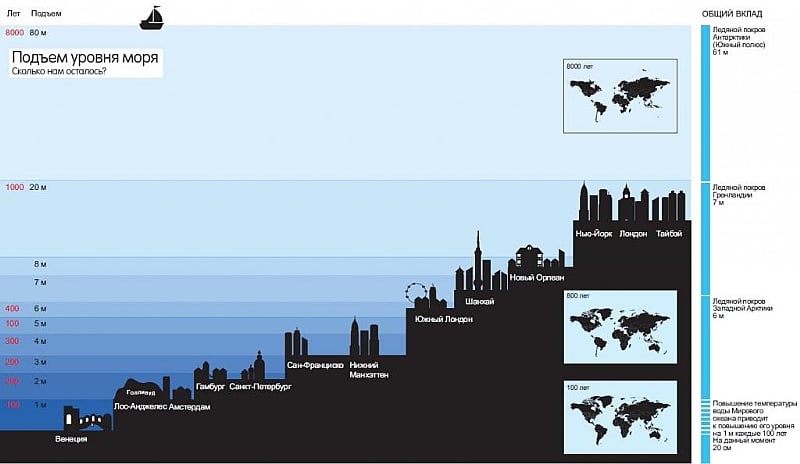
Fig. 1 The rise of water in meters is sufficient to flood the cities.
It is generally accepted in the world that comprehensive scientific oceanographic research began at the end of the 19th century. The measurements found that over the past 100 years, water in the oceans has arrived at about 2 mm per year.
In the last 20 years of observation, as stated in the UNESCO report 2024
https://www.unesco.org/ru/articles/novyy-doklad-yunesko-tempy-potepleniya-okeana
rise in the water level in the oceans has accelerated and is 3 millimeters per year.
Water on Earth comes all the time and it attracts attention.
There are assumptions about the reasons, for example, the term "greenhouse gas" appeared. Some say that it is caused by industrial human activity, which allegedly catastrophically heats the Earth and its atmosphere. - It is often found that for money, according to instructions, ignorance, people say what benefits someone, for example, production monopolies to eliminate competition.
At the same time, Russian scientists record the most powerful emissions of gigantic carbon reserves in the Arctic from melting permafrost. "Arctic Boiled." The public organization writes in the news the research center "Meteoklimat."
https://xn--80ajamjgdfo2bh.xn--p1ai/
First, the Sun heats the Earth, and only then a "greenhouse gas" is formed.
The article https://jiht.ru/science/temp/13-20 of the journal Energia of the Presidium of the Russian Academy of Sciences No. 2 for 2022. «Precessional, Global Climate Change on Earth», details the causes of warming on Earth. - Warming is caused not by the industrial activity of people, but by the precessional rotation of the planet during the Great Platonic Year - 25920 years (with all its variable seasonal periods: winter, spring, summer, autumn).
In the precessional motion of the planet, the angle of inclination of the Earth to the rays of the Sun changes significantly, that is, the aforementioned climate changes, the time, area and intensity of heating of land in the Northern Hemisphere increase.
The big one is better seen from a distance.
The warming up of the planet and the melting of snow in the spring cycle of the Great Platonic Year are confirmed by recent studies by German scientists.
For example, in 2021, in northern Germany near the city of Rerik in the Mecklenburg Bay of the Baltic Sea at a depth of 21 meters, researchers discovered a man-made stone wall 971 m long, made of large stones, built near
10,000 years ago, primitive tribes of people living in that area. A detailed scientific report was made about this: "Underwater structures of the Stone Age related to the hunting period...," published in the journal PNAS. https://www.pnas.org/doi/10.1073/pnas.2312008121
Ancient hunters built a trap wall, driving herds of free-grazing reindeer into it. When the next (precessional) ice age ended on Earth and warming began, the wall was gradually flooded with water.
If, after the end of the glaciation period, for 10,000 years the stone wall was under water at a depth of 21 meters (21,000 mm.), It means that over the time that has passed since then, the water level in the World Ocean and in particular in the Baltic Sea rose by an average of 2.1 millimeters per year. - Annual growth of 2 mm. celebrated since the 19th century.
Warming took 10,000 years, and humanity did not know or know about it.
Human activity on Earth cannot be compared to the consequences of interplanetary cosmic temperature interactions caused by the precessional change in the angle of inclination (climate) of the planet Earth to the Sun.
A little entertaining arithmetic, let's count...
The volume of water on Earth in the seas and oceans is approximately 1.37 billion cubic kilometers ru. wikipedia.org * ru.wikipedia.org.
We divide the volume of 1.37 billion km ³ by 3.7 billion years from the emergence of life on Earth. It turns out that water every year on average (taking into account all expenses) arrived at 0.37 cubic kilometers. This natural new water is formed in the bowels of the Earth and many terrestrial and underwater sources fill the World Ocean, feeding everything: rivers, lakes of our planet. Perhaps everyone saw these small fontanelles, streams and tried pure fresh, and sometimes salty, mineral water from them.
The surface area of the World Ocean is 361 million square kilometers.
If you divide 0.37 km ³ by 361 million km ², you get 0.00102 mm. That is (on average) only one thousandth of a millimeter, every year the level increased
The oceans due to the newly formed natural water in the bowels of the Earth.
For 1000 years - 1 mm, for 1 million years - 1 meter, for 1 billion years - 1 kilometer arrived.
If you divide 0.37 km ³ by 361 million km ², you get 0.00102 mm. That is (on average) only one thousandth of a millimeter, every year the level of the world ocean increased due to natural water newly formed in the bowels of the Earth. For 1000 years - 1 mm, for 1 million years - 1 meter, for 1 billion years - 1 kilometer arrived.
We continue to count.
As mentioned above, the rise in water in the oceans over the past 10,000 years was 2.1 mm. per year. This is significantly more than from new water from the bowels.
Multiply 2.1 mm. on the area of the World Ocean of 361 million km ². - We get that the annual increase in water was 758.1 km ³. - This increase was from meltwater.
We multiply this annual volume by 10,000 years and get what arrived on Earth - 7.581 million km ³ of water. Currently, according to Wikipedia: https ://ru.wikipedia.org/wiki/ fresh water on Earth 35-40 million km ³.
Of this number in the Arctic and Antarctica, accumulated: in snow, glaciers and icebergs, approximately 24 million km ³.
10000 years ago, there were 7.581 + 24 = 31.581 million km of ³ ice and snow on Earth.
To our time, 7.581 has melted: 31.581 = 0, 24 (24%), and 76% still remains.
7.581 million km of ³ caused the rise of ocean water by - 21 meters, and when the remaining 24 million km of ³ melt, the proportion of water will arrive at - 66.48 meters.
Meltwater during the Platonic year causes seasonal fluctuations in the water level of the World Ocean in the range of 21 + 66.48 = 87.48 m. - This, of course, is an approximate calculation, but not much different from reality.
In February 2024, in mainland Antarctica, members of the 69th Russian Antarctic expedition at the Vostok station drilled a well into an underground lake and from a depth of 3610 meters took out ice more than 1.2 million years old from under the continent's "shell." https://www.vokrugsveta.ru/articles/dostali-s-glubiny-3600
1.2 million years is more than 40 cycles of the Platonov year - 25920 years.
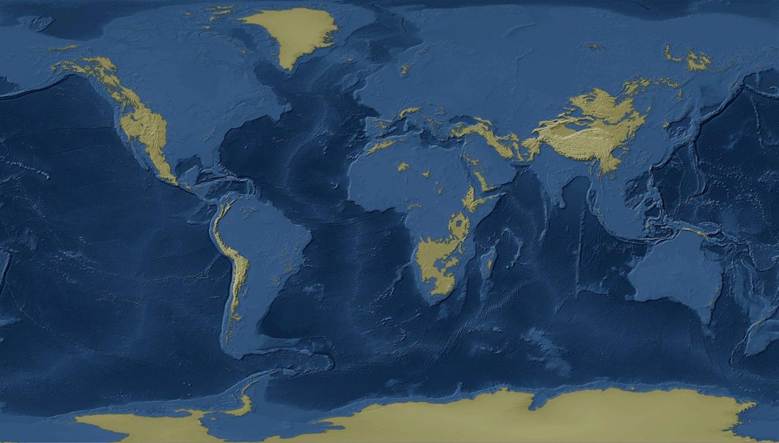
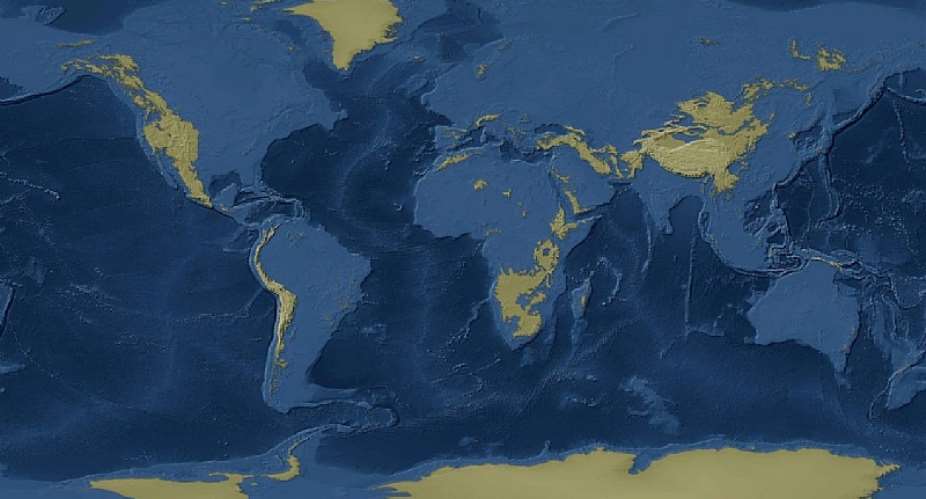
Fig. 2. So much land will remain on the planet if the level of the world's oceans rises by 1000 meters.
It is possible that not all ice in Antarctica will melt in the current Platonic year.
The upcoming rise in water in the oceans may be less than 66.48 m.,
But even if half of the 24 million km of ³ that remains melts, for many states it will be a disaster with their complete disappearance, immersion under water.
A water flood on Earth, it is possible, will begin "unexpectedly" in the 21st century.
According to the American Space Agency (NASA), in 2024 the level of the World Ocean rose by 59 millimeters. This indicates that according to the Platonic year, a period of active spring is coming on Earth.
In April, rapid melting of seasonal snow begins in the Northern Hemisphere, and during this period it happens that all winter snow and ice descends sharply in a few days.
Similarly, the same may happen in the "April" of the Platonic year.
The rise of water in the oceans from the melting of glaciers and snow in the Arctic and Antarctica will not be millimeters, but several centimeters (or even meters) per year.
One day of our year (the revolution of the Earth around the Sun) of 365 days corresponds to 71 years of the Great Platonic Year (25920:365 = 71.01).
The rise of water in the oceans at the estimated maximum 66.48 meters can occur in "one Platonic day," that is, in 71 years or much faster.
20 years ago, it arrived annually - 2 mm each, 10 years ago - 4 mm each, 2024 - 5.9 mm. How much the level of the World Ocean has risen in 2025 there is no information in the media in the public domain, but the rate of melting could be calculated. But they note that 2025 was warmer than 2024, which means that the rise in water was greater.
The boundary of the transition of snow into water is small (days, hours, minutes) and depends on many reasons. The sun heats the Earth continuously 24 hours a day and will not hide from it.
The flood may begin in our 21st century - "unexpectedly."
Why unexpected? - Because there are very few independent media (less than 1%).
There is no information freely available for people and does not reach the "centers" of decision-making. For example, if the rate of melting of snow and ice increases exponentially - 2, then the rise of water by 50 meters will occur in 12 years.
So that the universal Flood is not unexpected for the inhabitants of the Earth - you need to know when the time of the spring of the Platonic year will come. And for this we must calculate at what time of the Big Platonic year we live now.
Measurements of the angle of inclination of the Earth to the Sun should be made immediately, as stated in the article: "A new countdown on Earth and a new chronology." The material was published in the journal Russian-speaking America No. 691 for 2026 https://www.rusamny.com/2026/691/t06-691/, as well as in other independent media.
A little interesting information.
There was a time in the history of our planet when there was no water on Earth yet.
Researchers estimate the age of the Earth and all other planets of the solar system as 4.5-4.6 billion years. At the beginning of its inception, the Earth was like a modern hot Sun and gradually cooled in the surrounding cosmic cold.
Water (H ₂ O), consisting of oxygen and hydrogen molecules, according to Canadian scientists from the University of Saskatchewan, occurs in the bowels of the Earth at a depth of 40-400 km. at a high temperature of about 1500 °C and at a pressure of 20 thousand atmospheres.
3.6-3.8 billion years ago, the first simple living microorganisms appeared on Earth. It must be assumed that by that time the first small amount of water (0.37 cubic meters) appeared on its surface. km.) sufficient for life to settle in it
More about this in the article "Where did the water come from on Earth," published in the Russian scientific journal "Inventor and Innovator" No. 5 for 2025
http://i-r.ru/archive/3683/2955. And also in other respected, independent magazines, newspapers, on sites in: USA, Germany, Belarus and Russia. "Many thanks to them for their unselfish work.
Knowing that the level of the oceans has increased by 21 meters over 10,000 years, we can say what happened earlier with the Mediterranean, Aegean, Black and Azov and all other seas on Earth. It is not difficult to calculate and imagine where the boundaries of their shores passed.
If the oceans are filled with natural new water from the bowels of the planet for 1 meter per million years, then, for example, the connection between the Mediterranean and the Black Seas in the last 8 million years has been continuous. But earlier 8 million years ago, the Black Sea cyclically became, then a lake in the winter of the Platonic year, then a sea in the summer. Since the minimum depth of the navigable fairway in the Dardanelles Strait is 29 meters (29-21 = 8). The Bosphorus Strait is deeper and is 33 meters.
The minimum depth of the Strait of Gibraltar on the fairway is 338 meters. That is, 317 million years ago (338 - 21 = 317), the Mediterranean Sea was also in precessional cycles, then a large lake that has no connection with the Atlantic Ocean, then the sea.
Or, for example, there was no Sea of Azov 10,000 years ago, since its maximum depth today is 14.4 m. In each precessional Platonov year, the Sea of Azov appeared, expanding within the boundaries, filling with water, then completely dried up.
The Baltic Sea is young, it was also cyclically alternating between lake and sea (its average depth is 51 meters), and the maximum depth in the central part of the sea in the Landor basin is 470 meters.
Scientists argue whether 550 million years ago the ancient mainland of Gondwana was a single continent that occupied at least 75% of the land. To do this, they graphically connect modern continents into a single whole, like a children's mosaic along suitable contours of continents. But 550 million years ago, the water in the oceans was (according to estimates) 550 meters less. The cooled continents did not swim along the hot lava, but stood in the same place where they are now and were connected by land, which by now has been flooded. And 3 billion years ago, our entire planet was "Gondwana" - 99% land with separate lakes, on the site of modern deep-sea oceanic depressions.
Humans are inquisitive, and human life on Earth is short.
Люди любознательны, а жизнь человека на Земле коротка.
However, the knowledge that has already been accumulated by observing the world allows you to look not only into the past, but also into the future.
The time will come, perhaps in 2-3 billion years, when the water level on Earth rises by 2- 3 km with natural water from the bowels. (for 1 billion years - by 1 km.)
And then the Earth will look like a continuous water ocean, in which small islands of free-standing high mountain peaks meet.
And in the next billions of years, planet Earth will cool down.
The water level in the oceans will fall and all the water on Earth will evaporate.
It is possible that both filling with water and cooling will occur faster.
Humanity, if it does not destroy itself, will move to the planets closest to us, first to Venus, and then move to Mercury.
In the future, the Earth will first face the fate of dried Mars, the pictures from the surface of which we observe today, followed by a picture of the Moon, in which researchers note the presence of former rivers at the poles, and then the fate of other distant planets of the solar system (Saturn, Pluto, Neptune), which passed their short "life cycle" much faster than the Earth, since they were farther from the warming Sun.
Probably all these dead planets had life in varying degrees of development. Venus and Mercury will pass their life path following the example of the Earth. First they will cool down, then water will appear on them from the bowels, then comets will bring the simplest life on them, which will evolve evolutionarily, and then the planets will cool down...
Vladimir Garmatyuk
http://garmatyuk.viperson.ru
Vologda, Russia
24.09.2026

 Gold shipments resume as Ghana rebuilds foreign exchange reserves — BoG governor
 ECG unions to stage nationwide protest over proposed private sector participatio...
 ‘That penalty is a joke’ — Queiroz rejects referee decision in Ghana’s loss to C...
 GBA criticises EOCO over attempted arrest of lawyer Baffour Awuah at court premi...
 'Sceptics, naysayers, alarmists should be aware US ready to work with Ghana on r...
 Ibrahim Mahama took me abroad for surgery after Lordina’s intervention – Dzokoto
 President Mahama to Walk the Runway on November 7
 Heavy fighting, internet disruption as Ethiopia conflict rages
 Saudi reports fresh Houthi attacks as France pledges to defend key oil port
 Israel must win 'because we’ve got no other choice’, PM Netanyahu tells UN


