




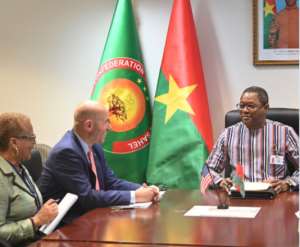
A short post on social media, accompanied by photographs, may not look like a turning point. But when the State Department's Bureau of African Affairs shared images from the UNGA81 meeting between Assistant Secretary Frank Garcia and Burkina Faso's Foreign Minister Karamoko Jean-Marie Traoré, the details mattered.
The AES confederation flag stood beside Burkina Faso's, and Washington thanked the Alliance of Sahel States as a bloc for cooperating on shared security priorities.
A reset months in the making
This did not come out of nowhere. Garcia and Deputy Secretary of State Christopher Landau met the AES ambassadors in Washington on 1 July to reaffirm a commitment to working together based on respect for sovereignty and mutual interests.
Garcia's first trip to the continent then took him to West Africa, and the Atlantic Council notes that his visit to Mali signalled renewed interest in engagement with the Sahel. The backdrop is stark: Washington is seeking to rebuild ties as the AES's Russian ally looks increasingly incapable of stemming the spread of jihadist insurgents.
It is a long way from 2024, when the US military completed its withdrawal from Niger. Two years on, the mood has shifted from disengagement to what analysts call "pragmatic cooperation," with military support reportedly under consideration.
Why the language matters
The post's vocabulary is deliberate. "Sovereignty," "mutual respect" and "commercial opportunities" are the AES governments' own terms. Sahelian authorities now set their own terms when negotiating future cooperation.
Washington seems to have concluded that lectures on governance and democratic transition bought it little, and that a transactional, security-first approach may reopen doors.
The AES has its own reasons to engage. Burkina Faso is using UNGA81 to present its own account of the country and the Alliance, aiming to influence international perceptions of the bloc. A photo with a US assistant secretary is diplomatic capital.
The AES has diversified its partners, drawing on Russia's Africa Corps, Turkey and China for arms, training and intelligence, and adding Washington fits that hedging strategy.
It also sits alongside overtures elsewhere: Traoré has been discussing Morocco's initiative to give Sahel countries access to the Atlantic.
The risks on both sides
For Washington, engagement carries reputational and practical risk. Rights abuses by security forces remain a serious concern, and Burkina Faso's authorities have been accused of cracking down on journalists and critics.
"Security cooperation" is also undefined in the post, and it is not clear what it covers: intelligence sharing, counterterrorism support, or something more.
Cooperation without clear conditions risks legitimising governments whose military solutions have not halted the insurgency.For the AES, the danger is overreach.
The bloc has yet to show it can overcome the problems that have undermined earlier regional security cooperation, including intelligence-sharing frictions and political disagreements.
Courting Washington while leaning on Moscow will test its diplomacy.
What it means for Ghana and the coast
For coastal West Africa, the stakes are direct. Jihadist pressure has pushed south toward the borders of Benin, Togo, Ghana and Côte d'Ivoire.
Any credible improvement in Sahelian security, and any restored intelligence channel between the AES and Western partners, serves Accra's interests.
Ghana, with its record of dialogue and its Zongo communities linked across the Sahel by language and trade, is well placed to keep talking to all sides.
ECOWAS's rupture with the AES makes this bridging role more valuable.
The photo-op will only matter if it is followed by clear, accountable arrangements that protect civilians.
For now, one thing is evident: the Sahel's military governments are no longer isolated, and Washington has decided it would rather be in the room.
Mustapha Bature Sallama
Medical/ Science Communicator,
Private Investigator, Criminal Investigation and Intelligence Analysis,
International Conflict Management and Peacebuilding. (USIP)
[email protected]
+233555275880
Sources
Bureau of African Affairs (@AsstSecStateAF), post on the Garcia–Traoré meeting, 23 Sep 2026, #UNGA81 (your screenshot; link the original post).
The Africa Report, "US-Africa Week Ahead: Trump's Africa envoy heads to West Africa as Washington courts Sahel juntas," 13 Jul 2026. https://www.theafricareport.com/424803/us-africa-week-ahead-trumps-africa-envoy-heads-to-west-africa-as-washington-courts-sahel-juntas/ (the 1 July meeting with AES ambassadors, the Garcia trip, Russia's declining ability to stem the insurgency)
Atlantic Council, "Pathways to partnership, prosperity, and security in the Sahel," Sep 2026. https://www.atlanticcouncil.org/event/pathways-to-partnership-prosperity-and-security-in-the-sahel/ ("pragmatic cooperation," reported consideration of military support, Garcia's Mali visit)
West African Voice Network, "Burkina Faso Seeks to Shape International Perceptions of AES at UN," Sep 2026. https://www.wavn.org/burkina-faso-seeks-to-shape-international-perceptions-of-aes-at-un/ (Burkina Faso's UNGA81 messaging)
GlobalSecurity.org, report on Traoré's Morocco talks, 22 Sep 2026. https://www.globalsecurity.org/military/library/news/2026/09/mil-260922-morocco-mfa01.htm (the Atlantic access initiative)
International Crisis Group, "Defining a New Approach to the Sahel's Military-led States," Jul 2026. https://www.crisisgroup.org/cmt/africa/sahel/burkina-faso-mali-niger/defining-new-approach-sahels-military-led-states (Sahelian authorities setting their own terms, AES split from ECOWAS)
HORN Review, "Self-Reliance or Struggle? How the Alliance of Sahel States Plans to Sustain Its New Security Coalition," 2 Apr 2026. https://hornreview.org/2026/04/02/self-reliance-or-struggle-how-the-alliance-of-sahel-states-plans-to-sustain-its-new-security-coalition/ (the AES's partnerships with Russia, Turkey and China, and the durability problems of joint operations)
Al Jazeera, "The Sahel and the UN: a smaller footprint, a different role," 21 Sep 2026. https://www.aljazeera.com/news/2026/9/21/the-sahel-and-the-un-a-smaller-footprint-a-different-role (ECOWAS exit on 29 Jan 2025, UNGA81 context)


 Gold shipments resume as Ghana rebuilds foreign exchange reserves — BoG governor
 ECG unions to stage nationwide protest over proposed private sector participatio...
 ‘That penalty is a joke’ — Queiroz rejects referee decision in Ghana’s loss to C...
 GBA criticises EOCO over attempted arrest of lawyer Baffour Awuah at court premi...
 'Sceptics, naysayers, alarmists should be aware US ready to work with Ghana on r...
 Ibrahim Mahama took me abroad for surgery after Lordina’s intervention – Dzokoto
 President Mahama to Walk the Runway on November 7
 Heavy fighting, internet disruption as Ethiopia conflict rages
 Saudi reports fresh Houthi attacks as France pledges to defend key oil port
 Israel must win 'because we’ve got no other choice’, PM Netanyahu tells UN


