




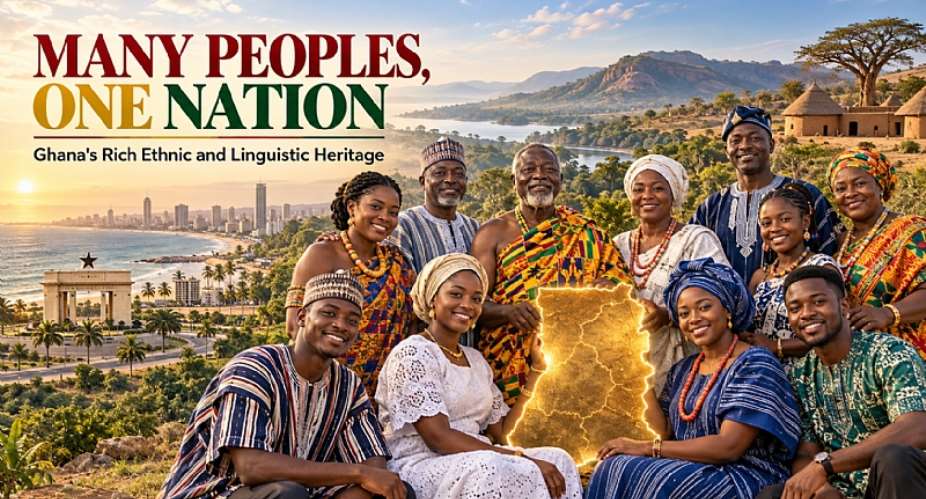
Ghana is often celebrated as one of Africa’s most peaceful and culturally diverse countries. Beneath its shared national identity lies a complex tapestry of ethnic communities, languages, customs and historical traditions that have shaped the country’s political, social and cultural development.
The country’s population is now estimated to be considerably higher than the often-quoted figure of 33.48 million. According to the Ghana Statistical Service, Ghana’s projected population for 2026 is approximately 34.38 million.
These millions of people belong to numerous ethnic and cultural communities. Although particular groups are historically associated with specific regions, internal migration, intermarriage, urbanisation and economic activity have made modern Ghana increasingly integrated. Accra, Kumasi, Takoradi, Tamale and other urban centres now contain people from virtually every part of the country.
The 2021 Population and Housing Census classified Ghana’s population into nine broad ethnic categories: Akan, Mole-Dagbani, Ewe, Ga-Dangme, Gurma, Guan, Grusi, Mande and other groups, including Hausa, Baribari and Zabrama communities.
The Akan constitute Ghana’s largest broad ethnic grouping, accounting for approximately 45.6 per cent of the population recorded in the 2021 census. Akan communities are concentrated mainly in the southern and central parts of the country, although they are now found throughout Ghana.
The Akan category includes several culturally related peoples, among them the Asante, Fante, Akuapem, Akyem, Bono, Kwahu, Wassa, Nzema, Sefwi, Denkyira and others. Although they share linguistic and cultural connections, each community has its own history, political traditions, festivals and local identity.
The Asante are strongly associated with the Ashanti Region and the historical Asante Kingdom, while the Fante are concentrated mainly along the Central Region’s coastal areas. Akuapem communities are historically connected to the Akuapem Ridge in the Eastern Region, while Akyem, Kwahu and other Akan groups occupy different parts of southern Ghana.
The Mole-Dagbani constitute the country’s second-largest broad ethnic group, representing approximately 18.5 per cent of the population. They are concentrated mainly in northern Ghana and include the Dagomba, Mamprusi, Nanumba and related communities.
The Dagomba are closely connected to the historic Kingdom of Dagbon, one of Ghana’s oldest surviving traditional states. Their cultural and political life is strongly associated with the Ya-Na and the traditional capital of Yendi. The Mamprusi are similarly linked to the Mamprugu Kingdom and the Nayiri, whose traditional seat is at Nalerigu in the North East Region.
The Ewe account for approximately 12.8 per cent of Ghana’s population. They are found predominantly in the Volta and Oti regions, as well as in parts of Greater Accra. Ewe communities also extend across Ghana’s eastern border into Togo and Benin, reflecting cultural identities that existed long before the creation of modern national boundaries.
The Ga-Dangme constitute about 7 per cent of the population. The Ga are the indigenous people of Accra and surrounding coastal settlements, while the Dangme are historically associated with areas east of Accra, including Ada, Krobo, Prampram, Ningo and Shai.
The rapid expansion of Accra has transformed the capital into a highly cosmopolitan city, but Ga culture remains central to its identity. The annual Homowo festival, traditional chieftaincy institutions and the Ga language continue to preserve the historical character of the city.
Gurma peoples make up approximately 6.4 per cent of the population and are concentrated mainly in northern and north-eastern Ghana. The broad classification includes several related communities, each with its own language and traditions.
The Guan represent about 3.2 per cent of the population. Unlike groups associated with one continuous geographical territory, Guan communities are dispersed across different parts of Ghana. They include the Gonja, Larteh, Kyerepong, Efutu, Awutu, Nchumuru and several other communities.
The Gonja are historically associated with the Savannah Region and the ancient Gonja Kingdom. Following the creation of new administrative regions in 2019, it is more accurate to connect the Gonja primarily with the Savannah Region rather than describe them only as a people of the former Northern Region.
The Grusi account for approximately 2.7 per cent of the population and include communities such as the Kasena, Sisala and related peoples, many of whom live in the Upper East and Upper West regions. Mande groups constitute about 2 per cent, while other communities, including Hausa, Baribari and Zabrama, account for a further 1.6 per cent.
Together, the Akan, Mole-Dagbani and Ewe account for about 77 per cent of Ghana’s population. However, the importance of a cultural community cannot be measured only by its numerical size. Every group contributes to the country’s music, food, festivals, political traditions, craftsmanship, oral history and systems of social organisation.
Language is one of the clearest expressions of this diversity. English serves as Ghana’s official language and is used in government, formal education, the courts, national administration and much of the media. Its use provides a common means of communication among citizens who speak different mother tongues.
However, English is only one part of Ghana’s linguistic life. Millions of people communicate daily in indigenous Ghanaian languages at home, in markets, during religious worship, through music and within traditional institutions.
Akan languages are the most widely spoken. Asante Twi, Akuapem Twi and Fante are related but maintain distinct forms, pronunciation patterns and literary traditions. Twi also functions as a widely understood trading and social language in many parts of southern Ghana.
Other prominent languages include Ewe, Ga, Dangme, Dagbani, Dagaare, Gonja, Kasem, Nzema and Mampruli. Numerous additional languages are spoken by smaller communities across the country, demonstrating that Ghana’s linguistic landscape is considerably broader than the languages most commonly heard in national broadcasting.
The Bureau of Ghana Languages currently focuses its publishing, standardisation and language-development work on 11 Ghanaian languages: Akuapem Twi, Asante Twi, Fante, Ewe, Dagbani, Dangme, Dagaare, Ga, Nzema, Kasem and Gonja.
These languages are sometimes mistakenly described as having the same official status as English. A more accurate description is that they are government-supported Ghanaian languages used in education, cultural promotion, literacy development and public communication. English remains the country’s official administrative language.
Under Ghana’s language-in-education approach, an indigenous language may be used as a medium of instruction during the early years of schooling, particularly where it is widely spoken in the local community. English is introduced and gradually becomes the principal language of instruction.
The policy is based on the educational value of teaching children through a familiar language during their earliest years. When properly implemented, mother-tongue instruction can improve comprehension, classroom participation and the transition to literacy in English.
Implementation, however, remains uneven. Teachers may be posted to communities where they do not speak the dominant local language, while textbooks and learning materials are not always available in sufficient quantities. Urban classrooms may also contain children from several linguistic backgrounds, making the selection of one local language difficult.
Ghana therefore faces the challenge of maintaining a shared national language without allowing indigenous languages to decline. English connects the country to international commerce, diplomacy, science and higher education, but Ghanaian languages carry cultural knowledge that cannot always be translated adequately.
Proverbs, oral histories, traditional names, songs, customary laws and indigenous environmental knowledge are preserved through language. When a language weakens, the society risks losing not only words but also the worldview and historical memory contained within them.
Urbanisation and the growing influence of global media have created concerns that some young Ghanaians are becoming less fluent in their ancestral languages. Families, schools, traditional authorities, broadcasters, publishers and cultural institutions must therefore work together to make indigenous languages relevant to contemporary life.
This does not require rejecting English or isolating cultural communities from one another. Ghana’s strength lies in its ability to combine unity with diversity. A Ghanaian can belong proudly to an Akan, Ewe, Ga, Dagomba, Guan, Gonja, Gurma, Grusi, Mande or another cultural community while remaining fully committed to the national identity.
The country’s ethnic and linguistic diversity should never become an excuse for discrimination, political exclusion or conflict. It should instead be treated as a national resource capable of enriching education, tourism, scholarship, creative industries and democratic participation.
Ghana is not one people because everyone speaks the same language or follows the same customs. It is one nation because its many peoples have chosen to build a common future.
The story of Ghana is therefore not the story of a single ethnic group or language. It is the continuing story of many communities—different in origin and tradition, yet connected through citizenship, shared institutions and a collective responsibility for the country’s future.


 Israel must win 'because we’ve got no other choice’, PM Netanyahu tells UN
 Mahama reiterates Ghana's commitment to two-state solution to Palestine-Israel c...
 Ablakwa calls for Return of African Artefacts held abroad
 Madina MP Francis-Xavier Sosu reportedly collapses while speaking at GIMPA
 Kumasi drivers, passengers react to 8% transport fare increase
 I will unite Africa, Caribbean and Latin America into world's biggest trading bl...
 Mahama petitioned to halt Sentuo Airport Garden City construction after sod cutt...
 Government should not fund the $4 billion Accra-Kumasi Expressway project — Alan
 Democracy must deliver tangible social benefits to citizens – Mahama
 Court to rule on bail applications of six accused in 3.9-tonne cocaine seized in...


