




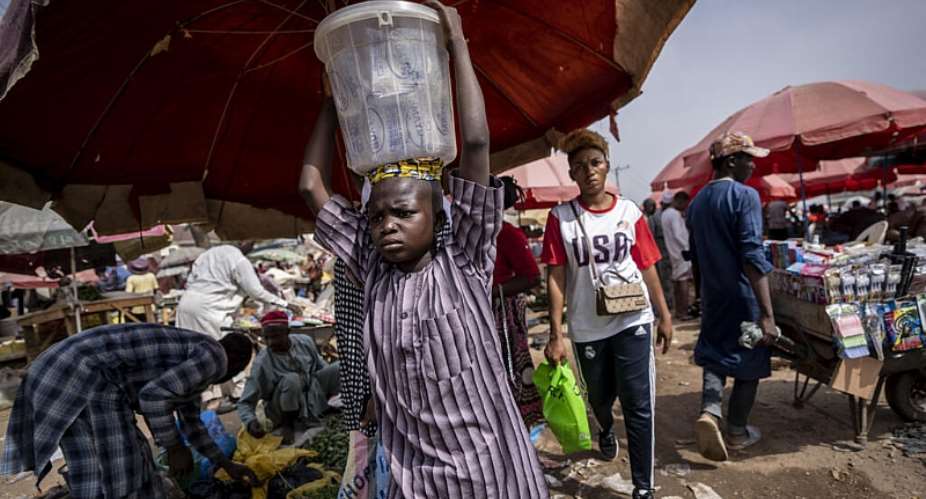
The Climate Impact Lab, a research group based at the University of Chicago, predicts there will be 66,800 extra deaths across the Sahel, the dry belt along the southern edge of the Sahara, between September and February compared with a normal year.
Nigeria alone accounts for 31,400 of these, followed by Sudan with 17,500, Niger with 10,000 and Chad with 8,000.
Worldwide, around 239,000 more heat-related deaths are likely to be seen over the same six months. Counting from June, when the current El Nino began, the estimated global toll rises to 451,000 by the end of February.
“This is such a large number that it can be numbing, but it is made up of parents and children, grandparents and neighbours, people going to work, caring for families and living their lives,” said Michael Greenstone, a University of Chicago economist and co-founder of the Climate Impact Lab.
Before its peak, El Nino brings failed crops and empty fishing nets
Emergency measures
The El Nino phenomenon is marked by unusually warm waters in the tropical Pacific and can disrupt weather around the world. This year's could become the strongest on record.
The projections cover deaths caused by extreme heat alone, but they come in addition to the death toll from droughts, wildfires and flooding linked to higher temperatures and shifting rainfall, said the report, which was published on Wednesday.
Some of the heaviest losses will come later in the six-month period. Nigeria could record 15,400 additional heat deaths between December and February – leaving more time to act.
Heat warnings, cooling centres, hydration stations and protection for outdoor workers are among measures that could help reduce the toll, the researchers found.
“This report allows decision-makers to see exactly where emergency actions can be taken now to save tens of thousands of lives in the coming months,” Greenstone said.
Some of these measures are already under way to protect communities.
“Increasing emergency response and better targeting our efforts can save many lives this year,” said Tamma Carleton, the lab's faculty head of research and an assistant professor at the University of California, Berkeley.
“But 20 years from now, once today's extreme temperatures become the new normal, we don't want to be in a constant state of emergency.”
The projections will be updated as El Nino develops, the lab added.
Three Pacific hurricanes gather strength as El Nino intensifies
A call to action
The analysis has not yet been independently peer reviewed, although the methods behind it have.
Scientists calculated the projections using research into the relationship between temperature and deaths in more than 24,000 regions worldwide, combined with seasonal temperature forecasts.
The findings should be treated as a call to action rather than simply another warning about extreme heat, Abhiyant Tiwari, a heat expert at the Natural Resources Defence Council India who was not involved in the research, told the Associated Press.
“The real measure of our preparedness is not how many heat warnings we issue, but how effectively we protect people and reduce preventable deaths,” he said.
El Nino is forecast to last until the northern hemisphere spring of 2027, while heat-related deaths could remain high into June or July, researchers said.
(with newswires)


 Israel must win 'because we’ve got no other choice’, PM Netanyahu tells UN
 Mahama reiterates Ghana's commitment to two-state solution to Palestine-Israel c...
 Ablakwa calls for Return of African Artefacts held abroad
 Madina MP Francis-Xavier Sosu reportedly collapses while speaking at GIMPA
 Kumasi drivers, passengers react to 8% transport fare increase
 I will unite Africa, Caribbean and Latin America into world's biggest trading bl...
 Mahama petitioned to halt Sentuo Airport Garden City construction after sod cutt...
 Government should not fund the $4 billion Accra-Kumasi Expressway project — Alan
 Democracy must deliver tangible social benefits to citizens – Mahama
 Court to rule on bail applications of six accused in 3.9-tonne cocaine seized in...


