




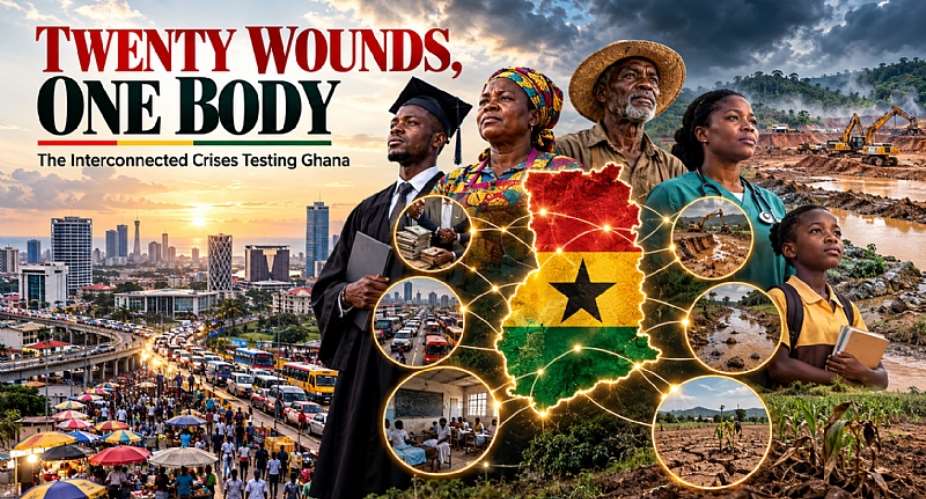
Ghana’s social problems are often presented as a list: poverty, unemployment, corruption, poor healthcare, inadequate education, child labour, crime, substance abuse, environmental destruction and brain drain. Yet these problems do not exist independently. They interact, reinforce one another and form a system in which the failure of one institution creates pressure on several others.
Understanding these connections is essential because a country cannot solve interconnected problems through isolated policies. Ghana’s difficulties are not twenty unrelated wounds. They are symptoms of a body struggling with weak institutions, limited economic opportunities and declining public confidence.
The pressure is felt first within the household. Although Ghana has recorded periods of economic growth, many families continue to struggle with food, housing, transport, healthcare, utilities and education. The Ghana Statistical Service reported that multidimensional poverty affected 21.9 per cent of the population in the third quarter of 2025, while food insecurity stood at 38.1 per cent. These figures reveal that macroeconomic recovery does not automatically translate into security at the household level.
Inflation has declined significantly from the severe levels experienced during the recent economic crisis. Official figures placed year-on-year inflation at 6.5 per cent in June 2026. However, lower inflation does not mean that prices have returned to their previous levels. It means that prices are increasing more slowly. Families must still cope with the accumulated increases in food, rent, transportation and utilities that occurred during the high-inflation period.
This distinction is important. Citizens may hear that inflation is falling while finding that their incomes still purchase much less than they did several years ago. When wages fail to recover as quickly as prices, statistical improvement can coexist with continuing hardship.
Unemployment deepens the pressure. Ghana’s official unemployment rate stood at 13 per cent in the third quarter of 2025. The burden is particularly severe among young people entering the labour market with qualifications but limited employment opportunities.
For generations, education was regarded as the most reliable path out of poverty. Families sacrificed to send their children to universities and technical institutions because a qualification appeared to offer access to stable employment. Today, many graduates spend years searching for work, accept positions unrelated to their training or survive through informal activities offering little security.
The problem is not simply that Ghana is producing too many graduates. It is that the economy is not creating enough productive enterprises capable of employing them. Educational expansion without industrial growth produces frustration rather than transformation.
When legitimate opportunities remain scarce, some young people become vulnerable to online fraud, illegal mining, drug trafficking and other illicit activities. Cybercrime is not caused by unemployment alone, and economic hardship can never excuse criminal conduct. Nevertheless, an economy that leaves large numbers of educated and digitally skilled young people idle creates fertile ground for criminal networks.
Substance abuse must also be understood within this wider environment. Young people facing unemployment, family pressure, social isolation and uncertainty may turn to alcohol or drugs as a form of escape. Addiction then damages physical and mental health, weakens families and reduces the person’s ability to find or retain employment.
The same cycle can draw frustrated young people into violent groups, political vigilantism and local criminal networks. Ghana remains more peaceful than many countries in the region, but recurrent community conflicts, armed robbery, violent land disputes and occasional kidnappings demonstrate that national stability cannot be taken for granted.
Corruption makes nearly every other problem more difficult to solve. It diverts resources, inflates contracts, weakens enforcement and teaches citizens that personal connections matter more than fairness or competence. Transparency International’s 2025 Corruption Perceptions Index gave Ghana a score of 43 out of 100 and ranked it 76th among 182 countries. The score underlines the persistent concern about public-sector accountability and the slow pace of institutional reform.
The damage caused by corruption extends beyond money stolen directly from the state. A poorly executed road contract increases transportation costs and accidents. Corruption in procurement can leave hospitals without suitable equipment. Political interference in appointments weakens public institutions. Selective enforcement encourages illegal businesses to continue operating while legitimate firms bear the cost of compliance.
This erosion of trust has serious consequences. Citizens become less willing to pay taxes, comply with regulations or believe official promises when they think public resources are being mismanaged. The government then collects less revenue and has fewer resources to provide the services whose weakness created distrust in the first place.
Infrastructure deficiencies reinforce this cycle. Poor roads increase the cost of moving agricultural produce and manufactured goods. Unreliable electricity disrupts factories, workshops, hospitals and schools. Inadequate drainage exposes urban communities to repeated flooding, while insufficient public transport consumes productive time and increases household expenditure.
Urbanisation is not itself a social problem. It can support productivity, innovation and economic growth. The difficulty arises when the urban population expands faster than housing, sanitation, transport and employment. Informal settlements then grow in flood-prone or environmentally fragile locations, and city authorities struggle to provide adequate waste management and basic services.
Healthcare reflects many of the same pressures. Ghana has trained skilled doctors, nurses, pharmacists and other professionals, but shortages, uneven distribution and difficult working conditions continue to affect service delivery. Rural facilities are particularly vulnerable to understaffing and inadequate equipment.
Migration adds another layer to the problem. Health professionals have the right to pursue better opportunities, but their departure can weaken facilities that already have limited staff. Research involving Ghanaian doctors has identified working conditions, professional opportunities and remuneration among the factors influencing intentions to migrate. The World Health Organization has urged Ghana and other African countries to align health-worker education with employment, improve working conditions and manage migration through ethical bilateral arrangements.
Brain drain is therefore not merely about patriotism. It is also about institutions. Ghana cannot ask trained professionals to remain indefinitely in systems that deny them the equipment, career development, predictable employment and working conditions required to practise effectively.
Education faces a similar crisis of quality and trust. Ghana has expanded access to schooling, but classrooms, laboratories, libraries, teachers and learning materials remain unevenly distributed. Some children attend well-resourced schools, while others study in overcrowded rooms or under structures that are unsuitable for effective learning.
Examination malpractice further weakens confidence in the educational system. In the 2025 WASSCE, WAEC cancelled the entire results of 653 candidates and individual subject results for 6,295 candidates after investigations into irregularities. The persistence of leaked questions, collusion, impersonation and the use of unauthorised devices damages the credibility of qualifications and punishes students who succeed honestly.
When certificates no longer provide reliable evidence of knowledge and competence, employers become suspicious of applicants, institutions lose credibility and education risks becoming a performance rather than a process of learning.
Child labour represents an even more fundamental failure because it denies children the opportunity to acquire the education that could improve their future. The International Labour Organization has reported that child labour affects nearly 28 per cent of Ghanaian children between five and 17 years of age, with significant exposure in agriculture, fishing and mining.
Children who work in dangerous conditions may suffer injury, abuse and long-term health problems. Their absence from school reduces their future earning capacity, making it more likely that poverty will be transmitted from one generation to the next.
Gender inequality and domestic violence also carry national economic consequences. Women who experience abuse, discrimination or restricted access to land, finance and employment cannot participate fully in national development. Violence within the home damages children, reduces productivity and places additional pressure on health, welfare and justice institutions.
Ethnic favouritism and excessive political partisanship create further divisions. Ghana’s cultural diversity should be a national strength, but it becomes destructive when appointments, contracts and opportunities are allocated according to ethnicity, family connections or political loyalty rather than competence.
Human-rights abuses by public authorities are particularly damaging because the state is expected to protect citizens. Allegations of police brutality, unlawful detention or excessive force must be investigated transparently. When misconduct goes unpunished, cooperation between communities and security institutions deteriorates, making crime prevention more difficult.
Environmental degradation demonstrates perhaps more clearly than any other issue how Ghana’s crises connect. Illegal and irresponsible mining destroys farmland, removes forest cover and contaminates rivers. The Water Resources Commission continues to monitor Ghana’s surface-water quality, while the Environmental Protection Authority has sought a nationwide assessment of pollution affecting rivers, groundwater and wastewater systems.
The consequences extend far beyond mining communities. Polluted water increases treatment costs and threatens public health. Damaged farmland reduces food production and rural incomes. Displaced farmers move towards already congested cities, while the profits from illegal extraction are often concentrated among a relatively small number of actors.
Child labour has also been documented in Ghana’s cocoa and gold-mining supply chains, demonstrating how poverty, weak enforcement and environmental exploitation intersect.
The temptation is to assign each problem to a separate ministry or agency. Poverty goes to social protection, unemployment to labour, examination malpractice to education, galamsey to mining and environment, and drug abuse to health and law enforcement. Administrative responsibility is necessary, but isolated action cannot address the relationships between these problems.
A child withdrawn from illegal mining and returned to school may still go back if the household has no income. A graduate given entrepreneurship training may still fail if credit is unaffordable, electricity is unreliable and public procurement excludes small businesses. A doctor may receive a salary increase but still migrate if equipment, housing and professional advancement remain inadequate.
The response must therefore be coordinated. Ghana needs economic policies that connect education to industrial development and job creation. Anti-corruption enforcement must be paired with transparent procurement, public access to information and meaningful consequences for misconduct. Social protection must reach vulnerable households before children are pushed into hazardous labour.
Healthcare reform must address staffing, equipment, working conditions and regional distribution together. Urban planning must integrate housing, drainage, public transport, sanitation and employment. Environmental enforcement must be accompanied by legal livelihood alternatives for communities dependent on informal mining.
Citizens also have responsibilities. Public officials do not operate in isolation from society. Bribery, examination fraud, illegal construction, political vigilantism and environmental destruction are sustained partly through public participation, silence or protection. National renewal requires a change in both institutional behaviour and social attitudes.
The situation is serious, but it is not hopeless. Ghana has conducted competitive elections, maintained a vibrant press and produced professionals who excel across the world. The country is not short of intelligence, experience or public institutions. Its central challenge is converting those assets into coordinated, accountable and sustained action.
Poverty, unemployment, corruption, crime, poor services, environmental destruction and brain drain are not separate entries in a national catalogue of complaints. They are parts of the same organism.
Ghana will not heal by applying a different temporary bandage to every wound. It must strengthen the whole body—its economy, institutions, communities and shared standards of responsibility.

 Israel must win 'because we’ve got no other choice’, PM Netanyahu tells UN
 Mahama reiterates Ghana's commitment to two-state solution to Palestine-Israel c...
 Ablakwa calls for Return of African Artefacts held abroad
 Madina MP Francis-Xavier Sosu reportedly collapses while speaking at GIMPA
 Kumasi drivers, passengers react to 8% transport fare increase
 I will unite Africa, Caribbean and Latin America into world's biggest trading bl...
 Mahama petitioned to halt Sentuo Airport Garden City construction after sod cutt...
 Government should not fund the $4 billion Accra-Kumasi Expressway project — Alan
 Democracy must deliver tangible social benefits to citizens – Mahama
 Court to rule on bail applications of six accused in 3.9-tonne cocaine seized in...


