




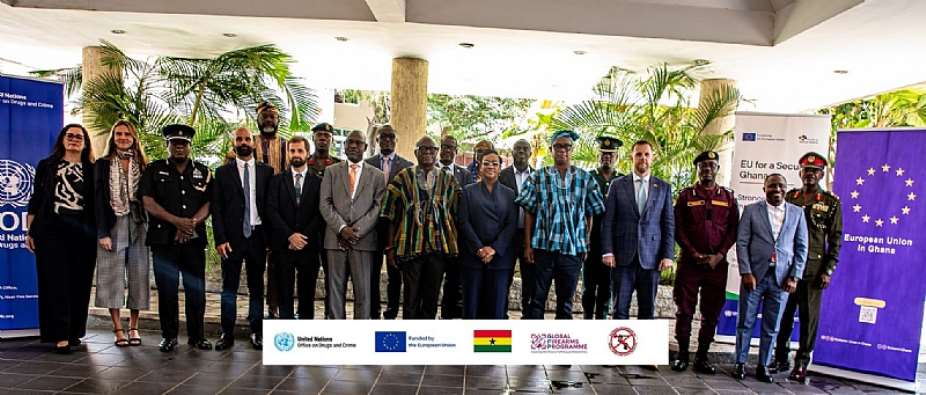
The Deputy Minister for the Interior, Mr Ebenezer Okletey Terlabi, has launched the “EU for a Secure Ghana” Project, an initiative aimed at strengthening Ghana’s capacity to prevent and respond to violent extremism, terrorism, transnational organised crime and the illicit trafficking of small arms and light weapons.
The project, which seeks to reinforce Ghana’s national security and crime-prevention mechanisms, was launched alongside a two-day national training workshop on the revised United Nations Illicit Arms Flows Questionnaire (UNIAFQ).
The workshop was organised by the United Nations Office on Drugs and Crime (UNODC) in collaboration with the National Commission on Small Arms and Light Weapons (NACSA).
Speaking at the launch on Wednesday, Mr Terlabi said the project’s objectives were closely aligned with Ghana’s security priorities, particularly the need to strengthen the country’s response to violent extremism, terrorism and transnational organised crime.
He said the initiative would contribute to building stronger institutions and communities capable of preventing security threats while ensuring that responses were grounded in the rule of law and respect for human rights.
According to the Deputy Minister, the project would focus on three key outcomes.
These include strengthening the capacity of state institutions to counter violent extremism and terrorism while upholding the rule of law and human rights; enhancing the capacity of state institutions to combat transnational organised crime, particularly the trafficking of small arms and light weapons; and strengthening the ability of civil society organisations, local communities and vulnerable groups to contribute to security and conflict-prevention efforts.
Mr Terlabi said the Government recognised that addressing emerging security threats required strong institutions, effective coordination and active participation from communities and other stakeholders.
He commended the European Union and other development partners for their continued support towards strengthening Ghana’s law-enforcement capabilities, institutional accountability, human rights protection, community resilience and firearms control.
He said such partnerships were important in helping Ghana build sustainable systems to address both traditional and emerging threats to national security.
The Executive Secretary of NACSA, Dr Adam Bonaa, stressed the importance of strengthening Ghana’s security systems and ensuring that the country remained proactive in addressing potential threats.
He said the initiative would help reinforce national systems for data collection and reporting, which were critical to evidence-based decision-making and effective security planning.
Dr Bonaa cautioned that Ghana should not take its peace and security for granted, stressing the need for continuous investment in institutions, systems and partnerships that could help prevent security threats before they escalate.
The UNIAFQ is designed to support countries in collecting and reporting information on illicit firearms and ammunition flows, thereby contributing to a better understanding of the trafficking of small arms and light weapons.
 Ibrahim Mahama took me abroad for surgery after Lordina’s intervention – Dzokoto
 President Mahama to Walk the Runway on November 7
 Heavy fighting, internet disruption as Ethiopia conflict rages
 Saudi reports fresh Houthi attacks as France pledges to defend key oil port
 Israel must win 'because we’ve got no other choice’, PM Netanyahu tells UN
 Mahama reiterates Ghana's commitment to two-state solution to Palestine-Israel c...
 Ablakwa calls for Return of African Artefacts held abroad
 Madina MP Francis-Xavier Sosu reportedly collapses while speaking at GIMPA
 Kumasi drivers, passengers react to 8% transport fare increase
 Mahama petitioned to halt Sentuo Airport Garden City construction after sod cutt...


