




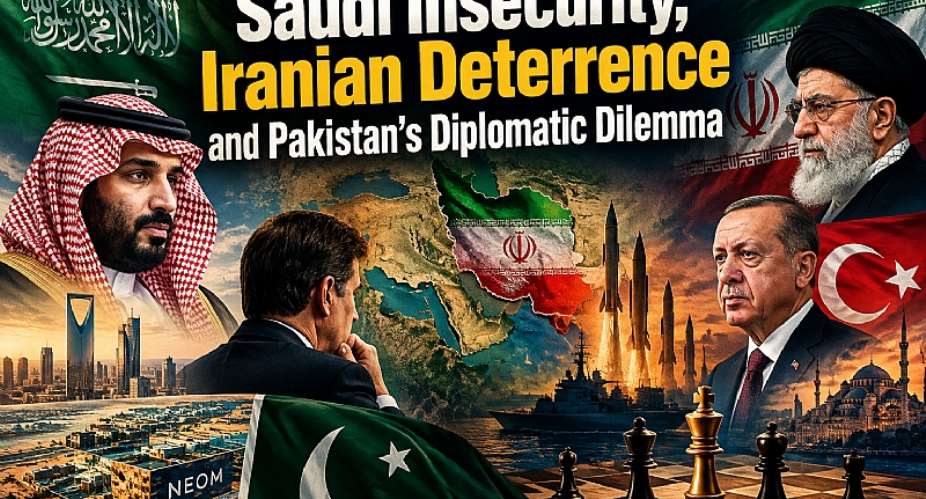
There are no permanent friends on a battlefield; survival itself becomes the mission. In international relations, therefore, no state can afford to rely completely on a single partner. Long-term friends can become competitors, while former rivals can sometimes discover limited areas of strategic convergence. This is precisely the changing character of Saudi-Türkiye relations, which have moved beyond some of their earlier rigidities toward greater diplomatic coordination. The question now is whether this emerging alignment represents genuine strategic coherence or simply a response to a rapidly changing security environment.
Saudi Arabia is the economically powerful player at the table. Vision 2030, artificial-intelligence programmes, technological investment and the ambitious NEOM project demonstrate Riyadh's effort to transform itself beyond dependence on hydrocarbons. Yet economic transformation requires security. The escalation of regional conflict has exposed the vulnerability of Gulf infrastructure and energy routes to missiles, drones and attacks originating from regional conflicts. The continuing Houthi threat has therefore created a difficult equation for Crown Prince Mohammed bin Salman: how can Riyadh protect its economic transformation while avoiding permanent dependence on external military powers?
This is where the Makkah Joint Defence Agreement enters the strategic equation. Saudi Arabia, Pakistan and Türkiye signed the agreement on August 7, declaring that an armed attack against one would be regarded as an attack against all. The three states subsequently moved to institutionalise the arrangement, including a planned secretariat in Saudi Arabia and greater defence-industrial and technological cooperation. But a crucial question remains: Can a diplomatic deterrence framework automatically become an operational military guarantee? The answer depends not merely on declarations, but on political decisions, military coordination, intelligence-sharing, logistics and the circumstances of any future crisis.
The Iranian factor makes this equation even more complicated. Riyadh has pursued economic diversification and technological development, while Tehran has placed considerable emphasis on indigenous military capabilities, missiles and drones. These represent different approaches to national resilience. Yet military pressure against Gulf states can disrupt the very economic transformation that Saudi Arabia is attempting to protect. Pakistan consequently occupies an unusually sensitive position: it has deep strategic relations with Saudi Arabia while simultaneously sharing a border and long-standing diplomatic relationship with Iran.
This explains why Pakistan-Iran relations cannot simply be reduced to the logic of confrontation. Both countries understand the geographical and economic cost of sustained hostility. Pakistan has repeatedly sought mechanisms for maintaining communication with Tehran even while strengthening its strategic relationship with Riyadh. The question, therefore, is not whether Pakistan must choose between Iran and Saudi Arabia, but whether Islamabad can preserve diplomatic space with Iran while honouring its commitments to Saudi Arabia under the Makkah framework.
For Riyadh, this is the real strategic dilemma. If Iran's military expansion is viewed as a security challenge, how much additional military responsibility is Saudi Arabia prepared to place upon Pakistan and Türkiye? And if Pakistan's deterrence capability is welcomed by Riyadh, does that necessarily mean Islamabad should participate in every confrontation involving Iran? These are fundamentally different questions, and confusing them could transform a defensive agreement into an instrument of escalation.
Where, then, does Türkiye enter this chessboard?
President Recep Tayyip Erdoğan has increasingly positioned Türkiye as an autonomous regional actor while maintaining its NATO membership and broader Western relationships. Ankara's security concerns regarding Israel, Syria and the wider Middle East have encouraged it to seek greater regional influence without completely abandoning its Western strategic connections. Saudi Arabia has similarly attempted to diversify its security relationships. Their convergence with Pakistan therefore reflects a common desire for greater regional strategic autonomy rather than a simple military bloc against one particular country. Turkish officials have explicitly described the Makkah agreement as defensive and not directed against Iran or any other state.
Yet the most important test is still ahead. The Makkah pact can strengthen deterrence only if its members maintain clarity about its limits. Recent statements by Saudi Arabia, Türkiye and Pakistan have simultaneously emphasised Saudi Arabia's right to defend itself and the importance of dialogue and diplomacy. That dual message may be the most sustainable interpretation of the agreement.
The strategic lesson for Pakistan is therefore straightforward but difficult: deterrence must not eliminate diplomacy. Islamabad can deepen defence cooperation with Riyadh and Ankara while preserving channels with Tehran. Saudi Arabia can strengthen its security without making every regional dispute a military confrontation. Türkiye can expand its regional role without turning the Makkah framework into an anti-Iran or anti-Israel alliance.
The ultimate question is not whether Makkah can deter Tehran. It is whether Makkah can create enough strategic balance to prevent another war. That distinction may determine whether this new regional arrangement becomes a platform for stability—or another layer in the region's already crowded architecture of confrontation.


 Israel must win 'because we’ve got no other choice’, PM Netanyahu tells UN
 Mahama reiterates Ghana's commitment to two-state solution to Palestine-Israel c...
 Ablakwa calls for Return of African Artefacts held abroad
 Madina MP Francis-Xavier Sosu reportedly collapses while speaking at GIMPA
 Kumasi drivers, passengers react to 8% transport fare increase
 I will unite Africa, Caribbean and Latin America into world's biggest trading bl...
 Mahama petitioned to halt Sentuo Airport Garden City construction after sod cutt...
 Government should not fund the $4 billion Accra-Kumasi Expressway project — Alan
 Democracy must deliver tangible social benefits to citizens – Mahama
 Court to rule on bail applications of six accused in 3.9-tonne cocaine seized in...


