




Theme of the 81st Session of UNGA
The theme of the 81st Session of the United Nations General Assembly (UNGA 81) reads:
"Restoring Trust, Managing Transformation: A United Nations That Delivers For All".
this points to a question that has haunted the world since 1945.
The UNGA 81st Session, running from 22-28 September 2026, has re-asked the question in plain language:
"Can the UN be truly international when Africa - home to 54 states, 1.4 billion people, one fifth of humanity and the majority of the Security Council agenda - has no permanent seat?"
For a just, equitable and truly United Nations, the achievement of African voice at the high table is a must.
Structural Injustice
The structural injustice is clear: When the United Nations (UN) was founded in 1945, most of Africa was under colonial rule. Today, 81 years later, the same system continues as if Africa is still under colonial dispensation. Sixty percent (60%) of Security Council issues concern Africa and nearly seventy percent (70%) of United Nations (UN) peacekeeping forces are deployed in Africa, yet Africa has no veto and no permanent seat to decide where those helmets go.
Africa Is Weary of an International System Accepting Rhetorically But Resisting Institutionally
Africa is concerned about a global trend whereby the international system has become adept at applauding Africa in the General Assembly, but skilled at blocking Africa in the Security Council - absorbing African demands rhetorically whilst resisting them institutionally.
The African Union (AU) has submitted its own reform model under the Common African Position, reviving the Ezulwini Consensus. The demand is precise: no less than two permanent seats with veto power and five non-permanent seats for Africa. The AU has already resolved the selection question - the continent nominates, not the P5. This is not sentiment; it is arithmetic. Africa contributes twenty- eight percent (28%) of UN membership but zero percent (0%) of permanent decision-making.
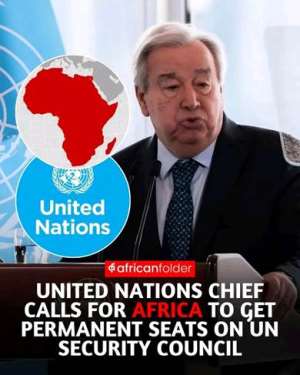
Even UN Secretary-General António Guterres, in his final address at UNGA 81, admitted:
"A 21st-century Security Council without permanent African representation is unjust and indefensible".
UNGA President Khalilur Rahman echoed him:
"Africa needs a seat at the table, not to be on the menu".
Why Amplified African Voices Cannot Continue to Be Ignored?
Why does Africa remain on the menu, not at the table? This is why voices from the length and breadth of Africa converged in New York to say - enough. As William Ruto, President of Kenya argued:
"You cannot claim to be the United Nations while disregarding the voice of 54 nations".
As Duma Boko of Botswana declared:
"We have to break into that organization and claim our seat at the head of the table, not just a seat at the table".
And as Tanzania's Vice President Deogratius Ndejembi, representing President Samia Suluhu Hassan, reminded the Assembly while announcing Tanzania's candidacy for the 2029-2030 Security Council term:
"... Africa will not wait for permanent reform to participate; it will occupy every available space.."
Addressing the Sceptics
Sceptics of UN Security Council reform, including some in the Permanent Five (P5), argue that adding more permanent members - especially with veto - will make an already paralyzed Council even more unworkable, citing the collapse of the historic League of Nations,1919-1939. Yet the League collapsed precisely because great powers refused to share power equitably, not because they shared it too widely. Others ask which African state would occupy the seat without deepening continental rivalries between Nigeria, South Africa, Egypt and others. These concerns are legitimate, but they cannot justify the status quo. Paralysis is not caused by too many voices, but by too few with unchecked power. No one is asking the P5 to surrender power out of charity, but out of self-preservation: a Council seen as a colonial relic in a majority-world century will not be obeyed.
Conclusion
Africa is no longer waiting quietly - it is building its case, one summit at a time, and demanding that the architecture of global governance be changed. The real test now set by the 81st Session of UNGA is whether trust can be restored without power being redistributed. As long as Africa remains the object of Security Council deliberations and not the subject authoring them, the UN cannot deliver for all. The question for Washington, Moscow, Beijing, Paris and London is no longer whether Africa deserves a seat, but whether a Council without Africa can still claim to speak for the world.
Madondo (African Teacher) [email protected]_

 Israel must win 'because we’ve got no other choice’, PM Netanyahu tells UN
 Mahama reiterates Ghana's commitment to two-state solution to Palestine-Israel c...
 Ablakwa calls for Return of African Artefacts held abroad
 Madina MP Francis-Xavier Sosu reportedly collapses while speaking at GIMPA
 Kumasi drivers, passengers react to 8% transport fare increase
 I will unite Africa, Caribbean and Latin America into world's biggest trading bl...
 Mahama petitioned to halt Sentuo Airport Garden City construction after sod cutt...
 Government should not fund the $4 billion Accra-Kumasi Expressway project — Alan
 Democracy must deliver tangible social benefits to citizens – Mahama
 Court to rule on bail applications of six accused in 3.9-tonne cocaine seized in...


