




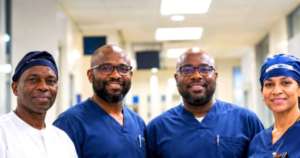
On Saturday, 19 September 2026, a surgeon in Ogun State removed a cancerous kidney from a patient in Abuja using a robotic system he controlled remotely.
The hospitals involved describe it as the first tele-robotic surgery in Nigeria and West Africa, a claim made by the organisers that I could not independently verify.
What happened
The operation was a robot-assisted right radical nephrectomy, carried out through a collaboration between Redeemer's Health Village (RHV), RoboMed Global and Nisa Premier Hospital.
The patient stayed at Nisa Premier in Abuja while the surgeon worked from RHV, about 500 kilometres away. The procedure ran in real time from a Toumai console. It lasted about three hours, and the hospital said the patient was discharged afterwards.
Reports name the operating surgeon as Professor Obi Davies-Ekwenna, a transplant and urologic surgeon and professor at the University of Toledo College of Medicine and Life Sciences.
Other outlets spell the name Ekwenna-Davis, and one says he co-founded RoboMed Global.
A Nigerian hospital, a US-linked robotics firm and a diaspora specialist made this possible together.
The connectivity question
Telesurgery depends on a reliable link. Reports say Starlink carried the connection, with MTN as backup, because the surgeon's commands had to reach the robot in Abuja in real time.
RHV's chief executive acknowledged that connectivity remains a challenge, and that weather, equipment quality and trained personnel can affect reliability.
That honesty is welcome. The same links that made this demonstration possible are the ones that fail during a storm or power cut.
Why it matters
The promise is about distance. RHV's CEO said the initiative shows how modern technology can widen access to specialised treatment and help reduce medical tourism.
Specialists are concentrated in a few big cities, and patients elsewhere often travel far or go abroad. Remote surgery could in theory bring expertise to them. RHV's leadership also says the goal is a sustainable system, not a one-off demonstration.
What remains unanswered
Several questions are still open, and none has been answered publicly:
Cost and access. RHV is a private hospital built by a church. Nothing in the reports says what such surgery costs or who will be able to afford it.
Safety and regulation.
Who is accountable if the connection drops mid-operation? What backup protocols exist, and which regulators oversee remote practice across state lines? Local capacity.
Who maintains the robots, and how many Nigerian surgeons are being trained to use them? One report says robotic surgery reached Nigeria only in late 2025, so the workforce is young.
Scale.
This was a single case. A capability means many cases, routinely, in places where the specialist is not.
A West African lens
Other countries in the region, Ghana included, should watch this closely, and the lessons cut both ways. Telesurgery can extend scarce expertise, but it also depends on power, bandwidth, biomedical engineers and clear rules.
Ghana's health planners should ask whether those foundations exist before buying machines, and whether regional arrangements, such as shared training and cross-border regulatory standards, could spread the cost.
Robots do not replace surgeons, nurses and anaesthetists at the patient's bedside. The remote surgeon still needs a skilled local team beside the patient.
The bottom line
Nigeria has shown that a remote operation can work across a long distance. The harder work is turning a milestone into a service that ordinary patients, in ordinary hospitals, can use safely and affordably. As the organisers themselves suggest, the real story is what happens next.
Mustapha Bature Sallama
Medical/ Science Communicator,
Private Investigator, Criminal Investigation and Intelligence Analysis,
International Conflict Management and Peacebuilding. (USIP)
[email protected]
+233555275880
Sources
Leadership, "Nigeria Records 1st Tele-Robotic Surgery As Surgeon Operates On Abuja Patient From Ogun" (leadership.ng)
News Agency of Nigeria, "Nigeria Records First Tele-robotic Surgery In West Africa" (nannews.ng)
BellaNaija, "Nigeria's First Tele-Robotic Surgery Successfully Performed at Redeemer's Health Village" (bellanaija.com), 23 September 2026
Pulse Nigeria, "Surgeon in Ogun remotely removes cancerous kidney from patient in Abuja" (pulse.ng)
Daily Trust, "Nigeria records first tele-robotic surgery in West Africa" (dailytrust.com)
NewsClickNG, "Redeemer's Health Village performs Nigeria's first tele-robotic surgery" (newsclickng.com)
Dockaysworld, "Nigeria makes history with first remote robotic surgery" (dockaysworld.com.ng)
Mojidelano, "Nigeria Just Recorded Its First Tele-Robotic Surgery" (mojidelano.com)

 Alagumgube welcomes Gurene as BECE subject, calls for more teachers and learning...
 Mahama calls for return of Africa’s cultural heritage at UNGA 81 side event
 ECOWAS directors meet in Lagos to align 2027–2029 expenditure plans
 Lordina Mahama urges African leaders to build stronger healthcare systems for wo...
 Speaker Bagbin summons Parliament for September 29 sitting
 Kwesi Pratt warns against abuse of free expression amid Ghana Jollof controversy
 PURC keeps electricity, water tariffs unchanged for fourth quarter
 EOCO heads must be removed over ‘abusive conduct’ – Bobby Banson
 GES transfers funds for SHS 1 perishables, recurring items
 Putin using citizens from 47 countries to fight Ukraine, Zelensky tells UN


