




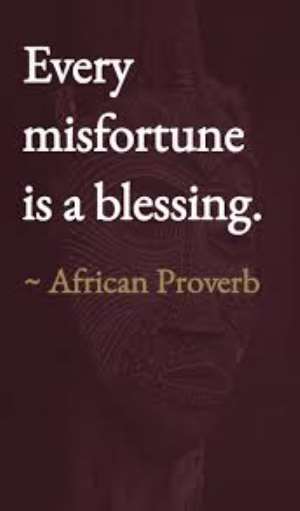
There was once a powerful soothsayer in Kumbungu. People came from far and near to consult him. Some travelled long distances. Others came secretly, hoping to ask questions they were afraid to ask anybody else. He had acquired a reputation that made people whisper his name with a mixture of fear, admiration and wonder. “He hardly gets it wrong,” they said. If he predicted something and it did not happen, people had an explanation ready. “Perhaps the time is not yet ripe.” If he told a farmer that something would happen and it happened months later, the farmer returned to tell everyone: “The man saw it long ago!” The more people talked about him, the more powerful his reputation became.
And then one day, a man from Savelugu went to consult him. The man sat before him. The soothsayer studied him for a while. Then he asked: “Is your wife seriously ill?” The man was surprised. “No,” he answered. “My wife is perfectly well. In fact, she left home this morning to go to the market to sell her wares before I set off for Kumbungu.” The soothsayer nodded. “If your wife were sick,” he said, “I would have shown you the herbs that could help her.” The man thanked him and left. But something about the conversation disturbed him. As soon as he got outside, he took out his phone and called his wife. “How are you?” “I am fine,” she replied. “I am at the market.” He breathed a sigh of relief. The soothsayer had been wrong. Or so he thought.
The man returned to say goodbye. The soothsayer looked at him and said: “When you come to Kumbungu again, you will hear about somebody's death at the lorry station.” The man left. Perhaps he dismissed it as another strange prediction. Perhaps he wondered who the dead person would be. Perhaps, like many of us, he carried the words with him but did not think much about them.
He returned to Savelugu. That night, however, something happened. His wife suddenly collapsed. There was panic. Neighbours rushed in. Someone shouted for a vehicle. Another person ran to call relatives. She was taken to the hospital.
By morning, her condition had deteriorated. The man sat beside her bed, frightened and helpless. Then he remembered the soothsayer. “If your wife were sick, I would have shown you the herbs.” Could this be what the man had seen? Was this what he had been talking about? Was the illness the reason he had asked about his wife? The man's heart began to pound. Perhaps the herbs could save her.
He decided to return. He travelled back to Kumbungu the following day. But when he arrived at the lorry station, something immediately caught his attention. A hearse. A crowd. People moving slowly towards the cemetery. He approached somebody. “Who has died?” The answer froze him. “The soothsayer.” He stood there speechless. The man who was supposed to tell him about his wife's illness had died. The man who was supposed to know what was coming could not see his own death.
The man who had told him that he would hear about someone's death at the lorry station had unknowingly predicted the news of his own death. But the story did not end there.
While he stood there trying to make sense of what had happened, his phone rang. It was the hospital in Savelugu. His wife had died. He could not move. The two deaths collided inside his mind. The wife whose illness the soothsayer seemed to have perceived was now dead. The soothsayer who appeared to know the future was also dead. And the man stood between the two tragedies, wondering what to believe.
Life, sometimes, can leave us without words. He began to cross the road absent-mindedly. A tricycle came suddenly. There was a crash. He fell. People screamed. He was rushed to Kumbungu Hospital. And there he lay. The soothsayer had not seen this either. Perhaps that is one of life's greatest mysteries. We sometimes think we know the future because we have seen a small piece of it. But only God knows the whole road.
They Have Eyes, but They Cannot See
There is a profound lesson in the story of the Hijrah of the Prophet Muhammad (pbuh). When the Prophet and his companion Abu Bakr fled Makkah, they sought refuge in a cave. Their pursuers came close. Very close. The enemies stood at the mouth of the cave. According to the well-known Islamic account, God protected His Messenger and his companion. A spider's web was at the entrance, and a bird's nest with eggs was also associated with the concealment of the cave. The pursuers could not imagine that the Prophet and his companion could be inside. While the two were in the cave, the Prophet told his companion: “Do not grieve; indeed Allah is with us.” The pursuers had eyes. But they did not see. They were standing close enough to the cave to discover the people they were looking for. Yet God prevented them from seeing what was before them.
And therein lies a lesson for every generation: Seeing is not always knowing. A person can have eyes and still fail to see. A person can have intelligence and still misunderstand what is happening. A person can have information and still get the future completely wrong. A person can predict tomorrow and yet be unable to predict what will happen to him before sunset. The unseen belongs to God. That is why we should be careful about those who claim complete knowledge of tomorrow.
We Are Always Trying to See Tomorrow
The young person is especially vulnerable to this temptation. At 20 to 30, we want to know: Will I become rich? Will I marry the person I love? Will I travel abroad? Will I get the job? Will my business succeed? Will I become famous? Will I ever own a house? Will my friends remain my friends? Will my parents live long enough to see me succeed? We desperately want answers. So when somebody appears to know the future, we listen.
But life has a strange way of teaching us that tomorrow is a territory no human being completely owns. There are things we plan for that never happen. And there are things we never planned for that completely change our lives. Sometimes the door we spend years trying to open is the very door God is preventing us from entering. Sometimes the door that closes in our face is the door that saves us. We simply do not know.
Joseph’s Well Was Not the End of His Story
Consider Joseph in the Bible. His story is one of the most beautiful lessons in patience and divine planning. His brothers envied him. They plotted against him. They took him away and threw him into a well. Imagine that. A young man suddenly separated from his family and abandoned in a dark pit. If Joseph had been standing at the bottom of that well, what would he have thought? “My life is finished.” “My brothers have destroyed me.” “Why me?” “I have done nothing wrong.” Yet the well was not his destination. It was a painful road towards his destination. He was eventually rescued. But then he was sold into slavery. Another disappointment. Another humiliation. Another apparent step backwards.
Then came another trial. He was imprisoned. If someone had told Joseph while he was sitting in prison that one day he would become a powerful minister in Egypt, would he have believed it? Perhaps. But he could not see the road between the prison and the palace. That road was hidden from him. The well was part of the road. Slavery was part of the road. The accusation was part of the road. The prison was part of the road. And eventually, the palace was part of the road. What looked like a series of disasters was actually a journey towards destiny. That is why you should be careful before calling something the end of your life. You may only be standing at the beginning of a chapter whose final page you have not yet read.
The Medicine You Do Not Like May Be the Medicine You Need
There is another lesson hidden in ordinary life. Sometimes healing comes in an unpleasant form. The medicine is bitter. The injection hurts. The operation frightens us. The exercise is painful. The doctor tells us to stop eating the food we love. At the time, we may ask: “Why must I go through this?” But we understand later. The bitterness was not necessarily punishment. It was part of the healing. Life is like that. Some experiences taste bitter while they are happening. Only later do we understand their purpose.
The Girl Who Rejected You
Young man, perhaps you once loved a girl desperately. You thought she was the only woman in the world. You prayed to have her all to yourself. You wrote poems for her. You spent money you did not have trying to impress her. And then she said:
“No.” Your heart broke. You thought your world had ended. You walked around wondering why God had allowed it to happen. Years later, you may look back and smile. Perhaps she was not the person you thought she was. Perhaps her character was different from what you imagined. Perhaps the marriage would have brought you years of sorrow. Perhaps you needed to meet somebody else. Or perhaps the lesson was simply that not every desire is a destiny. A rejection can sometimes be protection. The problem is that we usually discover this only after the tears have dried.
The Job You Did Not Get
Perhaps you applied for a job. You were qualified. You expected to be selected. Someone else got it. You were angry. You were disappointed. You complained. You asked: “Why didn't they choose me?” You did not know that three months later the company would collapse. Or that another opportunity would appear. Or that the job would have taken you away from the business you eventually built. Or that the person who got the job would spend ten unhappy years there. You saw the closed door. You did not see what was behind the next door. That is the problem with human beings. We judge life from one page while God knows the entire book.
The Man Who Promised and Failed
Sometimes somebody promises to marry you and disappears. Sometimes a friend promises to help and never comes. Sometimes someone promises you a job and keeps postponing it. Sometimes a person gives you hope only to disappoint you. It hurts. But disappointment can reveal character. The person who continually promises and never delivers may be teaching you something more valuable than the promise itself. He may be showing you that he is not dependable. She may be showing you that she is not the person you imagined. Not every person who leaves your life is a loss. Some departures are lessons. Some disappointments are warnings. Some closed doors are mercies.
But Do Not Turn Patience into Passivity
There is another lesson the young must learn. Trusting God does not mean sitting down and doing nothing. Joseph did not remain in the well and say: “God will take care of everything.” He endured. He acted when opportunities came. He interpreted the king's dream. He demonstrated his wisdom. He accepted responsibility. He prepared for famine. He worked. He persevered. Prayer does not replace effort. Faith does not cancel responsibility.
You pray, and you work. You hope, and you prepare. You trust God, and you do your part. Sometimes the answer to your prayer is not an immediate miracle. Sometimes the answer is the strength to survive another day. Sometimes it is an unexpected person. Sometimes it is a closed door. Sometimes it is patience. Sometimes it is an opportunity disguised as hardship. And sometimes the answer comes years later.
The Danger of Thinking We Know Everything
The story of the Kumbungu soothsayer leaves us with an uncomfortable question. How could a man appear to know what was happening to somebody else's wife, yet fail to see his own death? Perhaps the answer lies in something much bigger than the story itself. Human beings are limited. We see fragments. We hear fragments. We interpret fragments. Sometimes our interpretations turn out to be remarkably accurate. But accuracy in some matters is not ownership of the unseen.
The scriptures reminds us that knowledge of the unseen belongs ultimately to God. That should make us humble. It should also make us cautious. Do not surrender your life to somebody simply because he claims to know your tomorrow. Do not allow a pastor, mallam (corrupted form of Mualim --- teacher), fetish-priest, soothsayer, seer, clairvoyant, fortune teller or anybody else to frighten you into believing that your destiny is in his hands. Your future is not a commodity somebody can sell to you. And your life is not a script another human being can read with absolute certainty.
Young Man, Young Woman --- Wait!
There will be moments when you will not understand your life. Wait. There will be days when everybody seems to be moving ahead while you remain behind. Wait. Your classmates may be getting married while you are still single. Wait. Your friends may be buying cars while you are struggling to pay rent. Wait. Someone younger than you may become a manager while you remain an ordinary worker. Wait. You may apply for ten jobs and receive ten rejection letters. Wait.
You may start a business and watch it collapse. Learn. You may love somebody who does not love you. Heal. You may trust somebody who betrays you. Forgive, but learn. You may pray for something for years and receive no immediate answer. Keep praying. Not every delay is denial. Sometimes delay is preparation. Sometimes delay is protection. Sometimes delay is redirection. And sometimes we simply do not know why. That is where faith begins.
The Soothsayer Could Not See His Own End
The most haunting part of the Kumbungu story remains this: The man who told another person that he would hear of someone's death at the lorry station eventually became the dead man whose death was announced there. He seemed to see another person's future. But he could not see his own. The man who went looking for herbs returned to find that the person who might have given him the herbs was dead. His wife died. He was knocked down. Three lives were suddenly caught in a chain of events that nobody in that story could have fully understood beforehand. And perhaps that is the lesson.
There is a future that no human eye can completely see. So do not destroy your present because you are frightened of your future. Do not despair because today is painful. Do not conclude that your life is finished because one door has closed. Do not envy another person's journey because you do not know the price they paid to arrive there. And do not curse every difficult season. The well may be taking you somewhere. The prison may be preparing you for something. The rejection may be protecting you. The bitter medicine may be healing you. The failed business may be teaching you. The broken friendship may be revealing something. The delayed marriage may be saving you. The lost job may be redirecting you. And the disappointment that makes you cry today may become the story you tell tomorrow with gratitude.
We See the Storm; God sees the Shore
When the storm comes, the young often ask: “Why me?” Perhaps a better question is: “What can I learn from this?” And then: “What should I do next?” Pray. Work. Wait. Persevere. Try again. Ask for help. Learn from your mistakes. Keep your heart clean. And leave the unseen to God Almighty.
Because the human being sees the road immediately ahead. God sees the destination. Joseph saw a well. God saw a minister. Joseph saw prison. God saw a palace. The pursuers saw a cave. God saw safety. The rejected young man sees heartbreak. God sees protection. The unemployed graduate sees a closed door. God sees another entrance. The old man sees the end of one chapter. God still has another page to write. That is why, when life does not go according to your plans, do not be too quick to conclude that God has abandoned you. Sometimes what looks like a detour is the road. Sometimes what looks like a loss is protection. Sometimes what looks like an ending is preparation. And sometimes, the greatest blessing in your life is hidden inside the very thing you are asking God to remove. Be patient. Pray. Persevere. Do your part. And trust the One who sees what you cannot see. For we may have eyes, but we do not see the whole story.
[PS: I am saddened today by news that two people committed suicide in Tamale. Imagine a parent hanging himself because he could not afford GHc6,000 to pay the school fees of his child!?!]
FUSEINI ABDULAI BRAIMAH
+233208282575 / +233550558008
[email protected]


 Israel must win 'because we’ve got no other choice’, PM Netanyahu tells UN
 Mahama reiterates Ghana's commitment to two-state solution to Palestine-Israel c...
 Ablakwa calls for Return of African Artefacts held abroad
 Madina MP Francis-Xavier Sosu reportedly collapses while speaking at GIMPA
 Kumasi drivers, passengers react to 8% transport fare increase
 I will unite Africa, Caribbean and Latin America into world's biggest trading bl...
 Mahama petitioned to halt Sentuo Airport Garden City construction after sod cutt...
 Government should not fund the $4 billion Accra-Kumasi Expressway project — Alan
 Democracy must deliver tangible social benefits to citizens – Mahama
 Court to rule on bail applications of six accused in 3.9-tonne cocaine seized in...


