




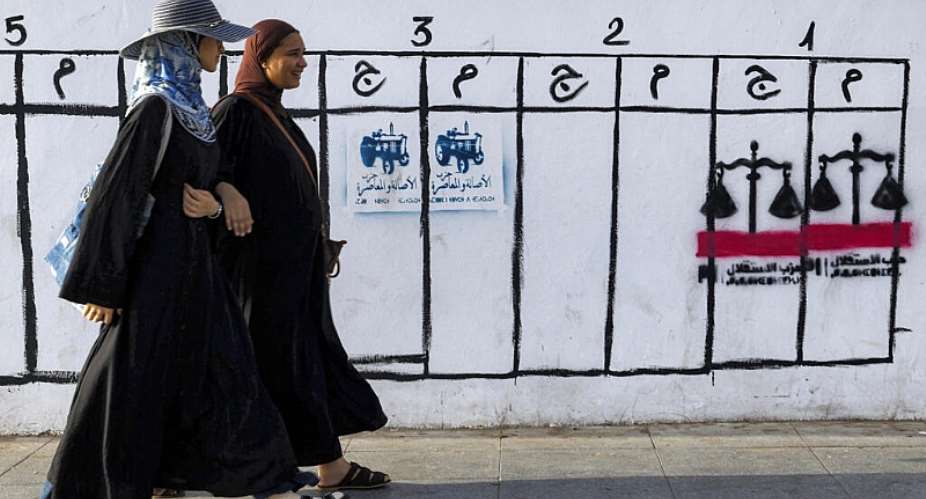
Nearly 15.8 million people are registered to elect the 395 members of the House of Representatives, Morocco's lower house of parliament.
But the most striking figure is the one concerning those not taking part: Moroccans aged 18 to 24 make up 12 percent of the population, but account for just 4 percent of registered voters.
Wednesday's election is the first since the Gen Z-led protest movement brought young people on to the streets last year, demanding employment opportunities and better access to healthcare and education and expressing their frustration over the cost of living.
Those frustrations were back in the spotlight in July, when large numbers of young Moroccans attempted to cross the border into the Spanish enclave of Ceuta in search of opportunities in Europe.
Morocco Gen Z protests enter sixth day with calls to oust government
Job creation lagging
For political parties, reconnecting with this generation has become one of the central challenges of the election campaign.
While some young Moroccans see voting as a way to press for change, others say they have little confidence the results of an election will improve their daily lives.
Morocco's economy grew by an estimated 4.9 percent in 2025 – its strongest performance in a decade – and the World Bank expects growth of around 4.2 percent this year.
The country has expanded its automotive and aeronautics industries, developed the Tanger Med port into a major international shipping hub and is extending its high-speed rail network.
However, job creation has struggled to keep pace. Official figures put unemployment at 13 percent in 2025 – rising to 37 percent among people aged 15 to 24, and 19 percent among graduates.
Morocco sets stage for 2030 World Cup with Spain and Portugal
World Cup investment
The incoming government will also take office at a crucial moment for Morocco's wider development plans.
The country is investing heavily in transport, stadiums and other infrastructure before co-hosting the 2030 football World Cup with Spain and Portugal.
Those projects are helping drive economic growth, but the election campaign has also highlighted demands for this investment to translate more directly into jobs, higher incomes and improved local services.
This is particularly important outside Morocco's major cities, where access to schools, hospitals and transport can remain limited.
While the election will determine which party leads the next government, political power in Morocco is divided between its elected institutions and the monarchy.
Under the constitution, King Mohammed VI appoints the head of government from the party that wins the most seats in the House of Representatives. The king also retains broad authority over areas including foreign policy, national security and major strategic decisions.
The outgoing coalition is made up of the National Rally of Independents, the Authenticity and Modernity Party and the Istiqlal Party. The opposition Justice and Development Party is also contesting the election.
(with newswires)

 Mahama asks MFWA, GJA to lead national dialogue on hate speech
 Teenage pregnancy: Parents ‘too busy’ to notice warning signs – Protect Our Futu...
 NPP intelligence points to cocaine manufacturing in Ghana – Baffour Awuah
 NPP's Obiri Boahen sues two Tiktokers over alleged defamation
 Ghanaian Pastor Rev Emmanuel Boakye-Danquah on the run over alleged counterfeit ...
 Sammy Crabbe reveals why most NPP members moved to NDC and became star performer...
 Ghana, Trinidad and Tobago sign air services agreement
 Finance Ministry to write off about US$120m of TOR’s legacy debt
 High profile busts must go with high profile prosecution – Rev Ntim Fordjour
 Ghana Maritime Authority dismisses claims of ineffective vessel monitoring in Gh...


