




Glenda and Karen have spent more than a year trying to find their brothers, Elmer Concepcion Romero Janes and Kevin Rolando Barrera Torres. RFI met the two women in El Salvador, where their search has taken them from government offices to prisons, with few answers.
“My brother has disappeared. He has been held for more than a year without any legal process. We would like proof that he is all right, because we can't go on living with this uncertainty,” Glenda told RFI.
Elmer and Kevin were among a group of Salvadorans flown from the US to El Salvador on military flights between March and April 2025. On the same flights were 252 Venezuelans, who were sent not to their own country but to El Salvador. Both governments described those deported as dangerous criminals.
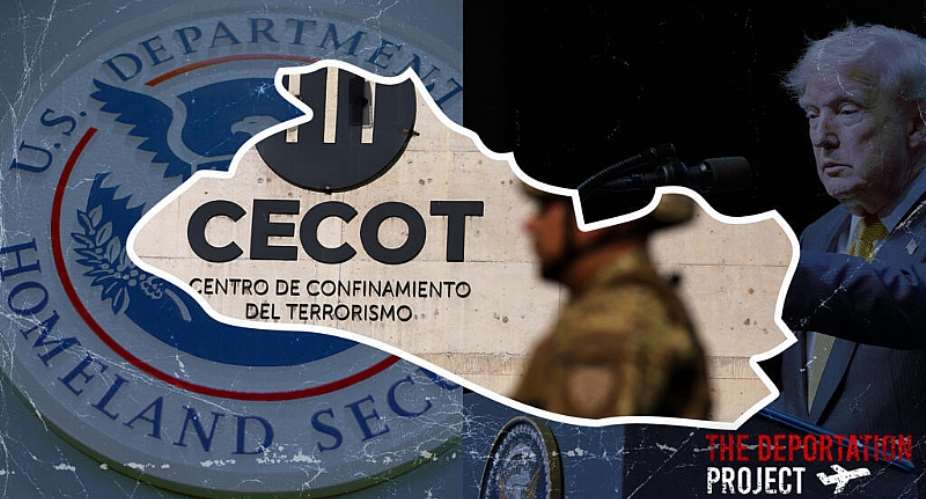
The detainees were taken to Cecot, a high-security prison built as part of Bukele's crackdown on the country's maras – powerful street gangs that have long controlled territory and been blamed for widespread violence in El Salvador. They were held without contact with the outside world, access to lawyers or a legal process.
Inside the US system deporting migrants through African countries
Four months later, the Venezuelans were sent home. The Salvadorans remained in detention.
Rights groups later established that 36 Salvadorans had been on the flights, although neither government had initially said how many there were. Families have since identified 11 of the men.
Finding out where they were being held was much harder. Glenda recognised Elmer in footage released by the Salvadoran government showing the deportees arriving. Karen said prosecutors confirmed that Kevin had arrived on the first flight in March, but refused to show her the document proving it because it was confidential.
“He was deported more than a year ago and, to this day, nobody has been willing to tell us where he is. For us, this is an enforced disappearance,” Karen told RFI.
The UN uses the term enforced disappearance when someone is detained with the involvement of the state, but the authorities then refuse to acknowledge it or say what has happened to the person or where they are being held. Karen and her mother have spent more than a year searching for Kevin Rolando Barrera Torres. Karen established that her brother was among 36 Salvadorans deported from the US between March and April 2025.
A secret pact
Bukele has ruled El Salvador under a state of exception since 2022, an emergency measure that suspends some normal legal protections. Introduced as part of his campaign against the country's gangs, it gives the authorities sweeping powers to arrest and detain people, including holding them without access to a lawyer or judge.
In the US, Trump returned to the White House in January 2025 promising “the largest deportation campaign in US history”. The scale of that campaign is documented by The Deportation Project, which found that more than 25,000 people have since been deported from the US to countries other than their own.
Within weeks of Trump's return, Washington and San Salvador announced a migration agreement, but did not make its terms public.
Under the arrangement, Bukele offered to imprison people deported by the US who were accused of belonging to gangs including Tren de Aragua and MS-13. The offer also extended to US citizens and legal residents convicted in the US.
During a visit to El Salvador in February 2025, US Secretary of State Marco Rubio called the offer “an unprecedented act of generosity”, adding: “It is further proof of President Bukele's incredible friendship.”
Bukele said El Salvador would receive a fee that would be relatively small for the US but bring significant benefits to his country.
The terms of the agreement only emerged in September 2025, when a Trump administration document was revealed as part of a class-action lawsuit brought by advocacy groups the American Civil Liberties Union and Democracy Forward on behalf of Venezuelans facing deportation.
“It's a contract they didn't want to make public,” Cotrino said.
The documents showed that Washington had agreed to pay El Salvador $4.76 million to hold Venezuelan and Salvadoran deportees at Cecot. A State Department letter from March 2025 also said El Salvador must not provide resources or legal assistance to asylum seekers as a condition of the funding.
An old wartime law
In February 2025, the Trump administration designated several criminal groups as terrorist organisations, including the Venezuelan gang Tren de Aragua – which it accused of having links to the government of Venezuelan President Nicolas Maduro.
A month later, Trump invoked the Alien Enemies Act, a law dating from 1798 that allows the US government to detain or deport people considered enemies during a war or invasion. Trump argued that Tren de Aragua was carrying out or threatening an “invasion” of the United States.
The move allowed his administration to target alleged members of the gang aged over 14 who were not naturalised US citizens, including permanent residents. Just hours later, the first military flight left for El Salvador.
Lawyers and legal groups challenged the use of the law, arguing that it was intended for conflicts involving a foreign country and could not be used to treat irregular migration or organised crime as an invasion.
“The worst part is that Judge Boasberg, of the federal court in Washington DC, ordered the flights to be suspended. Despite that, they went ahead,” said Carlota Roby, senior lawyer for Latin America at the Robert and Ethel Kennedy Human Rights Centre.
The administration's case also rested on its claim of links between Tren de Aragua and Maduro's government. But a declassified memo from the US Office of the Director of National Intelligence found no evidence that the Venezuelan government had directed, controlled or coordinated the gang.
Roby said the deportees were given no opportunity to challenge the accusations against them in court.
“None of them belonged to Tren de Aragua. But they never appeared before a judge, never had a fair trial and never enjoyed the presumption of innocence,” she said.
Forbidden Stories' Deportation Project: exiled to Africa by the US
Inside Cecot
Shackled at the wrists and ankles, the deportees were taken from the airport to Cecot, El Salvador's maximum-security mega-prison.
As they arrived, the prison director told them: “Welcome to hell”, adding that the only way they would leave was “dead”.
But the picture that emerged from investigations into the detainees was very different from the one presented by the authorities.
“Beyond the official narrative, the data we were able to gather told a completely different story,” said René Valiente, director of Cristosal, a leading Salvadoran human rights organisation that was recently forced into exile.
“These were poor migrants looking for a better future in the United States. Only a small percentage had criminal records and, in those cases, the offences did not suggest any involvement in organised crime.”
Cristosal and Human Rights Watch documented severe and systematic physical, psychological and sexual abuse of the deportees at Cecot. Valiente said they spent four months without appearing before a judge, while their families were given no information about where they were being held.
In July 2025, the Venezuelans were freed and returned home in exchange for political prisoners after negotiations involving the US, El Salvador and Venezuela. The Salvadorans remained behind, accused of belonging to the gangs targeted by Bukele's crackdown.
Human Rights Watch found that only 10 percent of the Salvadorans had records in the US involving violent or potentially violent crimes.
“As for the others, we don't know where they are. That is why we say the United States, in collusion with El Salvador, has subjected them to enforced disappearance,” Cotrino said.
It took almost a year for some families to seek help from rights groups, in part because they were afraid of the consequences.
“Because of the general climate of fear … these families only came to us almost a year after the deportations … Lawyers themselves told them they refused to take on these cases because they didn't want problems with the regime,” Cotrino said.
The families eventually took their cases to a regional human rights body, the Inter-American Commission on Human Rights. El Salvador then disclosed the whereabouts of six of the 11 identified men – one was being held at Cecot and five at Santa Ana prison.
How Cabo Delgado's riches became fuel for the Islamist insurgency in Mozambique
No trace, no answers
Before his deportation, Elmer called Glenda from a low-security federal prison in Lompoc, California. He told her he was being handed over to US immigration authorities and expected to be sent home.
“At no point was he told he would be locked up here in El Salvador,” Glenda said.
“I'll be in El Salvador at the beginning of April,” he had told her. Instead, the family next saw Elmer in government footage showing his arrival in El Salvador, where he was presented as a dangerous member of the MS-13 gang and taken to Cecot.
After that, they lost track of him. Elmer Concepcion Romero Janes is seen getting off a plane in El Salvador in footage released by the Salvadoran government. His family recognised him in the video, including by the clothes an aunt had sent him before his deportation.
Kevin was on the first flight to El Salvador, in March 2025. Two days earlier, he had called his friend and employer Gerber from a Texas detention centre run by the private prison company GEO Group.
“Here's the officer in charge of the deportation. I'll call you back,” Kevin told him. He never did, Gerber recalled.
Kevin's name then disappeared from the detention centre's records and his family was told he had been deported, Karen said. But they received no information about where he had been taken.
Glenda and Karen, who did not yet know each other, began searching for their brothers. They contacted immigration officials, the Foreign Ministry, the US embassy, prosecutors and prisons, including Cecot. Again and again, they were told there was no record of the men having entered El Salvador. Both filed missing persons reports, without success.
RFI sought access to the migrant reception centre, Cecot and Santa Ana prison, and requested interviews with El Salvador's vice-president and security minister. The government did not respond. The Foreign Ministry also did not answer questions from the consortium.
The families faced another obstacle in the United States. Once someone is deported, they are removed from the US Immigration and Customs Enforcement (ICE) detainee database, leaving families with no way to use it to trace where they were sent.
“If the United States respected its obligation under the Convention against Enforced Disappearances to disclose where a person is, it would have to say they had been transferred to El Salvador,” Goebertus said.
“Instead, ICE's online detainee locator says: 'This person is not in US custody', and nobody can then know where they are.”
Leaked files reveal Russia's blueprint to expand African Sahel alliance
Two brothers, two pasts
Kevin had already had several encounters with Salvadoran police before his deportation from the US. In 2015, he was accused of belonging to a gang but released after his innocence was established. Two years later, police detained him again.
“They took him to the local cemetery and tortured him to make him confess. He was only held for eight days, because it was proved he had nothing to do with it,” Karen said.
Kevin later went to work in the US, but his asylum claim failed and he was sent back to El Salvador. When Bukele introduced the state of exception in March 2022, police came looking for him again, Karen said.
More than 92,000 people have been arrested under the emergency measures over the past four years. Human rights groups say many people with no gang links have been swept up in the crackdown.
Kevin returned to the US and found work in construction in New Jersey.
“He was loading his work tools into his vehicle when they arrived. The strange thing is that they weren't wearing ICE uniforms but plain clothes. It was 3 March 2025 in Irvington, New Jersey,” Karen said.
ICE later deported him to El Salvador.
“They should not have sent him to El Salvador, given his history,” said Kelvi Zambrano, a US-based lawyer representing Kevin's family.
Zambrano argues that Kevin's deportation breached the principle of non-refoulement, which bars countries from sending someone somewhere they could face serious harm.
Kevin's family believes he was detained on arrival because both governments wanted to present the deportees as dangerous gang members.
“People with criminal records in El Salvador were arrested again, even though in his case his innocence had been proved. He doesn't even have a gang tattoo,” Karen said.
Human Rights Watch's Goebertus said ICE data showed that the vast majority of the deportees had no criminal record or gang links. HRW has also documented hundreds of arrests in El Salvador of people with no gang connections, as well as testimony from police officers who said they had been ordered to meet arrest quotas.
Elmer had a different history. He first went legally to the US in 2003 and obtained Temporary Protected Status (TPS), which allows people from countries facing war, disaster or other dangerous conditions to live and work temporarily in the US.
A year later, when he was 17, Elmer was sentenced to eight years in prison for group assault and involuntary manslaughter.
“He finished serving his sentence in 2011, was released and deported. He came back here and had no problems,” Glenda said.
Propaganda Machine: Inside Russia's drive to shift Chad from Western influence
Elmer's trail
Elmer returned to the US in 2023 and was arrested for being there without legal status. He spent 26 months in detention before being deported to El Salvador in March 2025.
Glenda said he had returned to the US to support his son.
“He didn't flee the country – he left to help his son, because times are hard here. The prosecutor's documents show he has committed no crime.”
For more than a year, she did not know where he was. Then a tip from another detainee's family led her to Santa Ana prison.
“At first they insisted he wasn't there, but I kept pushing. Then they told me: 'Yes, he's here, you can leave him a parcel.' But we haven't had a single call or photo to know whether he's all right.”
In June 2026, El Salvador confirmed to the Inter-American Commission on Human Rights that Elmer was being held incommunicado at Santa Ana, but did not say what he was accused of. Prosecutors have given his family a certificate stating that he has no criminal record in El Salvador.
Finding Elmer did not resolve the wider case. A year and a half after the deportations, lawyers for the families have still not seen case files or been told what charges, if any, the men face. Some families still do not know where their relatives are being held.
“The Salvadoran state has said where he is being held, but provides no legal basis for depriving him of his liberty. So we are dealing with arbitrary detention,” said Zambrano, who represents nine of the 11 identified families.
“We have filed a complaint against the Salvadoran state on behalf of these people, so that it is found responsible for enforced disappearance.”
Zambrano said responsibility did not stop at El Salvador.
“The crime starts in the United States and continues in El Salvador.”
► Forbidden Stories is a Paris-based journalism network that coordinates cross-border investigations.
This article has been adapted from the original version in French by Angélica Pérez.


 'Go after financiers, not just couriers' – Catholic Bishops to NACOC after Franc...
 Man beaten to death after alleged machete attack on elderly woman at Tamso
 Two arrested over kidnapping, murder of Senegalese goalkeeper in Ghana
 Ministers should answer legitimate questions regarding promises, public expendit...
 Mahama has done well for stabilising the economy but the real litmus test is sus...
 Chief Justice Paul Baffoe-Bonnie chairs 11-member Council for Legal Education an...
 Man reportedly commits suicide over inability to raise money for son's SHS prosp...
 Wontumi’s GH¢30m Exim Bank case adjourned to October 13
 Euro Spa CEO, three others remanded over €225m cocaine shipment bust in France
 Fresh South Africa drug arrest puts Ghana’s border controls under scrutiny


