




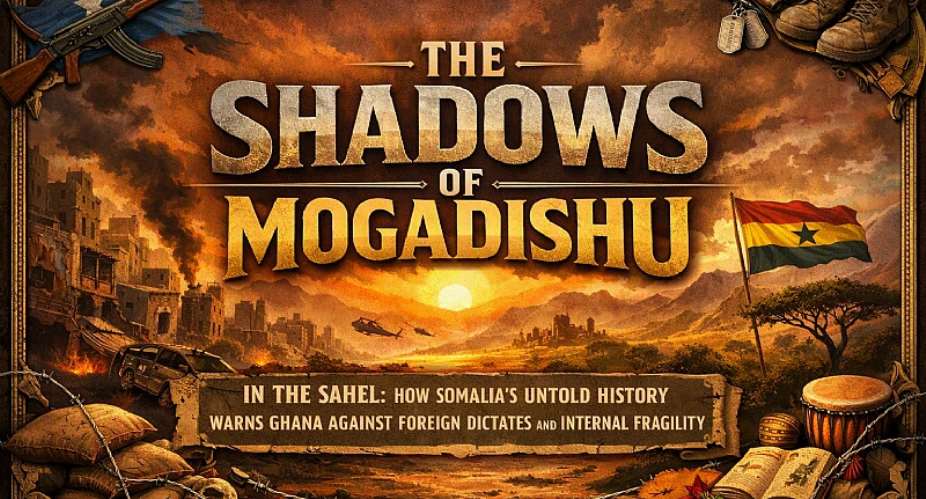
History is often written by the victors, but its deepest lessons belong to those who survived the crossfire. For most Ghanaians, the mention of the 1993 Somali conflict evokes Hollywood imagery of Black Hawk Down—a narrative dominated by Western heroism and tragedy. Yet, buried beneath the mainstream headlines lies a surreal, paradox-ridden history: a Somali general trained in the elite academies of Rome and Moscow, a devastating U.S. airstrike that accidentally obliterated the very elders trying to broker peace, and a naturalized U.S. Marine who was suddenly recalled from California to inherit his father's warlord throne.
As Ghana stands as a beacon of democratic stability in a West African sub-region increasingly threatened by political transitions and civil unrest, understanding the nuances of the Somali collapse is no longer just an academic exercise. It is a cautionary blueprint. To ensure our own democratic anchors hold firm, we must dissect how foreign interventions backfire, how traditional mediation fails when ignored, and how the path to peace ultimately requires local compromises over foreign dictates.
The Untold Realities of the Somali Conflict
To truly understand the crisis, we must look past the battlefield optics and examine the structural turning points that altered the course of East African history:
- The Deceptive "Warlord" Label: General Mohamed Farrah Aidid was frequently portrayed as a lawless tribalist. In reality, he was a highly educated elite, fluent in multiple languages, a graduate of Moscow's prestigious Frunze Military Academy, and a former Somali Ambassador to India. His rebellion began as a legitimate, popular democratic revolution to overthrow Siad Barre’s brutal 21-year communist dictatorship.
- The Tragedy of Bloody Monday: On July 12, 1993, U.S. forces launched a targeted missile strike on a Mogadishu villa. Unknown to intelligence, the villa was hosting a peace summit of moderate Somali elders, judges, and poets trying to restrain General Aidid. By killing over 50 of these revered mediators, foreign forces inadvertently destroyed the political middle ground, radicalizing the civilian population and uniting the city against the UN.
- The U.S. Marine Who Inherited a Militia: In one of the most bizarre twists of modern warfare, General Aidid’s son, Hussein Farrah Aidid, was a naturalized American citizen and a corporal in the U.S. Marine Corps. He had even served as a U.S. military translator in Somalia. When his father died in 1996, the clan elders bypassed veteran fighters to elect the 33-year-old American Marine as their new leader, proving that clan lineage heavily outweighed ideological alignment.
- The Power of Local Capitulation: Despite fears that his American military training would escalate the war, Hussein Aidid chose statesmanship over bloodshed. By signing the 1997 Cairo Declaration alongside his father's fiercest rivals, he voluntarily relinquished his claim to the presidency, dismantled the hostile "Green Line" checkpoints dividing Mogadishu, and successfully transitioned from an insurgent warlord to a national Deputy Prime Minister.
The Sahel Encroachment: Connecting Somalia's Ghost to West Africa’s Reality
The catastrophic errors of foreign intervention and institutional failure seen in 1990s Somalia are no longer confined to history; they are playing out in real-time along Ghana’s northern frontiers. As violent extremist groups like JNIM and Islamic State affiliates tear through Burkina Faso, Mali, and Niger, the threat of a southward spillover into coastal West Africa has reached a critical flashpoint.
Prominent Ghanaian security expert Prof. Kwesi Aning has pointedly noted that the ongoing collapse across the Sahel goes far deeper than basic terrorism; it is firmly rooted in "coups, corruption, weak governance, poverty, and the looting of state resources." Just as in Somalia, the solution cannot be imported. Prof. Aning emphasizes that the core lesson of the Sahelian crisis is that "countries must define their own security priorities rather than allowing external actors to dictate interventions."
Compounding this external pressure is the changing nature of the threat landscape within Ghana itself. Speaking at the Ghana Armed Forces Command and Staff College, Ghana's Chief of Defence Staff (CDS), Lieutenant General William Agyapong, issued a stark warning that the country faces a complex convergence of violent extremism moving from the Sahel down toward the Gulf of Guinea. "The map of our threat environment currently has shifted dramatically in ways that demand a direct and honest response from government," Lt. Gen. Agyapong stated, highlighting that local vulnerabilities—like illegal weapons trafficking and localized communal disputes—risk being exploited by highly adaptive, well-resourced regional terrorist networks.
Shifting Defensive Alliances: The New Geopolitical Chessboard
This regional instability has forced a radical realignment of West Africa's security structures, moving away from traditional models and into a deeply fragmented landscape. Historically, the Accra Initiative—comprising coastal nations like Ghana, Benin, Côte d'Ivoire, and Togo—served as the primary shield, operating as an intelligence-sharing and joint-border mechanism designed to stop the southward creep of jihadism into the Gulf of Guinea. However, this framework has faced immense strain following the political fractures in the upper Sahel.
In response to rigid external pressures and ECOWAS blockades, the military regimes of Burkina Faso, Mali, and Niger broke away to form the Alliance of Sahel States (AES). This new confederation values strict military autonomy, completely rejects Western military footprints, and operates its own 5,000-troop joint force. While highly operational, the AES remains isolated from its southern neighbors, creating a dangerous communication vacuum. To bridge this perilous gap, security envoys like Ghana's retired Colonel Larry Gbevlo-Lartey have championed the emergence of a new Sahel–Gulf of Guinea Accord. This developing dialogue mechanism focuses on pragmatic trade security and shared counter-terrorism communication, aiming to bypass diplomatic blockades and bring coastal democracies and Sahelian juntas back to the same negotiating table.
Strategic Suggestions and Recommendations for Ghana and West Africa
Somalia’s history and the Sahel’s current crisis prove that military might cannot replace institutional trust. Ghana must proactively apply these strategic remedies:
- Protect and Empower Traditional Authorities: The "Bloody Monday" disaster proved that when traditional, respected leaders are marginalized or removed, radicalization fills the vacuum. Governance experts at the John A. Kufuor Foundation warn that entrenched local disputes, such as the ethnic violence in Bawku, provide the exact societal fractures that Sahelian terrorists look to exploit. Ghana must legally and culturally empower our National and Regional Houses of Chiefs to resolve local conflicts before they become entry points for insurgencies.
- Pioneer Localized Regional Security Architectures: Rather than leaning on heavy-handed, Eurocentric military interventions that historically alienate populations, Ghana must champion flexible, indigenous frameworks. The proposed Sahel–Gulf of Guinea Accord represents a crucial step forward, utilizing pragmatism over ideological rigidity to maintain security channels open with the AES juntas.
- Engage the Diaspora Productively: Hussein Aidid’s sudden transition highlights the volatile but potent influence of the diaspora. Ghana boasts a vast, highly educated diaspora. Government policies must continue to incentivize the diaspora to return as builders, investors, and diplomats, ensuring their global exposure is leveraged for institutional wealth rather than factional politics.
- De-escalate Political Polarization Early: The Somali civil war worsened because political factions refused to share power, leading to total state collapse. Ghana’s political duopoly (NDC and NPP) must fiercely guard our culture of political tolerance. Political disputes must strictly be fought in the courts and through the ballot box, ensuring that partisan rhetoric never compromises the neutrality of the military or police forces.
The Blueprint for a Resilient Nation
The legacy of the Aidid family serves as a powerful reminder that wars end not when the weapons get louder, but when adversaries choose the roundtable over the trenches. Somalia’s tragedy was born from a failure to listen to local voices, an over-reliance on foreign military blueprints, and the destruction of moderate political spaces.
Ghana’s enduring peace is not an accident; it is the result of deliberate choices, strong traditional frameworks, and a collective national disdain for civil conflict. By learning from the untold history of our East African brothers and heeding the urgent warnings of our own security experts regarding the Sahel, Ghana can successfully fortify its democratic defenses, shield its northern borders, and remain the undisputed gold standard of peace and stability on the African continent.
✍️ Submitted by:
Retired Senior Citizen
For and on behalf of all Senior Citizens of the Republic of Ghana 🇬🇭
Teshie-Nungua
[email protected]


 'It will not die quietly in New York’s diplomatic corridors' — Mahama launches A...
 Akatamanso War: The victory that gave Akuapem's Odwira a memory, meaning and ide...
 We should make it easier for Africans to travel and invest across the continent ...
 Mahama turned around Ghana’s economy in a very short time – Dangote
 September 22: Cedi sells at GHS12.15 on forex market, GHS11.56 on BoG interbank
 We need to train judges on new laws to ensure proper application – Barker-Vormaw...
 Ghana’s democracy under pressure; youth must speak to defend their freedoms – Os...
 Ghana’s independence must translate into economic empowerment -- CPP's Nana Frim...
 Don’t just prosecute couriers, go after drug financiers – Catholic Bishops urges...
 ‘No ownership without control’ – Mahama pushes new global health financing model...


