




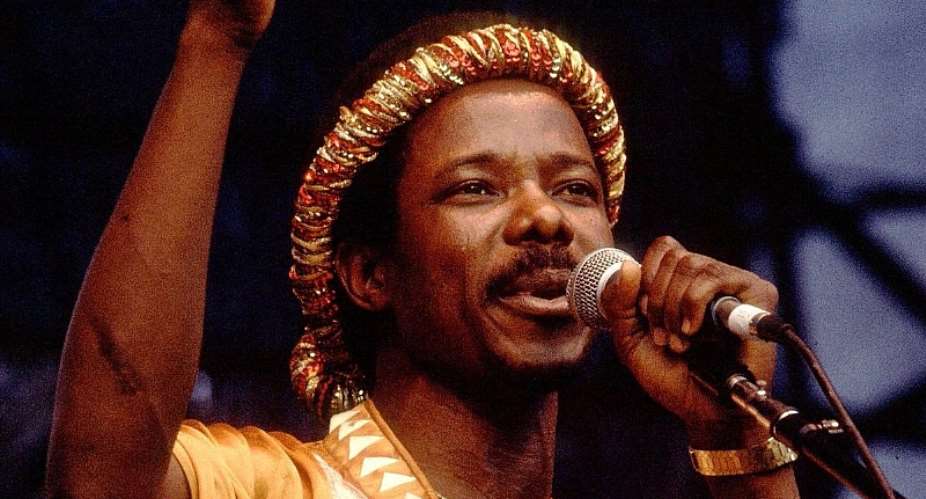
Sunday Adeniyi Adegeye, known as King Sunny Adé, is 80 this year. He has devoted more than 60 years of his life to influencing Nigeria's popular music and promoting the unique sounds of jùjú music.
Jùjú is a Nigerian musical tradition that combines intricate rhythms, percussion, guitars, talking drums, call-and-response and Yoruba oral culture. It's not only entertainment but a vehicle for expressing cultural identity, transmitting proverbs and praise traditions, and social life commentary.
Sunny Adé's career embodies an impressive blend of cultural grounding, musical innovation, entrepreneurial insight and global acclaim. From his beginnings in Lagos to his rise as the globally celebrated “King of Jùjú”, his story is intertwined with the development of contemporary African popular music.
As a social philosopher, I regard Adé's music as a tool for social change. This is because it transforms cultural expression into a medium of moral reflection and social engagement. His music communicates values such as communal responsibility, respect, humility, peace, diligence and integrity. It also draws attention to the social problems confronting Nigerian society.
I've argued that Adé's music addresses social challenges, preserves Yoruba identity and promotes civic awareness, national unity and moral renewal.
Early years and education
Sunny Adé was born on 22 September 1946 in Òṣogbo to a Yoruba family linked by royal ties to Ondo and Akure, two towns in Ondo State, south-west Nigeria. Òṣogbo is a town renowned as a centre of arts, music and culture.
His father was a church organist and his mother worked as a trader. His childhood thus immersed him in both religious and traditional music settings. His early experiences with music, especially the performances tied to Yoruba cultural and royal events, laid the groundwork for his career.
Although his family background and education could have propelled him towards a more conventional professional career, Sunny Adé developed a strong attraction to music. He attended St Charles Grammar School, Òṣogbo from 1960 to 1963, but later moved to Lagos. This offered entry to a lively musical scene where highlife and jùjú thrived – but a music career was considered unsuitable for royalty.
In Lagos, Sunny Adé gained experience as a guitarist and percussionist. He collaborated with renowned musicians, such as Moses Olaiya Adejumo's Federal Rhythm Dandies, a popular highlife band. He was also inspired by the groundbreaking jùjú artist Tunde Nightingale. These experiences gave him insight into the potential for creativity in Nigerian popular music. King Sunny Adé at London Reggae Sunsplash 1984.
Career highlights
Sunny Adé's career took a decisive turn in the 1960s. He established his own group, the Green Spots, in 1967. It had been formed in 1965 as Sunny Adé and His High Society Band and later became known as the African Beats and then as Golden Mercury. Having his own band allowed him to develop a distinct musical identity.
His recordings quickly established him as an important figure in Nigerian jùjú, while his energetic and extended live performances built a substantial following. He established his own record label, Sunny Alade Records, in the mid-1970s. This gave him greater control over his recordings and career. His popularity also extended beyond Nigeria through tours, including performances in Britain. His first performance in the UK was in 1975. By the end of the decade, he had become one of the leading figures in jùjú music.
Perhaps the most internationally significant chapter of his career began in 1982, when he signed with Island Records. The release of the album Juju Music in 1982 introduced his distinctive sound to a much wider audience. It was followed by Synchro System in 1983 and Aura in 1984. Synchro System earned a Grammy nomination in 1983, the first for a Nigerian artist.
Although his relationship with Island Records ended in 1985, the international exposure he had gained changed the perception of popular African music in many parts of the world. His 1998 album Odu received another Grammy nomination. His success shows that African musicians don't need to abandon the cultural foundations of their art.
His music
Sunny Adé's most significant artistic achievement is in the evolution and global expansion of modern jùjú music. He maintained its traditional elements and incorporated new instruments, arrangements and production methods. His music integrated electric guitars, talking drums, pedal-steel guitar, synthesizers and other instruments, producing a sound that was both contemporary and classic.
He also showed how musical practices can develop while maintaining their cultural essence. The talking drum was central to his sound, as guitars intertwined with percussion to create the layered, polyrhythmic quality linked to his performances. His music was often sung in Yoruba and incorporated praise singing, proverbs, social commentary and aspects of Yoruba oral heritage.
A key feature of his music was his method of live performances. Sunny Adé gained fame for directing large groups and maintaining lively shows that could go on for hours. His guitar skills, dancing, onstage charisma and engagement with his band turned the concert into a festivity of rhythm and collective involvement. King Sunny Adé and His African Beats in “O.C. & Stiggs”
Legacy as a musician
Sunny Adé's impact goes far beyond the quantity of albums he has produced or the accolades and nominations he has attained. His most significant accomplishment may be the part he took in showcasing the global potential of African popular music.
He proved that Yoruba musical traditions could capture interest on prominent international platforms while preserving their unique identity. This gave later African artists more opportunities.
His impact is also evident in his dedication to nurturing musical institutions and the younger generations. He established the King Sunny Ade Foundation, linked to resources for music, performance and nurturing young musicians. He has also made a notable impact in Nigeria's music industry by participating in copyright advocacy and the Musical Copyright Society of Nigeria.
Upon turning 80, King Sunny Adé continues to be an emblem of Nigeria's creativity and cultural pride. He didn't just inherit a musical tradition; he broadened it, tested it, and transmitted it across cultural and geographical lines. His music linked Yoruba traditions with worldwide popular culture, and his career showed that African artists could engage in global music without compromising their cultural identity.
The “King of Jùjú” remains a renowned musician and a cultural ambassador whose impact still echoes.
Damilola Peter Olatade does not work for, consult, own shares in or receive funding from any company or organisation that would benefit from this article, and has disclosed no relevant affiliations beyond their academic appointment.
By Damilola Peter Olatade, Lecturer, Lagos State University

 Ghana, Panama sign MoU to deepen bilateral political consultations
 Founder’s Day: NAPO urges Ghanaians to uphold Kwame Nkrumah’s legacy
 Founder’s Day: Mahama urges Ghanaians to draw inspiration from Nkrumah’s vision
 Mahama to build 400-bed Mother and Child Block at Korle Bu – Kwakye Ofosu
 GES threatens sanctions against SHS heads imposing unauthorised charges
 Betting could destroy future of Ghana’s youth in 3–5 years – Akim Swedru MP
 Zimbabwe Suspends Journalist for One Year Over ‘Unethical’ Reporting on Chinese ...
 Third Drug Mule in 3 Weeks: R2m Heroin Found in SA Man’s Luggage at OR Tambo
 NACOC Debunks MP’s Claim as France’s €225m Cocaine Case Deepens
 Putin party retains majority in first vote since 2022 invasion of Ukraine


