




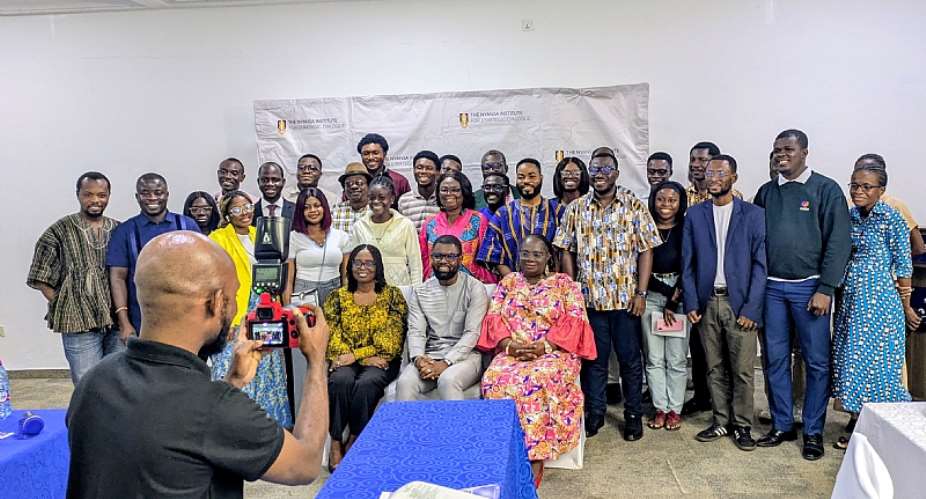
The Economic Community of West African States (ECOWAS) must undertake significant institutional reforms to remain relevant to the changing political, economic and security realities of the region, experts have said.
The call was made at the fourth Nyansa Dialogue Series organised by the Nyansa Institute for Strategic Dialogue held in Accra on Friday, September 18.
The dialogue, held under the theme “Regional allies in peril: Can a fractured ECOWAS still be a force for good?”, brought together Dr Emma Birikorang, Director of Research at the Kofi Annan International Peacekeeping Training Centre (KAIPTC), and Dr Juliana Appiah, Senior Research Fellow at the Legon Centre for International Affairs and Diplomacy (LECIAD), as the main speakers.
Speaking on the theme, Dr Birikorang said increasing dissatisfaction among young people with elected governments is partly linked to their inability to provide the human security, public services and economic opportunities they expect.
“Elected governments are increasingly failing to provide the human security that the citizens want, the equitable public services that young people are looking for,” she said.
She said the situation had contributed to instances where young people had welcomed military takeovers, not necessarily because they supported military rule but because they were seeking alternatives to existing political systems.
Dr Birikorang further noted that the emergence of new external partners and the formation of alternative regional alliances had changed the political and security dynamics of West Africa.
She said the situation had weakened ECOWAS' ability to manage conflicts and enforce its own protocols on democracy and good governance.
On her part, Dr Appiah, however, argued that the challenges facing ECOWAS should be traced to both the conduct of member states and structural weaknesses within the regional organisation.
She said member states had failed to uphold commitments under ECOWAS protocols, particularly those relating to democracy and good governance.
“Despite these things, I think the ECOWAS of today is not fit for purpose. The conditions of 1975 are not the same conditions today, but our leaders are still living in 1975,” Dr Appiah said.
She explained that ECOWAS was established in 1975 primarily as an economic integration project, but its responsibilities had gradually expanded into areas including security, democracy and environmental issues.
Dr Appiah said the organisation's intergovernmental structure is one of its major weaknesses because the ECOWAS Commission lacked sufficient authority to hold member states and their leaders accountable.
“ECOWAS is an intergovernmental organisation, not a supranational organisation,” she said, explaining that the Commission does not have the authority required to effectively enforce its decisions against member states.
Dr Appiah further argued that ECOWAS could still be salvaged despite the withdrawal of Burkina Faso, Mali and Niger from the bloc.
Speaking to ModernGhana News on the sidelines of the dialogue, she said the organisation's current challenges do not necessarily mean its institutions had become irrelevant.
“The fact that the three left does not mean that ECOWAS is dead. It still has institutions that are able to carry on, provided we have the political will to do the changes we need to do for ECOWAS to survive,” she said.
She called for greater powers and resources for the ECOWAS Commission, including the authority to impose and enforce targeted sanctions against political leaders rather than measures that disproportionately affect ordinary citizens.
On his part, the Executive Director of the Nyansa Institute for Strategic Dialogue, Samuel Koranteng Adjei, in his welcome address, said Ghana had a direct interest in the stability and effectiveness of ECOWAS because of its geographical, economic and security links with neighbouring countries.
He said instability in the Sahel could have consequences beyond the region through disruptions to trade, migration, organised crime and terrorism.
“The greater danger is allowing disagreement to become permanent fragmentation, because ultimately the future of ECOWAS will not be determined by the strength of its institutions alone,” Mr Adjei said.
He urged participants to look beyond whether ECOWAS had succeeded or failed and instead consider what the organisation should become over the next 50 years.


 Mahama to build 400-bed Mother and Child Block at Korle Bu – Kwakye Ofosu
 GES threatens sanctions against SHS heads imposing unauthorised charges
 Betting could destroy future of Ghana’s youth in 3–5 years – Akim Swedru MP
 Zimbabwe Suspends Journalist for One Year Over ‘Unethical’ Reporting on Chinese ...
 Third Drug Mule in 3 Weeks: R2m Heroin Found in SA Man’s Luggage at OR Tambo
 NACOC Debunks MP’s Claim as France’s €225m Cocaine Case Deepens
 Trump to meet Macron in New York before UN General Assembly
 Putin party retains majority in first vote since 2022 invasion of Ukraine
 Third-country removals: Trump’s deportation policy by the numbers
 US, China discuss AI safety ahead of Trump-Xi summit


