




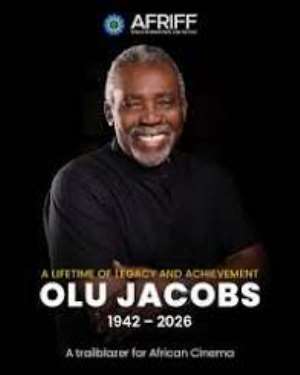
For more than five decades, Olu Jacobs gave African storytelling a powerful and distinctive voice. With his commanding presence, resonant delivery and remarkable ability to portray figures of authority, he became one of the most respected and recognisable actors in African cinema.
The veteran Nigerian actor died on September 16, 2026, at the age of 84. His family described him as “The Lion of Lufodo,” bringing to a close an extraordinary career that spanned theatre, British television, international film and Nigeria’s Nollywood industry.
Born Oludotun Baiyewu Jacobs on July 11, 1942, in Kano, Nigeria, he developed an early interest in acting after watching a performance by legendary Nigerian theatre practitioner Hubert Ogunde. Inspired by that experience, Jacobs travelled to Britain and trained at the Royal Academy of Dramatic Art in London.
His professional training provided the discipline, precision and versatility that later distinguished his performances. Long before Nollywood emerged as an internationally recognised film industry, Jacobs had already appeared in several British television productions, including The Goodies, The Professionals and The Tomorrow People. His international film credits included The Dogs of War, Baby: Secret of the Lost Legend and Roman Polanski’s Pirates.
At a time when opportunities for African actors on major international platforms were limited, Jacobs demonstrated that African performers could succeed in different production environments while remaining connected to their cultural identity.
His return to Nigeria coincided with the expansion of the country’s entertainment industry. As Nollywood grew from a modest home-video market into one of the world’s most productive film industries, Jacobs became one of its defining personalities.
He was widely known for portraying kings, chiefs, patriarchs, elders and other powerful characters. His deep voice, measured delivery and dignified presence gave credibility to every role he played. Although he became closely associated with figures of authority, his talent extended across drama, comedy, historical productions and contemporary stories.
Jacobs’ contribution to African cinema earned him numerous honours. He won the Africa Movie Academy Award for Best Actor in a Leading Role in 2007. In 2011, Nigeria honoured him as a Member of the Order of the Federal Republic. He also received the Industry Merit Award at the 2013 Africa Magic Viewers’ Choice Awards and a Lifetime Achievement Award from the Africa Movie Academy Awards in 2016. His official Lufodo profile records his distinguished work as an actor, writer, director and producer.
His legacy, however, extends beyond the screen. Together with his wife, respected actress Joke Silva, Jacobs established the Lufodo Group and the Lufodo Academy of Performing Arts. Through these institutions, the couple helped train and mentor young people seeking careers in acting and other areas of the creative industry.
This commitment to nurturing talent made Jacobs more than an accomplished performer. He became an institution-builder who understood that the future of African entertainment depended on professional training, mentorship and the creation of sustainable opportunities for emerging artists.
His career also reflected the remarkable transformation of Nigerian cinema. Jacobs began acting when the infrastructure and international visibility available to African performers were extremely limited. He lived to witness Nollywood become a major cultural force, carrying African stories, traditions and experiences to audiences around the world.
In his later years, Jacobs largely withdrew from public life because of declining health. Joke Silva had previously disclosed that he was living with dementia with Lewy bodies. Several false reports of his death circulated before his family confirmed his passing in September 2026.
Yet the difficulties of his final years cannot diminish the scale of his achievements. His journey connected Nigeria’s traditional theatre heritage with British professional training, international cinema and the emergence of modern Nollywood.
Through his performances, Jacobs showed that acting could be more than entertainment. It could preserve culture, examine society, communicate African values and influence how the continent is perceived globally. His professionalism also helped establish standards for generations of actors who followed him.
As Nollywood continues to expand internationally, it stands on foundations built by pioneers who worked at a time when the possibilities were far more limited. Olu Jacobs was unquestionably one of those foundational figures.
His voice may now be silent, but the characters he created, the institutions he helped establish and the performers he inspired remain part of Africa’s cultural inheritance. Olu Jacobs did not merely participate in the history of African cinema—he helped shape it. His enduring legacy will continue to speak through every generation of African storytellers that follows.

 'We have spent 60years arguing about Nkrumah and rather less time doing what he ...
 Judge recounts attempted MoMo scam on him moments after jailing scammer
 'Systemic failure due to NACOC removal from port inspections' – Inusah Fuseini o...
 Akyem Oda commercial drivers raise fares arbitrarily amid commuter concerns
 Two arrested over alleged GH¢22,000 SHS placement scam
 Police uncover alleged network behind Ghana Jollof videos
 NACOC says cocaine suspects were under surveillance for up to two years
 Suhuyini assures Accra-Kumasi Expressway won’t miss December 2028 deadline
 Foreign Affairs Ministry releases 200-page RTI response on GH¢49.7m South Africa...
 Chartered flights account for GH¢27.18m of South Africa evacuation cost


