




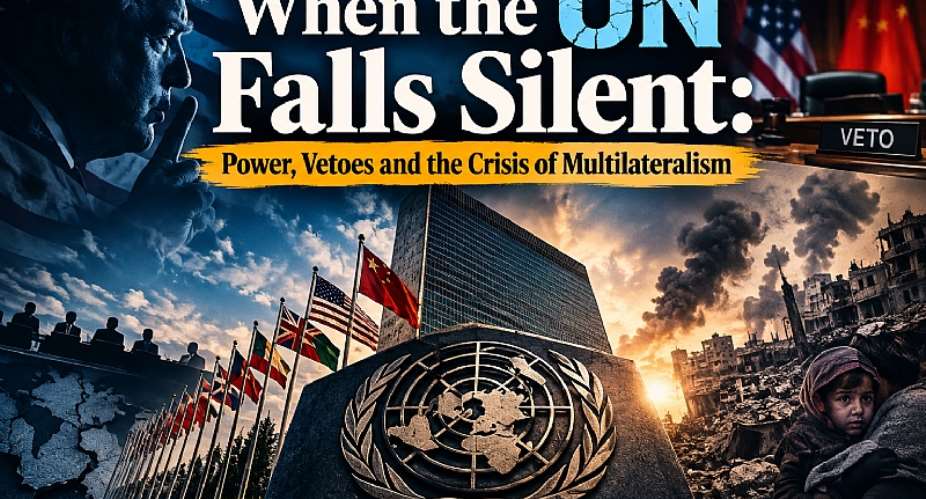
Power demands the ability to be exercised, but diplomacy demands that power be restrained by institutions. The United Nations was created as the central multilateral structure through which sovereign states could participate, present their narratives and place their disputes before an international forum. Yet the organisation increasingly appears trapped between political divisions, institutional limitations and the unequal influence of powerful states. The question is no longer simply whether the UN exists, but whether it can still provide an impartial platform where every voice carries meaningful weight.
How Has the UN Become Unpopular?
The criticism of the UN is not new. Even Donald Trump, during his presidency, repeatedly questioned the organisation's effectiveness and compliance mechanisms. Such political rhetoric may have been provocative, but the underlying question remains relevant: how many times has the UN actually succeeded in preventing two states from moving towards war?
The leadership of the organisation has often struggled to translate diplomatic statements into effective political action. The deeper problem, however, is structural. The Security Council's veto system gives five permanent members extraordinary power, allowing one permanent member to block a resolution even when the other fourteen members support it. The Gaza conflict has repeatedly exposed this contradiction. In June 2025, the United States vetoed a Gaza ceasefire resolution despite 14 members voting in favour. The same pattern occurred again in September 2025.
This raises a serious question about whether the UN can genuinely represent a multipolar world while its most consequential decisions remain vulnerable to great-power rivalry.
How Has the UN Failed During and After War?
Gaza has become perhaps the clearest test of the UN's institutional credibility. In September 2025, the United States denied or revoked visas for representatives of the State of Palestine ahead of the General Assembly session. The General Assembly subsequently voted 145–5 to permit Palestinian participation virtually.
The controversy was particularly significant because the UN headquarters itself operates within the United States. If representatives of a recognised UN observer state can face restrictions that require the General Assembly to intervene, questions naturally arise about the practical independence of the organisation.
At the same time, Israel has maintained access to the UN's diplomatic stage. The issue is therefore not simply who speaks, but whether the international system can guarantee equal diplomatic access during conflicts where representation itself becomes part of the struggle.
EU Hypocrisy or Strategic Dependence?
The European Union faces a parallel dilemma. European governments increasingly speak about strategic autonomy, yet European security remains deeply connected to NATO and American military capabilities. Differences among European states over Iran, Israel, Gaza and Middle Eastern security further demonstrate the difficulty of developing a single foreign-policy position.
France, Italy and Spain have at times expressed positions that differ from other European governments, while Britain has also adjusted aspects of its Israel policy. Yet Europe has still struggled to emerge as an independent mediator capable of resolving major conflicts.
The result is a diplomatic paradox: Europe wants strategic autonomy, but its security architecture remains deeply interconnected with Washington.
UN Silence on Pakistan-India Water Dispute?
The Indus Waters Treaty provides another test. Signed in 1960 between India and Pakistan with the World Bank's involvement, the treaty created a framework for sharing the waters of the Indus river system.
When India announced that it would hold the treaty in abeyance in 2025, Pakistan repeatedly raised the issue internationally. Pakistan has argued before the Security Council that weaponising water threatens regional peace and the livelihoods of millions.
Yet the UN has not produced a decisive diplomatic settlement. For Pakistan, this reinforces the perception that international institutions often react after crises emerge rather than preventing them from escalating.
Has the UN Already Failed Its Mission?
The UN cannot be declared an outright failure. It continues to provide humanitarian assistance, peacekeeping, diplomacy and international legal frameworks. But its political limitations are increasingly difficult to ignore.
The same concern extends to institutions such as the IMF and ADB. Their programmes for countries such as Pakistan contain substantial policy conditions. The IMF's Pakistan programme includes fiscal, monetary, taxation and structural reform requirements, while ADB policy-based lending explicitly links financing with policy reforms.
The question, therefore, is not whether international institutions should impose discipline. It is whether global institutions can apply principles consistently without allowing geopolitical power to determine whose interests receive priority.
The UN was designed to prevent the world from being governed solely by the strongest. If its institutions become paralysed whenever great-power interests collide, then multilateralism becomes procedural rather than substantive.
The real challenge before the United Nations is therefore not survival, but credibility. A genuinely international organisation must ensure that Palestinian, Asian, African and other developing-world voices are not merely heard but meaningfully considered. Otherwise, the phrase “United Nations” risks becoming less a promise of collective action and more a reminder of how divided the international system has become.


 'We have spent 60years arguing about Nkrumah and rather less time doing what he ...
 Judge recounts attempted MoMo scam on him moments after jailing scammer
 'Systemic failure due to NACOC removal from port inspections' – Inusah Fuseini o...
 Akyem Oda commercial drivers raise fares arbitrarily amid commuter concerns
 Two arrested over alleged GH¢22,000 SHS placement scam
 Police uncover alleged network behind Ghana Jollof videos
 NACOC says cocaine suspects were under surveillance for up to two years
 Suhuyini assures Accra-Kumasi Expressway won’t miss December 2028 deadline
 Foreign Affairs Ministry releases 200-page RTI response on GH¢49.7m South Africa...
 Chartered flights account for GH¢27.18m of South Africa evacuation cost


