




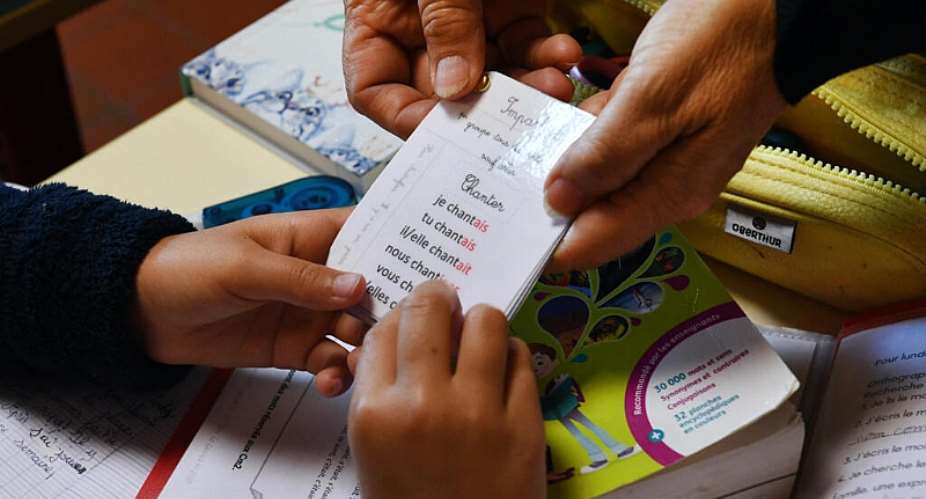
Algeria's 2026-27 school year kicks off next week with a change: a shift away from its usual focus on French as a second language.
Introduced in primary schools alongside French in 2022, from now on English will be the first foreign language children study.
Algerian education minister Mohamed Seghir Saadaoui announced in July that English classes would begin in the third year of primary school, when children are around 8. French lessons will follow a year later.
"In third year, only English will be taught," Saadaoui said.
Colonial baggage
The reform is part of a broader shift towards English in Algeria, where French remains closely tied to the country's colonial history.
In a paper published earlier this year, Algerian linguist Fadhila Leroul of the Mouloud Mammeri University of Tizi-Ouzou says the change can be explained not only by English's status as a global lingua franca, but because in the political context of former French colonies cutting ties from France, it steers Algeria "beyond the colonial legacy attached to French".
Algeria's history with France is long and tightly knit. Algeria was under French rule from 1830 to 1962, and was formally incorporated into France in 1848.
The French language was imposed everywhere from administration to formal education, but French was not accessible to just anyone. Arabic remained the language of the majority, while French was for Europeans and those with access to education.
According to Abu Bakr Khaled Saad Allah, an Algerian professor and researcher on higher education, this division made language deeply bound up with questions of national identity. Algerian writer Kateb Yacine, who wrote in French, once described the language as a "war trophy" taken from the former colonial power.
How a Nigerian town came to speak 'street French'
Following its independence, Algeria pursued policies to make Arabic the official national language. Arabic has been the country's primary language ever since, but for decades French remained prevalent in academia.
Algiers began toying with the idea of pushing English in the early 1990s, when primary school students were given the choice between English and French as a second language.
The plan was shut down and English was taken off the syllabus until 2019, when the minister of education put forward a plan to promote the use of English in universities. In 2022, President Abdelmadjid Tebboune announced that English would be introduced in primary schools.
The move coincided with a weakening of Algeria's relations with France. The relationship between the two countries has been tense since 2021 and, despite a period of rapprochement in 2023, worsened in 2024 after France declared its support for Morocco's sovereignty over the disputed Western Sahara.
The last word: why half of the world's languages could vanish this century
Regional shift
Both Morocco and Tunisia also took pains post-independence to cut ties to their former colonial power.
Morocco was a French protectorate from 1912 to 1956. Under Paris, French was the only language used for instruction. When Morocco got its independence, it steered the country towards policies of Arabisation to ensure Arabic once again took a central place.
The Moroccan government progressively introduced Arabic into primary education, but French remained the language of higher study, particularly in mathematics and science.
In the 2000s, the kingdom began to move towards a more multilingual model that supported both Arabic and French. At the same time, English was cementing its dominance as a global language – particular with younger generations.
One 2021 survey of 15-25-year-olds, commissioned by the British Council, found 40 percent of respondents believed English was the most important language to learn, compared to only 10 percent for French. As one participant said: “Everyone is turning to the English language because of its dominance on the internet.”
By 2023, the Moroccan government began introducing English in public schools, where before it had been limited mainly to private institutions.
French overtakes Arabic to become world's fourth most spoken language
Tunisia was also a French protectorate from 1881 to 1956. The colonial rulers soon established a public education system that prioritised French, and it became the language of administration and economy. Those seeking access to higher opportunities therefore became bilingual in both French and Arabic.
After its independence, unlike Morocco and Algeria, Tunisia did not seek to cut out French from education and daily life. While it also pursued a policy of Arabisation, it maintained strong links with French education. The language of its former colonisers remained important in science, medicine, higher education, business and government.
But in contrast to its neighbours, Tunisia introduced English early on after independence as a foreign-language option in schools. Decades on, young people are increasingly choosing it.
In a 2020 Afrobarometer survey, around 68 percent of Tunisian respondents said English was the most important language for young people to learn. Only some 13 percent chose French.


 Ahafo Ano South West MP involved in road accident
 Constitutional Review alone will not solve Ghana’s problems – Kwesi Pratt Jnr.
 East Legon Football Academy applauds NPA Boss for supporting youth football
 Gov't didn't show NPP enough respect in constitutional review process – Martin K...
 September 18: Cedi sells at GHS12.15 on forex market, GHS11.53 on BoG interbank
 Lawyer challenges two-week remand of Salomey over connection to wanted 'Ghana Jo...
 Minority calls for NSA boss Ampofo Ankrah, others to be dismissed over alleged 2...
 ‘You gave us GH¢60,000 to run 66 offices nationwide and expect us to function?’ ...
 Russia seizes assets of Swiss food giant Nestle and three French firms
 Russia votes in parliamentary election as war in Ukraine drags on


