




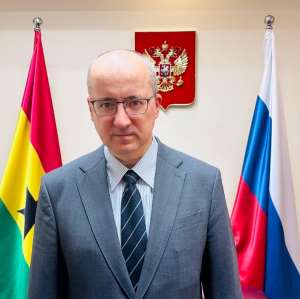
A war of words between two of Ghana's foreign missions has spilled into public view, after the Russian Embassy in Accra issued a pointed rebuttal to the European Union's ambassador, who had publicly questioned whether Moscow could be trusted as a partner to Ghana at all.
How the Dispute Started
The row began when EU Ambassador to Ghana Rune Skinnebach, speaking at an event marking Ukraine's independence day commemoration in Accra, directly challenged Russia's standing as a partner to Ghana. "Russia is neither reliable nor credible partner to Ghana," Skinnebach said, citing what he described as Moscow's pattern of failing to follow through on commitments made to the country.
He pointed to two specific grievances: the alleged illegal recruitment of young Ghanaians to fight alongside Russian forces in Ukraine recruits he said were, in some cases, used as little more than "cannon fodder" and a number of proposed Russia-Ghana projects, including nuclear energy cooperation, that have yet to be realised years after being announced.
Russia's Response
The Russian Embassy did not let the comments go unanswered. In a statement issued on September 15, 2026, it dismissed Skinnebach's characterisation outright, calling it "unfounded" and accusing the EU of turning reality "on its head."
The Embassy insisted that Russia remains a "consistent and predictable partner" to both Ghana and the wider African continent, and pushed back specifically against the recruitment allegations and claims of stalled projects, describing the EU's position as patronising and part of a broader pattern of Brussels repeatedly criticising Moscow.
Central to Russia's rebuttal was an argument about Western sanctions themselves: the Embassy argued that restrictions imposed by the United States, the European Union, and their allies have made it harder for Russian entities to arrange financing, logistics, and international payments and that African banks and businesses working with Russian partners now face heightened compliance and financial risk as a result.
In effect, Moscow's position is that any delays or difficulties in delivering on its commitments to Ghana stem from Western sanctions pressure rather than any lack of genuine Russian intent.
The Substance Behind the Dispute
Beneath the diplomatic sparring sits a real and growing commercial relationship.
According to Russia's Ambassador to Ghana, Andrei Ordash, bilateral trade between the two countries climbed from $247 million in 2022 to more than $800 million in 2024, and continued rising in the first half of 2026. Ordash, who arrived in Accra earlier this year, has repeatedly described Ghana as "a reliable and promising partner for Russia in West Africa," citing the country's political stability, growing economy, and its role as host of the African Continental Free Trade Area (AfCFTA) Secretariat as reasons Russian businesses find it an attractive destination.
Areas of proposed cooperation span agriculture, energy, mining, manufacturing, infrastructure, and technology. The most closely watched of these is a memorandum of understanding between Ghana's Atomic Energy Commission and Russia's state nuclear firm, Rosatom, which Ordash has said lays the groundwork for a potential Ghanaian nuclear power station involving Russian specialists and training for Ghanaian personnel though the project remains at an early cooperation-and-development stage, which is precisely the point the EU has seized on in questioning Russia's follow-through.
Why It Matters for Ghana
For Ghanaian policymakers and businesses, this is more than a diplomatic spat playing out in statements. Large infrastructure, energy, and technology projects depend on financing arrangements, secure payment channels, insurance, and the ability of partner companies to operate within international sanctions frameworks all factors that become more complicated when a potential partner is under Western sanctions, regardless of the political rhetoric on either side.
The dispute effectively puts Ghana in a position where it must weigh the genuine economic opportunities Russia is offering against the practical and reputational friction that comes with deepening ties to a sanctioned power.
The timing is also notable: Ghana is expected to send a delegation to the Third Russia-Africa Summit, scheduled for October 28–29, 2026, in Moscow an event Ordash has described as a milestone intended to give Russia-Africa relations "tangible economic substance" across trade, investment, energy, logistics, and technology. How this diplomatic dispute with the EU plays out in the coming weeks may shape the tone, if not the substance, of Ghana's participation in that summit.
Mustapha Bature Sallama
Medical/ Science Communicator,
Private Investigator, Criminal Investigation and Intelligence Analysis,
International Conflict Management and Peacebuilding. ( USIP)
[email protected]
+233555275880
Sources
The High Street Journal, "Russia Hits Back at EU Over Ghana Ties, Investment And Sanctions," September 15, 2026
Diplomatic Times Online, "Russia is neither a credible nor reliable partner to Ghana - EU Ambassador"
Diplomatic Times Online, "Russian Embassy asserts Moscow is a consistent partner to Ghana and Africa"
Ghanamma.com, "Ghana-Russia trade hits US$800 million as Moscow seeks deeper economic partnership," July 15, 2026
Ghanamma.com / Ghana News Agency, "Exclusive Interview: New Russian Ambassador Andrei Ordash outlines vision for a new era of Ghana-Russia relations," July 20, 2026
Diplomatic Times Online, "Russian Ambassador Andrei Ordash on Ghana-Russia ties, Africa and Ukraine Written responses"

 Constitutional amendment: Five-year presidential, parliamentary terms will weake...
 Constitutional review: NPP calls for constituent assembly before referendum
 BOST cuts fuel exports to Burkina Faso and Mali over domestic demand
 Rent Control Commission needs more funding to function effectively – Acting Comm...
 September 17: Cedi sells at GHS12.15 on forex market, GHS11.51 on BoG interbank
 Mahama, IFC boss discuss Ghana's plans to boost agriculture, infrastructure and ...
 'We are not targeting Konkombas over Agbogbloshie 24-Hour Market project' — AMA ...
 Abandoning Nkrumah's 7-year development plan for 1D1F, Nkoko Nkitinkiti, Big Pus...
 ‘Young people will chase politicians away if something drastic is not done’ – Pr...
 Govt GH¢1 billion intervention saved diesel from hitting GH¢28 per litre – NPA C...


