




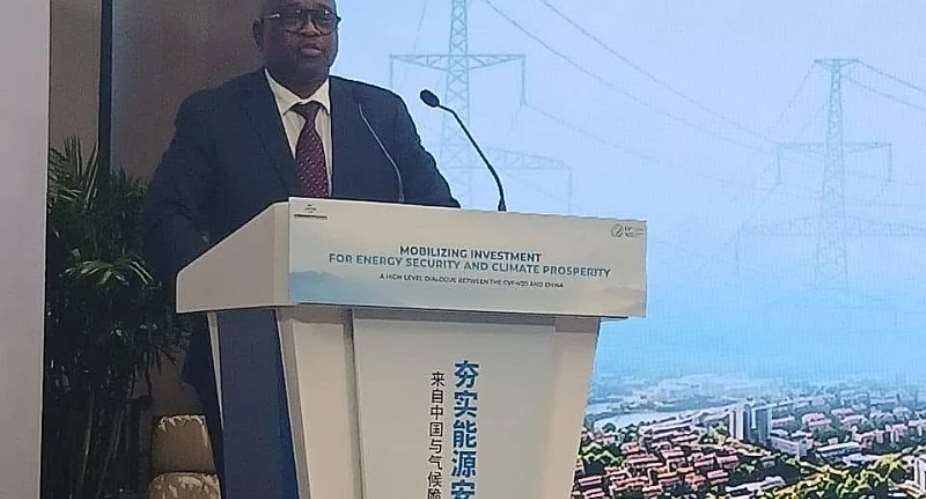
The Minister of State for Climate Change and Sustainability, Mr Seidu Issifu, has called for stronger investment partnerships between China and climate-vulnerable countries to accelerate climate-resilient and low-carbon development.
He said Chinese public and private sector institutions should move beyond conventional trade relations and invest directly in climate-resilient infrastructure, renewable energy, green manufacturing, water security and climate-smart agriculture across vulnerable economies.
Mr Issifu made the call on Monday at a high-level Climate Vulnerable Forum and V20 (CVF V20) China dialogue held at the Shougang International Convention and Exhibition Centre in Beijing, as part of the China International Fair for Trade in Services (CIFTIS) 2026.
He noted that the CVF V20 was approaching China with investment opportunities and country-owned development pipelines rather than seeking assistance.
“We come to CIFTIS 2026 with a clear proposition, not a plea,” he said.
He said the 74-member CVF V20 represented a growing market for clean technologies, supported by renewable resources, strategic geographical locations, expanding markets and a young workforce.
According to him, China’s expertise in clean technology, manufacturing, infrastructure development and green industrialisation positioned it to partner with climate-vulnerable countries to transform their development opportunities into commercially viable investments.
Mr Issifu said the immediate task was to move from Climate Prosperity Plans to bankable projects supported by technology, finance, industrial capacity and strong institutional partnerships.
The minister highlighted Ghana’s revised Climate Prosperity Plan as an example of how climate priorities could be converted into an investment and financing framework.
“The Plan focuses on sustainable industrialisation and value addition, renewable energy and green transport, climate-resilient health and water infrastructure, financial and economic resilience, sustainable food systems and nature-based solutions,” he stated.
He said the Plan was supported by financing mechanisms including debt for climate swaps, Article 6 carbon market transactions, blended finance, partial credit guarantees and first loss capital.
He stated that the instruments could help bridge financing gaps and connect Ghana’s climate priorities with Chinese capital, technology and industrial expertise.
The dialogue, held on the theme, “Mobilising Investment for Energy Security and Climate Prosperity,” focused on translating Climate Prosperity Plans into concrete investment opportunities, with particular attention to green industrialisation, resilient infrastructure and water security, as well as climate-smart agriculture and value chains.

 Ivorian footballer Malick Yalcouyé falsely accused of lying about his age
 South Africa's president taken ill after BRICS summit
 Chief Justice praising government policies is problematic – Kwesi Pratt
 Police interdict seven officers for allegedly forcing victim to withdraw money f...
 GAF ready to deepen defence cooperation with Russia – Major General Annan
 WHO sees 'encouraging signs' in DR Congo Ebola response but says outbreak 'far f...
 GRA challenges GH¢79.65m Servestar Minwax judgment debt
 Government allocates GH¢1.98bn to school feeding programme in 2026 — Gender Mini...
 DVLA boss calls for modernisation of learner’s licence acquisition process
 EPA shuts down Empire Cement over alleged environmental breaches


