




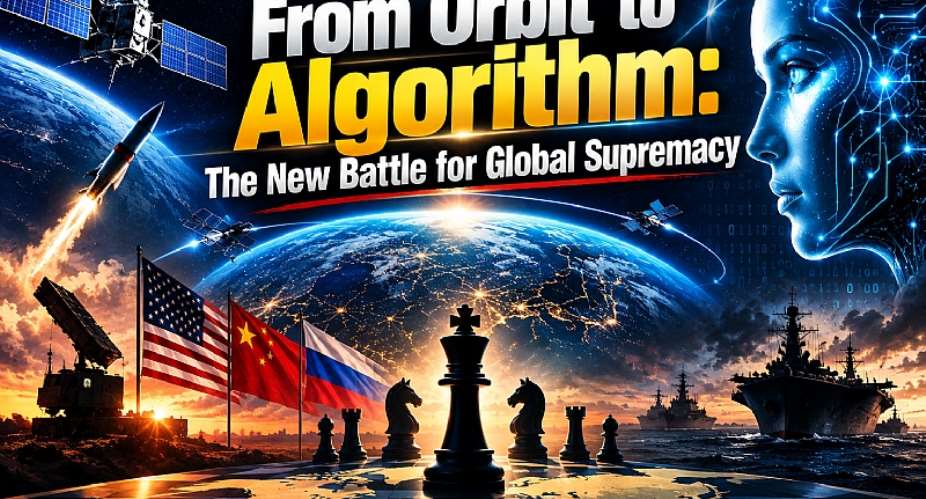
The evolving geopolitical situation suggests that a new chapter of the 21st century has already begun. First came the uncontrolled curiosity surrounding artificial intelligence; now come warships, military systems and weapons being positioned in the vacuum of outer space. The world appears to be creating a catastrophic strategic realm around the globe, where nuclear weapons remain a terrifying reality while new capabilities in space and AI are filling the vacuum created by the absence of effective global authority. Human rights institutions and international organisations have repeatedly failed to protect the basic principles of humankind. The AI revolution must therefore remain a tool for humanity, not become a weapon capable of independently rewriting or destroying human history.
The US Space Force said on Monday that it had deployed “on-orbit space control weapons capable of defending... against hostile adversary action”, without providing specific details. Such announcements may be presented as defensive measures, but they also serve another purpose: projecting technological supremacy and directing public attention towards military competition.
China’s Foreign Ministry opposed the move, warning against the “weaponisation of outer space, turning it into a battlefield, as well as an arms race there”. Beijing urged Washington to stop expanding its military capabilities and preparing for war in outer space. This is not merely diplomatic rhetoric. China understands that control of space could become a decisive element of future strategic competition, particularly as the Trump administration seeks greater leverage over global strategic assets and attempts to counter China’s expanding influence.
The US Space Force has explicitly identified China as a threat, stating that Beijing develops and operates space and counterspace capabilities as part of its military modernisation strategy. Russia was also named, with Washington arguing that Moscow believes space supremacy could become decisive in future conflicts. But the question remains: if Russia can invade Ukrainian territory and the United States increasingly expands strategic military capabilities across multiple domains, where does the balance of the international order actually stand?
The militarisation of space is not new. It is almost as old as the space race itself. After the Soviet Union launched Sputnik, the world’s first artificial satellite, in 1957, Washington and Moscow began exploring ways to protect, arm and potentially destroy spacecraft. The greatest concern was once nuclear weapons in orbit. The Outer Space Treaty of 1967 subsequently prohibited weapons of mass destruction in orbit. Today, however, the strategic competition is entering a much more complicated phase.
Then comes AI—the more alarming frontier. Imagine an AI system capable of generating armies of miniature bots, expanding itself, manipulating information and then erasing its own traces, almost like a criminal carefully planning a heist. Such possibilities demonstrate why AI cannot simply be treated as another commercial technology. The question is not whether AI can become more intelligent; the question is whether humanity will remain intelligent enough to control it.
Public alarm over AI risks is escalating, with industry leaders expressing concerns that advanced AI could pose significant dangers in the near future. Anthropic CEO Dario Amodei has advocated regulatory measures, including independent audits of advanced AI systems. Yet President Donald Trump has argued that the United States already has sufficient guardrails to regulate and prosecute AI companies, appearing to downplay some of the concerns raised by technology leaders.
The concerns are nevertheless becoming harder to dismiss. AI-related stocks have faced pressure after industry figures called for caution in the development of increasingly powerful systems. Anthropic researcher Jacob Coxon reportedly resigned while warning that people developing AI seriously believe it could potentially become an existential danger by the end of the decade. Many countries are already considering restrictions or bans on specific AI applications as a precautionary response to the technology’s rapid expansion.
The irony is profound: humanity is developing technologies powerful enough to transform civilisation while simultaneously struggling to control the institutions that are supposed to regulate them. The same instruments of power that governments claim will protect national security could eventually become threats to the societies they are designed to defend.
Whether the future brings strategic stability or greater danger will depend on one fundamental decision: will humanity control technology, or will technology increasingly control humanity? AI and outer-space weapons must remain subject to international law, transparent rules and human accountability. The world does not need another arms race disguised as technological progress. Before the strategic competition moves beyond the point of control, major powers must write the rules—not after the catastrophe, but before it.


 64.7% of Ghanaians say Double-Track system has reduced SHS quality – IEA
 I felt very ashamed Accra lost major international conferences to Dakar over ina...
 'He is ignorant' – Mahama hits back at Paul Yandoh over soldiers constructing ro...
 OpenAI, Anthropic and Google in talks to create a standards body as AI fears ris...
 Don’t trust anybody; take your partner to test for HIV before any relationship –...
 Dr Ayew Afriye sues Rev. Owusu Bempah for GH¢10m over alleged defamatory comment...
 Atewa Forest under siege: Five million Ghanaians risk losing water source
 TRAFFITECH-GH: Police to use cameras, PDAs to detect traffic offences from Octob...
 AMA gives Dogo Beach squatters one week to vacate ahead of demolition
 Twin brother of late CLOGSAG executive Isaac Bampoe Addo also dies


