




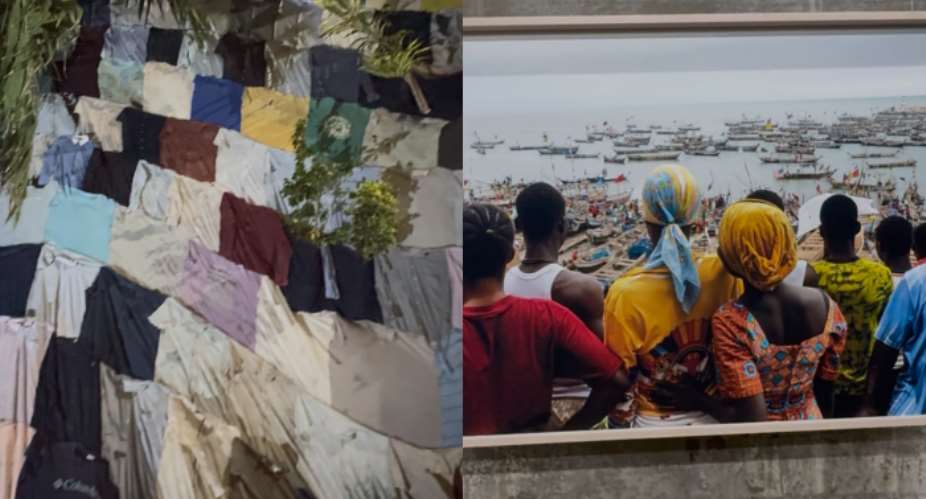
What washes up on Ghana’s beaches is not always just rubbish. For Italian artist and documentary photographer Francesco Bellina and Ghanaian textile artist Emmanuel Aggrey Tieku, discarded clothes found on beaches and in landfills tell a much bigger story about how the world consumes, discards and shifts its environmental burden across borders.
Their collaboration is at the centre of Tides of Humanity, an exhibition which opened at the Nubuke Foundation in Accra on Friday, September 11, 2026.
Curated by Rosa Cascone, the exhibition brings together photography, discarded textiles and other materials to explore climate change, migration, waste, coastal communities and the relationship between Ghana and Sicily.
Bellina’s connection to the project began with the sea.
Born in Trapani, a fishing community in Sicily, he comes from a family of fishermen. His work has taken him between Sicily and Ghana, where he has spent time documenting fishing communities and listening to their experiences.
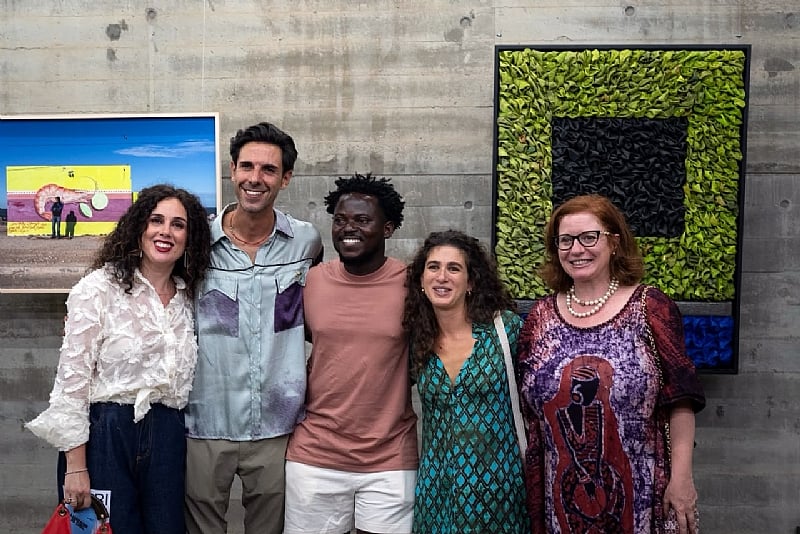 From right: Laura Ranalli, Italian Ambassador to Ghana; Rosa Cascone, Exhibition Curator; Emmanuel Aggrey Tieku; Francesco Bellina and Laura Saitta, a staff of the Italian Embassy in Ghana.
He said fishermen in Sicily are facing changes to their marine environment, including warmer waters, declining fish stocks and the arrival of fish species from other seas.
In Ghana, he has spent considerable time in Jamestown, building relationships with fishermen, community members and chiefs while documenting the coastal community and its changing landscape.
“My hope is that everybody from Sicily to Ghana, anyone who works with the sea, can have a better life, better opportunities, and nobody can be exploited,” Bellina said.
“But first, we shouldn’t exploit the environment, the sea, because it’s our lives.”
When clothes return to Ghana
The exhibition’s textile installation was created by Tieku using discarded clothing collected from Ghanaian beaches and landfills.
Tieku, whose primary medium is textiles, said his interest in the material comes partly from his grandmother, who was a textile collector.
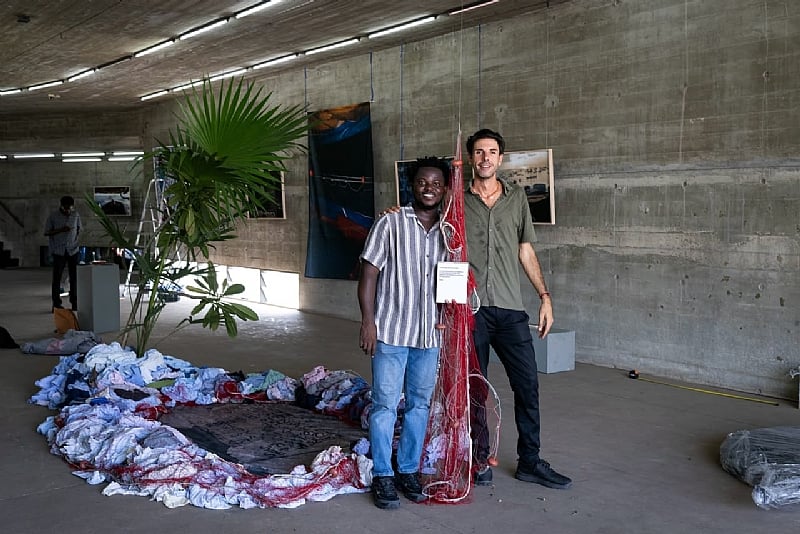 The two artists, Emmanuel Aggrey Tieku (left) and Francesco Bellina (right) posing with some of their works at the exhibition.
For him, clothing is more than something people wear. It accompanies people through important stages of life and carries stories about identity, culture and how people live.
But when discarded clothing ends up on Ghana’s shores, he sees another story.
He said the continuous cycle of consumption and disposal is reflected in the fabric that the sea repeatedly deposits on Ghana’s beaches.
“I think those are some of the things that I think about,” he said. “But I also think about the lives that these clothes have touched, and people that I’ve never met before, who are in continents all around the world.”
Tieku described the movement of used clothing from other parts of the world to Ghana as a possible “reverse of slavery”, drawing a parallel between the historical movement of people from African shores and the return of materials in the form of discarded clothes.
He said the installation forms part of his long-term project, How to Heal a Broken World, which began in 2023 and is expected to run until 2068.
The 45-year project explores textile archiving, material innovation and the use of textiles as a tool for social intervention.
Tieku said the project has already included installations and billboard interventions using second-hand clothing, with plans for the work to travel to other countries.
Art as environmental education
For Bellina, documenting environmental problems is only one part of the responsibility of an artist.
He believes art and culture can help people understand how everyday decisions affect the environment and their own communities.
He recalled an experience in Palermo where an elderly man regularly threw waste outside his window, attracting rats to the area.
Instead of confronting the man directly, Bellina said he recorded a video of the rats and showed it to him, explaining the connection between the waste and the unsafe environment around his grandchildren.
According to Bellina, the man stopped dumping the waste.
He used the experience to argue that enforcement alone may not be enough to change environmental behaviour.
“Sometimes, especially in Europe, if there is a problem, the government say, okay, I send the police to manage this problem,” he said.
“But people didn’t understand why they have to do something before.”
For him, education is therefore central.
“We have to explain that any choice you do in your life is connected with your future. And so culture in this and art in this, try to help a lot.”
Documenting a changing Jamestown
Bellina also sees photography as a way of preserving places that are changing rapidly.
He said some of the landscapes he photographed in Jamestown several years ago are no longer visible in the same form, with new buildings altering views around the community, including areas near the lighthouse.
His work, he said, therefore serves not only as documentation of the present but also as a record of how Accra’s coastal communities are changing.
Bellina first came to Ghana in 2019 after developing a close connection with the Ghanaian community in Palermo.
He said living in a neighbourhood with a large Ghanaian population introduced him to Ghanaian culture and eventually led him to visit communities and cities including Kumasi, Takoradi and Koforidua.
He now describes himself as living between Accra and Palermo.
Beyond the exhibition
Bellina said his work in Ghana will continue beyond Tides of Humanity, with an interest in environmental issues including the impact of illegal mining on communities and health.
He said he appreciates efforts by the Ghanaian government to tackle galamsey but believes the health effects on people living in affected communities also deserve greater attention.
His approach, he said, is not limited to photography.
He wants to continue organising programmes and classes for young people, including in Zongo communities, while building stronger cultural links between Ghana and Sicily.
He also hopes to create opportunities for Ghanaian artists to exhibit their work in Sicily, just as he has been able to bring his work to Ghana.
For both artists, Tides of Humanity is therefore more than an exhibition.
It is an attempt to make visible the environmental consequences of consumption, the changing lives of coastal communities and the connections between people and places separated by thousands of kilometres.
The exhibition, curated by Rosa Cascone, runs at the Nubuke Foundation in Accra until September 26, 2026.

 Catholic Bishops' Conference calls for 20% SHS admission into Catholic schools f...
 Catholic Bishops' Conference calls for probe into SHS placement for sale allegat...
 Trump calls concerns over rogue AI a 'hoax' promoted by a ‘SICK conspiracy’
 US Space Force confirms weapons deployed in space for first time
 How IGP Yohuno led Police team to rescue victim, arrest four kidnappers in Assin...
 Akufo-Addo would have used Accra-Kumasi expressway for galamsey – Mahdi Gibrill
 Nigeria's Dangote refinery launches continent's biggest IPO
 'Our own money $2billion ready, we have not gone to borrow money from anywhere' ...
 Don't be a Bar that flips on principles but a Bar that is consistent — AG tells ...
 Prostate cancer may show no symptoms until advanced stage – Urologist warns


