




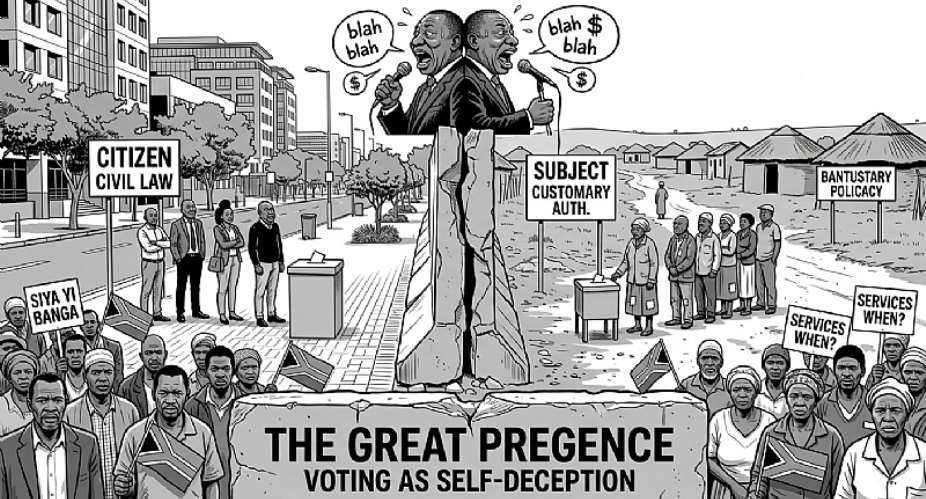
South Africans have perfected a peculiar political art: we speak from both sides of our mouths and have cultivated the habit of knowingly fooling ourselves and anyone else willing to listen.
We complain about broken municipalities, collapsing infrastructure, potholes, sewage in the streets, intermittent water, dysfunctional electricity systems, and councils that cannot perform the most elementary functions of government. Then, when election time arrives, we participate in another ritual, as though changing the name on a ballot paper would somehow change the underlying system.
On 4 November 2026, South Africans will once again make the pilgrimage to voting stations for the local government elections. There will be speeches, T-shirts, posters, promises, songs, food parcels, social media campaigns and endless declarations about service delivery. The Electoral Commission says 142,072 candidates have been nominated for 10,526 council seats, about 43% more nominations than in 2021. Meanwhile, 547 political parties are reportedly contesting the election, compared with 325 in 2021.
This is presented as democratic vitality.
It may instead be the most spectacular evidence of our collective self-deception.
We know that local government is broken. We know that many political parties lack a credible municipal programme. We know that national politicians routinely descend on municipalities during election season, despite having little interest in the mundane business of running them. We know that councillor positions can become avenues for patronage, contracts, influence and political survival. But we continue to behave as though another election, by itself, constitutes democratic renewal.
It is time to ask a more uncomfortable question: why does South African local government remain so numb to citizens after more than three decades of universal suffrage?
Perhaps we have started the story too late.
- The local state did not begin in 1994
The roots of South Africa’s local-governance problem go much further back than the democratic transition. Colonial rule created a political architecture in which different populations were governed by distinct legal and administrative systems.
Mahmood Mamdani's famous formulation in Citizen and Subject describes this as a “bifurcated state”: one political identity was associated with citizenship and civil law, while another was constituted by state-controlled customary authority and subjecthood.
South Africa offers an especially revealing history of this arrangement.
The Shepstone system in colonial Natal helped to construct a model in which African communities were governed indirectly through traditional authorities subordinated to the colonial state. The Governor became the ultimate authority over African administration; chiefs could be appointed, removed and manipulated; customary practices could be codified; and African political identity became increasingly tied to territorial and ethnic administration.
This matters because local government was not originally designed as a democratic instrument enabling citizens to exercise power over the state. It was, in significant respects, designed as an instrument through which the state exercised power over Africans.
Mamdani calls the resulting structure “decentralised despotism”: power was decentralised administratively but not democratised politically. Local authorities could exercise considerable power, yet they remained subordinate to the central state.
The Native Administration Act of 1927 subsequently nationalised and institutionalised elements of this architecture, including the state's capacity to govern Africans through officially recognised traditional authorities. The result was not merely administrative decentralisation, but it was a peculiar form of decentralisation lacking genuine democratic sovereignty.
That history should make us suspicious of the assumption that simply holding elections automatically produces democratic local government.
It does not.
- 1994 changed the franchise. It did not magically change political culture.
The great achievement of 1994 was establishing universal political citizenship and dismantling apartheid’s formal racial order. But political institutions do not become democratic merely because citizens receive ballot papers.
The ANC inherited a state whose institutional culture had been shaped by centralised command, racial administration and highly unequal forms of political participation. The irony is that the movement that liberated South Africa was never structured as a conventional liberal-democratic party. Its traditions of discipline, hierarchy, secrecy and democratic centralism were forged largely under conditions of exile and underground struggle.
The result has been a persistent mismatch between the language of grassroots democracy and the reality of political organisation.
“Amandla asemasebeni” (power belongs to the grassroots) is invoked constantly. But where is that power when the branch cannot meaningfully hold the national leadership to account? Where is it when citizens can attend a meeting but cannot compel a municipality to fix a water system? Where is participation when public hearings become procedural exercises whose outcomes have already been predetermined?
The problem is not confined to the ANC.
This is where South Africans speak from both sides of their mouths.
The ANC talks of transformation while tolerating municipal dysfunction. The DA talks of clean government while nationalising local political contests and turning municipal administration into a proxy war over national power. The EFF speaks the language of radical grassroots emancipation while participating in the same institutional competition for positions and municipal resources.
The IFP, Freedom Front Plus, ActionSA and numerous smaller formations similarly present themselves as alternatives, yet the fundamental question remains: what is their concrete theory of democratic local government? Too often, there isn’t one.
Instead, there is a theory of winning office.
- Politics has become an industry in its own right
The extraordinary number of parties and candidates in 2026 should therefore not be automatically mistaken for extraordinary citizen participation.
It may simply mean politics has become an industry in its own right: politicians are entrepreneurs and corruption is their entrepreneurship.
The municipal council seat has acquired economic and political value. Control of municipalities means access to budgets, procurement, appointments, influence and networks. Pork-barrel politics is not an accidental defect in the system; it has become deeply embedded in political competition. The late Desmond Tutu's image of the “gravy train” remains painfully relevant because the train has not disappeared. More passengers are simply trying to board it.
The absurdity is that parties campaigning for local government routinely speak about national issues. National political figures, including DA’s Helen Zille and Action SA’s Herman Mashaba, appear on local ballots. National ideological battles are imported into ward contests. Candidates promise to ‘save South Africa’ while their actual job may be as mundane as ensuring refuse is collected, billing systems work, roads are maintained, and sewage does not flow into people’s homes.
Local government is treated as a miniature national parliament rather than what it should be: the institutional machinery through which citizens experience the state every day. That is why the distinction between citizen participation and electoral participation matters. Voting once every five years is not the same thing as governing.
A citizen who votes but cannot influence a municipal budget, monitor procurement, access information, hold a councillor to account, or participate meaningfully in decisions affecting their neighbourhood is politically enfranchised yet practically disempowered.
That is the great contradiction in post-apartheid South Africa.
We have expanded formal citizenship while leaving enormous numbers of people trapped in material conditions that make citizenship feel abstract.
Former Statistician-General Pali Lehohla has recently described the country’s democracy as having “collapsed,” forgetting that Shepstonian areas like squatter camps, rural areas and townships are yet to experience democracy more than thirty years later.
Nonetheless, Lehohla’s view highlights declining support for democracy and the widening divide between places such as Sandton and Alexandra. Recent research presented at an IEC seminar indicated that support for democracy had fallen to about 36%, while trust in local government, Parliament, national government and political parties had fallen dramatically.
- The ‘invisible’ citizen is still waiting for 1994
For the affluent South African, local government failure may mean a pothole, a broken traffic light or an unreliable municipal service. For millions of others, it means something much more fundamental: no job, unreliable water, inadequate sanitation, poor roads, overcrowded schools, inadequate healthcare, insecure housing and an economy that seems permanently located somewhere else.
This is why the phrase ‘service delivery’ is itself too small.
The real issue is citizenship.
A person who has a vote but no meaningful economic opportunity, whose municipality cannot provide basic services and whose participation in public decision-making is largely ceremonial, possesses the formal attributes of citizenship without enjoying its substantive possibilities.
And so we prepare for another pilgrimage on 4 November.
We will vote. We will celebrate turnout. Parties will claim victory. Losers will blame the IEC, coalitions, foreign conspiracies, voters or one another. New councils will be formed. Old bureaucracies will remain. The potholes will return. The sewage will continue. The unemployed will remain unemployed.
And five years from now we will repeat the performance in a democracy cycle of ululations and regrets.
Perhaps the greatest South African political fiction is not that politicians lie.
It is that we do not know they are lying.
We know.
They know that we know.
And yet we continue to perform the ritual.
South Africa does not simply suffer from a crisis of local government but suffers from a crisis of political imagination. We have mistaken elections for democracy, participation for attendance, representation for accountability and political competition for public service.
Until we confront the colonial and apartheid inheritance of local administration, the centralisation of political power, the patronage economy and the hollowness of citizen participation, another ballot will change very little.
On 4 November, we will once again be asked to choose who should govern our municipalities.
The more important question is whether we are finally prepared to demand how they will govern them. And whether we, as citizens, will have any real power after the votes are counted.
Otherwise, it will be another pilgrimage to the same political shrine.
And the invisible citizens will still be waiting for their 1994.
Siya yi banga le economy!

 Algeria cuts diplomatic ties with United Arab Emirates over 'provocative and hos...
 Colombia court orders President de la Espriella to hide social media videos of h...
 Account for GH¢49.7m South Africa evacuation expenditure – Minority tells Ablakw...
 Ghana wishes Guyanese diplomat well in UN Secretary-General bid – Ablakwa
 Galamsey 'stealing' boys from classrooms in Bongo – DCE raises alarm
 Leaving Majority Leader role for ministerial position was my choice – Mahama Aya...
 A Rocha Ghana stands by claim of 50-plus forest reserves affected by galamsey
 September 10: Cedi sells at GHS12.15 on forex market, GHS11.45 on BoG interbank
 Open aviation fuel supply to more players to reduce airfares – Akim Swedru MP to...
 Pay my salary arrears, terminal benefits by September 11 or face court – Former ...


