




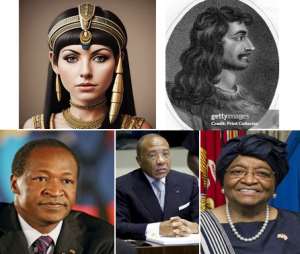
As a history student and enthusiast, I recently researched leaders who killed to gain power. The findings surprised me, and I was shocked by the evil people did to acquire power. Therefore, I am sharing the information with you.
CHARLES TAYLOR
Charles Taylor was president of Liberia from 1997 to 2003. Before, he was a Liberian student leader in the US. In 1979, he returned to Liberia by the invitation of former Liberian President William Tolbert. While in Liberia, the military overthrew Tolbert on April 12, 1980. The coup ended the rule and domination of the Americo-Liberians, a minority Black settler group, particularly from America in the early 1800s. The settlers oppressed and suppressed the native majority whom they met on the land later called Liberia. The junta made Taylor head of the GSA, Government Service Agency. However, the government accused him of embezzling millions of US dollars. He fled to America, where the State of Massachusetts imprisoned him. He escaped jail, left the US, went to Libya, and trained with his rebel group, which removed Doe from power through a civil war. To become president, Taylor double-crossed his financial supporters and eliminated key political opponents, including Jackson Doe and Moses Duopu. He and Duopu were good friends in America. Duopu was also a student leader in New York. Moreover, they served as officials in the Doe military government. Duopu functioned as minister of labor. Taylor became Liberian president after the first Civil War.
Nevertheless, for apparent greed or geopolitics, Taylor became involved in the civil war in neighboring Sierra Leone while president. He supported the rebel group, RUF, sent fighters to the country and received diamonds in return. “The war killed more than 50,000 people, excluding those amputated in Sierra Leone.” At the same time, rebel groups in Liberia mounted attacks against his government, resulting in his forced removal from power. The people of Sierra Leone and other concerned individuals accused him of crimes against humanity and called for him to face justice.
Taylor went into exile in Nigeria. However, he attempted to escape to Cameroon and was caught. Interpol returned him to Liberia, handcuffed him, and then flew him to Sierra Leone. Later, the International Criminal Court, ICC [in The Hague] trialed and found him guilty. ICC jailed him for 50 years for crimes against humanity committed primarily in Sierra Leone for aiding and abetting [in the country’s civil war].”
ELLEN JOHNSON SIRLEAF
Ellen Johnson Sirleaf became Liberian president from 2006 to 2018. Before, she served as finance minister in the Tolbert government. The military spared her from execution. She escaped to the US, where she and others organized a group against President Samuel Doe. The group encouraged ex-general Thomas Quawonpha to implement a failed invasion in Liberia to depose the Doe government. Sadly, Quawonpha died in the operation. Henry Boima Fahnbulleh, Jr., Doe’s former minister of foreign affairs, planned and helped carry out the invasion using his Sierra Leone connection. He attended college in Sierra Leone, knew the president and other Sierra Leonean officials, and married a Sierra Leonean. Sirleaf also recruited the late Amos Sawyer for the invasion because of his Sierra Leone connection. Besides conducting his Ph.D. research in Sierra Leone, his father came from the country.
Determined to succeed in her mission, Sirleaf reportedly helped Taylor escape prison in America to remove Doe. While she banked on Taylor to help achieve her presidential ambition militarily, she faced a crucial problem: Jackson Doe, her party’s political leader, was an obstacle. He was the standard-bearer of the Liberian Action Party in the 1985 Election, and based on an election fraud allegation, he was next in line to assume the presidency upon the invasion success. Further, Jackson Doe hailed from Nimba County, which had the largest number of rebel fighters. To resolve this problem, Patrick Tamba, an eyewitness, described how she handled the situation.
Tamba stated that Sirleaf had talked to Jackson Doe, who was under house arrest, to support the civil war, but Doe firmly refused. Tamba described the execution in the detail that follows.
"Ellen told Taylor that the revolutionary fighters were made predominantly of people from Jackson Doe's tribe from Nimba County; thus, he (Doe) was a threat to her political future as well as Taylor's leadership of NPFL. She said the logical thing to do was to "get rid" of him.... Jackson Doe's hands were tied behind his back (tabby style). His eyes were blinded with red clothes, and he was taken behind Phebe Hospital in Gbarnga and shot in the head by Gen. Jesus. Gen. Cassius Jacobs was sad and was not in favor of the killing of Jackson Doe..... Jackson Doe's body was burned to ashes. We then returned to confirm that the operation was carried out." "Prez Sirleaf Ordered Former Presidential Candidate, Jackson Doe's Execution," Modern Ghana, March 20, 2014.
The late “Tom Woewiyu's letter to Ellen Johnson Sirleaf in 2005 confirms Tamba's assertion regarding Jackson Doe's execution”. Woewiyu was a key advisor to the Taylor rebel forces of NPFL. Moreover, he was one of Taylor’s best friends since their days as leaders of ULAA, the Union of Liberian Association in the Americas. “He was also Sirleaf's friend, though upon becoming [head of state], she tried to sue Woewiyu for exposing her role in the war after the election.”
As mentioned, Sirleaf became president of Liberia, achieving her political ambition. She stayed in office for 12 years until 2018. She also appointed Fahnbulleh as national security advisor for the 12 years of her reign. Though a powerful speaker and progressive icon in the 70s, and “in 1985, he criticized her as Madam Politician and corrupt”, Fahnbulleh kept silent about the wrongs of her administration and on national issues during his appointment. This behavioral contradiction and inconsistency helped her re-election as president in 2011. Additionally, most opposition standard-bearers, specifically Charles Brumskine, Prince Johnson, and Togba-Nah Tipoteh, supported her re-election bid, though the economy under her performed poorly, and she failed to achieve most of her campaign promises in 2005. The main opposition party, the Congress for Democratic Change, CDC, boycotted the second round of the re-election. Consequently, she ran unopposed.
Nevertheless, her administration brought peace and allowed freedom of speech and the press.
BLAISE COMPAORE
Blaise Compaore was president of Burkina Faso from 1987 to 2014. The country is in West Africa and was called Upper Volta. Compaore and his friend, Thomas Sankara, overthrew Jean-Baptiste Ouédraogo, ex-leader of Burkina Faso. Sankara became president. He was progressive, revolutionary, and popular. Compaore served as deputy. Later, he became minister of justice. However, Compaore planned Sankara’s removal and death, paving the way for Compaore’s presidency in 1987. Why and how?
Compaore married Chantal DeFougeres, a foster daughter of Ivory Coast former President Houphouët-Boignye. Her foster sister, Daisy Delafosse, Boignye’s adopted daughter, married A.B. Tolbert, son of Liberian ex-President William Tolbert. The son and his father died in the 1980 Revolution led by Master-Sergeant Samuel Doe. She and DeFougeres were close. In fact, Delafosse moved to Burkina Faso to be near her sister when Compaore became president. While there is no evidence that Delafosse impacted or influenced Compaore’s behavior, AB’s death pained her and her father. President Boignye blamed Doe for AB’s demise. Moreover, Compaore decided to help Charles Taylor’s plan to invade Liberia to remove Doe from power. However, Sankara disapproved of the invasion. As a way to remove Sankara, Compaore used Taylor’s men, particularly Prince Johnson, to participate in assassinating Sankara. Johnson confirmed this below in a testimony before the Liberian Truth and Reconciliation Commission.
”When we got there [Burkina Faso] we were told that we were going to be arrested if we did not comply to remove Thomas Sankara from office because he was not in favor of our plan. We were asked to join a special group of Burkinabe soldiers to overthrow Sankara. That was how Thomas Sankara was removed”.
Compaore became president afterward and introduced Taylor to Gaddafi, who provided a training facility and assistance to Taylor’s invasion. Further, as president, Compaore “contributed troops and other resources to the Liberian invasion”. Tonia King, a Liberian who resided in Ivory Coast, reportedly introduced Taylor to Compaore. King was a Liberian politician who escaped to Ivory Coast after the attempted invasion in 1985.
However, a popular uprising in Burkina Faso in 2014 removed Compaore from power. He fled to Ivory Coast and became an Ivorian citizen. In 2022, the military court in Burkina Faso found him guilty of Sankara’s assassination and sentenced him to life imprisonment in absentia.
EDWARD IV
King Edward IV, April 28, 1442-April 9, 1483, was the son of Richard, Duke of York, and Cecily Neville of England. Both were descendants of King Edward III. The Wars of the Roses, a series of civil wars in England from 1455 to 1487, brought tremendous hardship and painful instability in the country. During the wars, Edward and his younger brother, George, Duke of Clarence, helped depose King Henry VI. Consequently, Edward became king. However, George was unhappy with Edward. Hence, he planned with his Uncle, Richard Neville, to overthrow Edward. But the plan failed twice. When Edward found out about George’s involvement the second time, he executed him by drowning him in a barrel of sweet wine.
HEROD OF JUDEA
King Herod the Great, 72BCE-4BCE, was a well-known Biblical king who ruled Judea during the birth of Jesus. He reigned with the support of Roman authorities, including Mark Anthony, who made him king of the Jews. He gained political power through his father's strong relationship with Emperor Julius Caesar. Herod’s alliance with the Romans made him unpopular in Judea, despite his numerous infrastructural projects in the country. To become popular, he married Mariamme, granddaughter of Hyruans, Judean high priest. But that did not work. Therefore, he accused his family of plotting against him. Hence, he killed Mariamme and their two sons, together with the son of one of his other wives.
RICHARD III
William Shakespeare’s Richard III depicts the ruthless and manipulative nature of King Richard III’s rise and fall. King Richard, October 2, 1452-August 22, 1485, was the brother of King Edward IV and George. He grew up during the Battle of the Roses discussed. He became king after his brother, King Edward IV, was dethroned for bigamy, which delegitimized Edward’s sons and temporarily barred them from ascending the throne. To stay in power, Richard locked up the children in the Tower of London, had them disappeared, and never heard from.
King Richard was defeated and died in the Battle of Bosworth Field in 1485. King Henry VII succeeded him, ending the Wars of the Roses and beginning the Tudor dynasty.
AURANGZEB (November 3, 1618-March 3, 1707)
The children of Shad Jahan of the Mughal Empire, which is now part of India and Afghanistan, started fighting among themselves for the throne during their father’s old age. The father had wanted one of the older sons to succeed him. The two younger brothers, Aurangzeb and Murad, agreed that their two older brothers would be terrible leaders. Therefore, they killed the brothers to make Murad emperor. However, Aurangzeb had wanted to be the emperor all along. So, he killed Murad and made himself emperor. He also imprisoned his father after declaring him unfit to rule. Sadly, he sent Murad’s head in a box to his jailed father.
ATTILA (406-453)
Attila, the Hun, also nicknamed the Scourge of God, ruled the Hun Empire, which consisted of Huns, Alans, and other areas in Central and Eastern Europe. The Huns were Eurasian Nomads who migrated further into Western Europe during the 370s C. They were warriors skillful in mounted archery and were one of the most fearful enemies of the Romans. Attila was the son of Mundzuk, a member of the royal family, and had a brother called Bleda. Their childless uncle, the emperor of the Hunnish Empire, willed that the two brothers rule together. Within 10 years of their rule, Bleda mysteriously disappeared. It was alleged that Bleda’s wife accused Attila of killing Bleda so Attila would be the sole ruler.
ELIZBETH I
Queen Elizabeth I, September 7, 1533-March 24, 1603, was one of the well-known England royal rulers. She had her cousin, Mary of Scots, killed in 1587. Many people considered Mary to be the rightful heir to the throne, “being the granddaughter of Henry VIII’s eldest sister, Margaret Tudor.” Accordingly, Mary, at her execution, stretched out her arm and said her last words: “in manus tuas, domane, commendo spiritum meum”, meaning, “Into thy hands, O Lord, I commend my spirit”.
Before the execution, the executioners knelt before Mary and asked forgiveness. She replied. "I forgive you with all my heart, for now, I hope, you shall make an end of all my troubles”. They helped undress Mary and beheaded her.
Also, before Mary’s death, in 1554, Elizabeth executed another cousin, her opponent, Duke Thomas of Norfolk. Elizabeth alleged that he associated with Mary in the opposition.
JOHN I
John the Fearless, May 28, 1371-September 10, 1419, was known in French history as the Duke of Burgundy or John I. He was the son of Philip the Bold, who was the youngest son of King John II of France. He got the nickname John the Fearless for his ruthlessness in the Battle of Nicopolis in 1396 against the Sultan Bayezid of the Ottoman Empire.
During King Charles VI’s reign, John and his cousin, the Duke of Orleans, engaged in a power struggle, which started due to the king’s mental illness. The two dukes tried to capitalize on the condition by fighting each other for the throne. The struggle resulted in “lies, kidnapping, and even going after each other’s wives”. John went so far as to have a gang beat his cousin to death in the streets. He alleged that he did it because the cousin was using Black magic to kill the king. John became king. However, in 1419, his bodyguards assassinated him on the bridge of Montereau. Philip III succeeded him.
SULEIMAN
Suleiman, the Magnificent, November 6, 1494-September 6, 1566, was sultan of the Ottoman Empire in the 16 century. He reigned for 46 years, from 1520 to 1566, making him the longest ruler in the empire's history. He succeeded his father, Selim I, who ruled only for 8 years. By tradition, Suleiman was to kill his brothers to secure the throne. He had sons with his legal wife, Mahidevan, and also with his many concubines. However, he broke custom by marrying his concubine, Roxelanna, who wanted her son to inherit the throne, instead of his first son with Mahidevan. To achieve this, Roxelanna made Suleiman believe that the first son was plotting to kill him. Therefore, Suleiman killed the son. Roxelanna’s son continued to rule after killing his other brothers.
Interestingly, during Suleiman’s reign, he befriended a Greek slave named Pargali Ibrahim, who became his protégée and closest adviser. Yet he later had Pargali killed.
CATHERINE THE GREAT
Empress Catherine of Russia, May 2, 1729-November 17, 1796, ruled the country from 1762 to 1796, making her the longest-reigning female leader in Russia. She was born in Germany and came to Russia at age 15. She was originally Princess Sophie Auguste Friederike. She was the daughter of Prince Christian August and Joanna Elisabeth. She married Peter III, who became Emperor after the demise of Empress Elizabeth. However, Catherine deposed him after Peter had been on the throne for 6 months. She became Catherine II, the Empress of Russia. 6 days after she ascended to the throne, Peter suddenly died. While it is debatable whether Catherine was involved in his death, documents state that to stay in power, Catherine had her potential rival, Ivan VI, assassinated. Indeed, Ivan “was the only rightful heir, he spent 20 years imprisoned in a dark cellar until he was murdered by order of Catherine”. She went on to rule for 34 years.
CLEOPATRA (About 69-30 BC.)
Cleopatra was queen of Egypt from 51 to 30 BC. She was the daughter of Ptolemy XII, who requested in his will that Cleopatra and her older brother marry each other and rule as king and queen. They refused. Cleopatra allegedly killed her brother and became queen. However, with Julius Caesar’s advice, she grudgingly agreed and married her younger brother. However, after Caesar’s death, she killed the brother and other siblings to become the sole ruler of Egypt. Some documents indicate that she visited Rome several times and that Caesar was her lover. Further, to maintain her reign, influence, and power, she had a political and romantic relationship with Caesar and later, after Caesar’s assassination, married Mark Anthony, Caesar’s friend. Cleopatra committed suicide in 30 BC at age 39. She was the last ruler of the Ptolemaic Kingdom of Egypt.
DIPENDRA (June 27, 1971-June 4, 2001)
Dipendra Bir Bikram Shad was a prince of Nepal from June 1, 2001, to June 4, 2001. He was the son of King Birendra and Queen Aishwarya of Nepal. In 2001, Dipendra was said to have been vexed with his father after his father refused to let him marry a local aristocrat. The prince reportedly came to dinner one day drunk and started arguing with his parents. His siblings calmed him down and helped him to bed. But later that night, he woke up and fatally shot his parents and siblings. He became king. However, after three days, he shot himself dead. His uncle succeeded him.
JULIA AGRIPPINA
Queen Julia Agrippina, November 6, 15-March 23, 59 AD of Rome, was a young Roman’s empress from 49 to 54 AD. Reportedly, she had bad marriages. Her husbands had died of poison. Her son Nero was from her first husband. She married her cousin, Emperor Claudius, and convinced him to adopt Nero. Nero became emperor after Claudius’ death. Julia was implicated in Claudius’ demise. It was alleged that she poisoned him. Nevertheless, Julia unsuccessfully tried to control Nero as emperor. Nero exiled her. While in exile, Julia started plotting against Nero, who eventually executed her.
CONCLUSION
History is the factual narrative of past events. They cannot be erased, changed, or rewritten for the benefit or interest of the powerful, for whatever evils they did in the past became history and are known.
The above true stories are examples of people who killed for power. However, as you read, the power did not last. Many of the leaders discussed became victims of the power. For instance, the ICC sentenced Charles Taylor to 50 years in prison; Compaore went into exile and cannot return to his native country; Cleopatra committed suicide; John I of France died in the street; and Dipendra killed himself.


 Algeria cuts diplomatic ties with United Arab Emirates over 'provocative and hos...
 Colombia court orders President de la Espriella to hide social media videos of h...
 Account for GH¢49.7m South Africa evacuation expenditure – Minority tells Ablakw...
 Ghana wishes Guyanese diplomat well in UN Secretary-General bid – Ablakwa
 Galamsey 'stealing' boys from classrooms in Bongo – DCE raises alarm
 Leaving Majority Leader role for ministerial position was my choice – Mahama Aya...
 A Rocha Ghana stands by claim of 50-plus forest reserves affected by galamsey
 September 10: Cedi sells at GHS12.15 on forex market, GHS11.45 on BoG interbank
 Open aviation fuel supply to more players to reduce airfares – Akim Swedru MP to...
 Pay my salary arrears, terminal benefits by September 11 or face court – Former ...


