




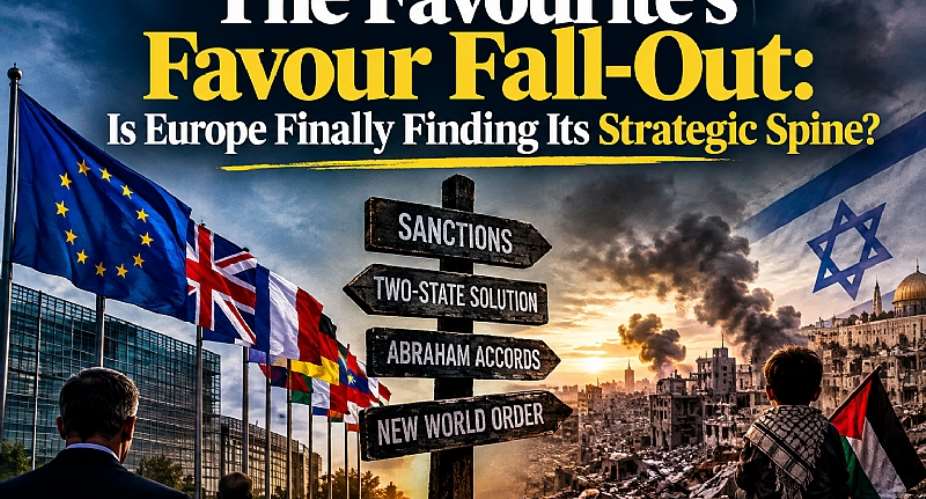
The disorder reshaping today’s geopolitical map is forcing countries to reconsider their foreign-policy calculations. The old diplomatic vocabulary—condemnation, concern, restraint and appeals to international law—is increasingly losing its meaning unless it is followed by action. Foreign policy is no longer merely about carefully chosen words; it is increasingly becoming a reflection of a country’s real strategic interests, values and willingness to defend them.
That is precisely why the latest European move concerning Israeli settlements in the occupied West Bank deserves attention.
The United Kingdom, France and nine European countries, alongside Canada, have announced measures targeting products originating from Israeli settlements in the West Bank. While the European Union’s 27 members failed to reach a unified position, the collective announcement nevertheless represents a significant political signal. For years, Europe largely limited its response to settlement expansion and the Gaza war to diplomatic criticism, while Israel continued to benefit from a degree of political and economic normalisation.
Is that era finally coming to an end?
British Foreign Secretary Ed Miliband’s language was particularly striking. The British government has openly argued that hesitation cannot continue when civilian suffering reaches such a scale. The humanitarian catastrophe in Gaza, the destruction of civilian infrastructure and the continuing displacement of Palestinians have created a political and moral challenge that Europe can no longer indefinitely postpone.
But the real question is not whether Europe can condemn the suffering. The question is whether it can translate condemnation into strategic policy.
Is EU policy shifting towards Israel?
The timing of these measures is politically significant. Israel is heading towards elections in October, while its government continues to face intense international criticism over its conduct in Gaza and its settlement policies.
Yet Europe must be careful not to confuse a change of government with a change of policy.
Benjamin Netanyahu’s political survival has repeatedly demonstrated how domestic political calculations can override diplomatic pressure. Washington’s approach under President Donald Trump has also complicated the European position. Trump has at times pressured European partners while simultaneously maintaining strong political and strategic support for Israel.
But the geopolitical equation appears to be changing. If Europe can impose meaningful economic and diplomatic costs on settlement expansion despite pressure from Washington, it would demonstrate that European foreign policy possesses a strategic identity of its own.
If not, these measures risk becoming another diplomatic blink—strong language today, limited action tomorrow.
Is the Abraham Accord still on the cards?
The Abraham Accords remain an important component of the broader Middle Eastern strategic architecture. Their underlying objective—normalisation between Israel and Arab states—has not simply disappeared because of the Gaza war.
But the political environment surrounding the project has changed dramatically.
Regional states increasingly want security arrangements that address Palestinian grievances rather than bypass them. Any emerging regional security framework, including the broader discussions around a Mecca-centred security architecture, therefore deserves to be viewed not necessarily as an alternative to the Abraham Accords, but as part of a potentially evolving regional equation.
The real test is whether normalisation can survive without a credible political pathway for the Palestinians.
Where does Pakistan stand?
Pakistan has consistently condemned the suffering of Palestinians and opposed policies that undermine Palestinian statehood. Islamabad’s traditional position gives it considerable moral and diplomatic space—but moral positioning alone is no longer sufficient.
Pakistan now faces a larger strategic question: if the international system is genuinely moving towards a new balance, what role does Islamabad intend to play?
The answer cannot simply be another statement of condemnation. Pakistan needs a stronger diplomatic strategy, greater engagement with regional security initiatives and a clearer articulation of its position on the future Middle Eastern order.
The deeper lesson from Europe’s latest move is therefore not merely about Israel or Palestine. It is about whether foreign policy still means what governments claim it means.
If Europe truly believes in international law, human dignity and a two-state solution, the moment has arrived to demonstrate those principles through policy.
The favourite may still have powerful friends. But even favourites eventually discover that unconditional diplomatic protection has a strategic cost


 Open aviation fuel supply to more players to reduce airfares – Akim Swedru MP to...
 Pay my salary arrears, terminal benefits by September 11 or face court – Former ...
 Trump says he'll give Americans $5,000 each if Republicans win midterm elections
 'Govt moves to confiscate, auction containers left at Ghana’s ports for over six...
 'We are not serious Christians; bunch of selfish, greedy people' – Duncan-Willia...
 30,000 classrooms without teachers is a crisis waiting to happen – Adutwum
 How honest station loading boy handed over missing £3,000, GH¢1,000 to Police
 Upgrade one SHS in each MMDAs to first class category A school to tackle placeme...
 How frustrated parents sleep at GNAT Hall as CSSPS placement challenges enter th...
 Two men accused of land guard activities weep in court for forgiveness


