




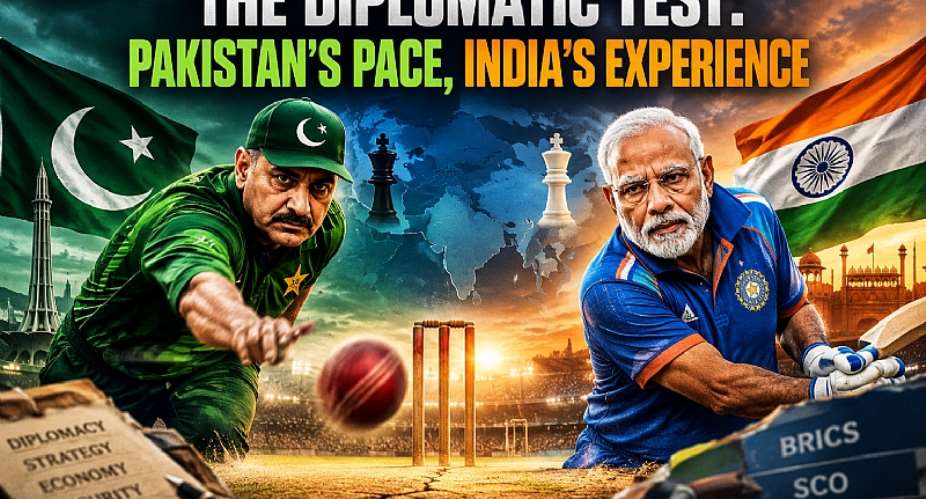
The craze for cricket is a mutually adopted culture across the Indo-Pak region. But beyond the ICC and ACC, an intense diplomatic and strategic match is being played on the political pitch of South Asia. Just as Pakistan once possessed a feared pace attack capable of producing swing, bounce and aggression, its contemporary diplomacy appears to be testing India’s more experienced and defensive diplomatic batting lineup. Let us take a closer look at both sides—their strengths, weaknesses and strategies—and ask the larger question: how will this game ultimately shape the balance of power in Asia?
Pakistan’s display begins with what could be described as extreme pace and attacking diplomacy. The pitch may be the wider Asian region, but the bounce appears greater than even the MCG. Pakistan’s bowling lineup begins with movement from the very first delivery. The ball swings both ways. First comes the outswing, forcing the batsman to recognise that the contest is serious. Then comes the inswing of Asim Munir, leaving little room for anticipation and apparently pushing Narendra Modi away from Washington’s diplomatic lunch table. The experienced Modi takes a review, but on the umpire’s call, Donald Trump delivers the decisive verdict. Pakistan has seemingly taken a major diplomatic wicket.
The Indian batting lineup then finds itself on the back foot, confronted by what resembles a series of swinging yorkers. Pakistan’s game plan appears to be built around sustained pressure. With perceived assistance from its Chinese strategic partner, Pakistan has strengthened its position in the match. The diplomatic pressure has also exposed internal tensions within the Indian camp, with debates involving Gen Z and the older generation affecting political morale. Then, in the middle overs, the Mecca defence pact emerges unexpectedly, further complicating India’s strategic calculations. Pakistan appears to have seized an early powerplay, while the Iranian dimension adds another layer to the contest. Even where the umpire appears reluctant, Pakistan’s diplomatic captain continues to play aggressively. The repeated strikes of the Mecca Accord and the strategic weight represented by the F-16 have left the opposing batsman facing a difficult equation.
The Indian camp, however, does not remain defensive forever. Initially, India protects its wicket through a strong strategic combination, with Rafale aircraft and American support forming part of its broader security architecture. But its decision to take what could be viewed as a wrong review concerning Iran and Israel creates a diplomatic setback. The subsequent argument with the neutral umpire and accusations of bias only add fuel to the contest, particularly when the umpire appears increasingly willing to respond to repeated appeals from the opposition.
India then decides to come onto the front foot. The BRICS platform becomes its opportunity to counter Pakistan’s pace attack, while the SCO summit acts as a strategic shield. As the diplomatic ball becomes older, India appears increasingly comfortable coming out of its crease and sending a stronger message. The idea of a BRICS currency becomes the equivalent of a powerful six over the boundary. The umpire may attempt to restore discipline, but India’s diplomatic batters continue running aggressively between the wickets—from the Russian end toward the Chinese pavilion and back again.
India’s counterstrategy then appears to take the form of an economic powerplay against the Mecca Accord. New economic alignments provide diplomatic space, allowing New Delhi to argue that strategic sovereignty means preserving national dignity while maintaining room for manoeuvre. India’s experience and institutional depth therefore begin to matter more as the match enters its decisive phase. The final ten overs may become the most consequential, with Trump, Pakistan and India all attempting to influence the umpire’s call. Meanwhile, the Afghanistan boundary remains contested from both directions, while India’s independent strategic and economic positioning provides it with additional breathing space. Some anxiety is consequently visible in the Pakistani camp as the Indian batting lineup begins to settle.
Whatever the final result, this match is clearly ongoing. Yet the spirit of the game must not be forgotten. In cricket, biased decisions, questionable appeals and accusations of ball tampering can damage the credibility of the contest. The same principle applies to the political arena. Strategic competition should not become a permanent source of confrontation. Pakistan and India must recognise that respect, dignity and mutually acceptable rules remain essential to regional stability.
The ultimate prize should not simply be the title of Asian power. The greater prize should be Asian peace and prosperity. A genuinely successful diplomatic match would allow both Pakistan and India to strengthen their positions internationally without undermining the other. The final decision should therefore emerge through dialogue, mutual consensus and a credible neutral environment—not through external pressure or unilateral calculations.
The real victory will not belong to the side that merely takes the most wickets or scores the most runs. It will belong to the side—and ultimately the region—that knows how to finish the match without destroying the pitch on which everyone must continue to play.


 Colombia court orders President de la Espriella to hide social media videos of h...
 Account for GH¢49.7m South Africa evacuation expenditure – Minority tells Ablakw...
 Ghana wishes Guyanese diplomat well in UN Secretary-General bid – Ablakwa
 Galamsey 'stealing' boys from classrooms in Bongo – DCE raises alarm
 Leaving Majority Leader role for ministerial position was my choice – Mahama Aya...
 A Rocha Ghana stands by claim of 50-plus forest reserves affected by galamsey
 September 10: Cedi sells at GHS12.15 on forex market, GHS11.45 on BoG interbank
 Open aviation fuel supply to more players to reduce airfares – Akim Swedru MP to...
 Pay my salary arrears, terminal benefits by September 11 or face court – Former ...
 Trump says he'll give Americans $5,000 each if Republicans win midterm elections


