




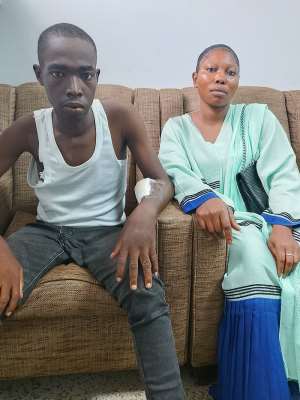
For Alhassan Mohammed Sani, a 35-year-old mathematics teacher at a Junior High School in Bole, in the Savannah Region, the road to a dialysis chair in Accra began with what looked like an ordinary stomach complaint. Sani, who holds a Bachelor of Education (B'Ed) in Mathematics, built his career in the classroom long before illness reshaped his daily routine.
What was initially treated as stomach ulcers at the Bole District Hospital would, in time, turn out to be something far more serious a kidney condition that has since reshaped every aspect of his life.
Sani's case echoes a pattern increasingly familiar to clinicians and patient advocates tracking Ghana's renal care system: symptoms first misread as routine gastrointestinal illness at the district level, only for the underlying kidney damage to surface later, often after it has progressed significantly.
Once his kidney condition was properly identified, Sani was placed on Peritoneal Dialysis at the Tamale Teaching Hospital, a treatment option that allowed him to remain closer to home in the early stages of his illness. But as his condition advanced to the point of requiring Hemodialysis, he found himself facing a familiar reality for patients in Ghana's northern regions: the specialists and equipment for that level of care are concentrated in Accra.
That transition from Peritoneal Dialysis in Tamale to Hemodialysis in the capital is what brought Sani south, where he now receives treatment at the Dorris Dialysis Center inside Ridge Hospital, and has remained tied to that routine since 2025.
A Teacher's Life Interrupted
Before his diagnosis, Sani built his life around the classroom, teaching in Bole, a district that, like much of Ghana's Savannah Region, sits hundreds of kilometers from the concentration of specialist renal facilities in the country's south.
His transition from classroom routine to a recurring dialysis schedule in Accra reflects a broader structural gap facing patients from Ghana's northern and middle-belt districts: the nearest life-sustaining treatment is often a full day's journey or more from home.
Since beginning dialysis in 2025, Sani has had to manage his treatment schedule from a city far from his hometown, his students, and the support networks he built over years of teaching in Bole.
The Weight of Financial Strain
At the time of this interview, Sani had travelled to Accra for one of his weekly dialysis sessions a routine that has now stretched across more than a year.
By his own account, GHC 10,000 has already been consumed on this single session's related costs, part of a cumulative treatment bill that, on a teacher's salary, has climbed to roughly GHC 70,000 to date.
Dialysis is a long-term, recurring commitment, and for a civil servant on a teacher's salary, sustaining it in a city far from home carries a financial burden that compounds with each passing month. Beyond the direct cost of treatment, Sani's case reflects the layered expenses that patients from outside Accra typically face transportation, accommodation, and the loss of income that comes with stepping away from steady employment to manage a chronic illness.
A Search for a Donor With Nowhere Left to Turn
Sani's condition has now progressed to the point where dialysis alone is no longer positioned as a long-term solution his doctors have identified a kidney transplant as the next necessary step. But that path has hit an early obstacle: those closest to him, the relatives he might ordinarily have turned to first, have not been found suitable as donors. The search for a compatible donor now extends beyond his immediate circle, adding a new layer of uncertainty to a journey already defined by cost and distance.
Anxiety as a Constant Companion
Alongside the financial pressure, Sani's experience reflects the anxiety that clinicians describe as near-universal among dialysis patients: uncertainty about long-term prognosis, the disruption of a stable professional life, and the psychological toll of being tethered indefinitely to a treatment routine far from the familiarity of home.
His story adds to a growing body of patient accounts illustrating why Ghana's renal care conversation increasingly extends beyond the clinical question of access to dialysis machines, toward the harder question of how patients like Sani misdiagnosed, relocated, and financially stretched are meant to sustain years of treatment with the support systems currently available to them.
Even under the weight of his diagnosis, Sani has not set aside his ambitions in the classroom. Building on his B'Ed in Mathematics, he remains willing to pursue a second degree, hoping to advance his career as a mathematics educator once his health and finances allow a reminder that behind the recurring dialysis appointments and mounting bills is a professional still reaching toward the future he had planned for himself before illness intervened.
Mustapha Bature Sallama
Medical/ Science Communicator,
Private Investigator, Criminal Investigation and Intelligence Analysis,
International Conflict Management and Peacebuilding. ( USIP)

 UCC-UTAG demands clearer boundaries for GTEC’s regulatory role to avoid interfer...
 Mahama congratulates Lula da Silva on ‘well-deserved’ re-election as Brazil Pres...
 Mahama arrives in Moscow to push for Russia-Ukraine ceasefire at Russia–Africa S...
 'Irresponsible media coverage is hurting Obuasi SHTS abuse probe' – Gender Minis...
 ECG announces 7-hour power outages in parts of Ashanti Region on Tuesday
 World Cup visa scandal deepens discontent among NDC grassroots – Prof Smart Sarp...
 'It is frivolous' – State declines to respond to motion challenging its oppositi...
 'We still have feelings' — Wontumi proposes conjugal visit facilities for marrie...
 'Young men must work and eat' – Prophet Badu Kobi backs Sammy Gyamfi on galamsey
 Foreign Affairs Ministry seeks names of evacuees allegedly shortchanged in GH¢5,...


