




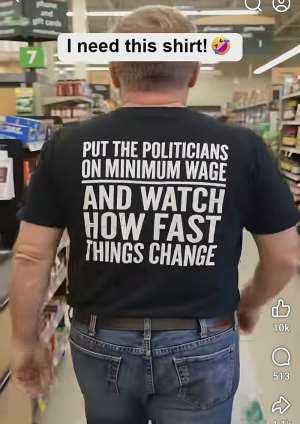
The GH¢60,000 vs GH¢21.77 controversy, the betrayal of workers and why Ghana urgently needs one fair system for public-sector pay. A man walked into a supermarket in America wearing a simple black T-shirt. There was no designer logo on it. No political party symbol. No photograph of a politician. Just a few words written in white: “PUT THE POLITICIANS ON MINIMUM WAGE AND WATCH HOW FAST THINGS CHANGE.” Someone took a photograph. The photograph went viral. Perhaps it went viral because the message was simple. Perhaps it was because millions of ordinary people everywhere understand the frustration behind it.
And in Ghana today, that frustration has acquired some very uncomfortable numbers. The 2026 National Daily Minimum Wage is GH¢21.77. That is an increase of GH¢1.80, or 9%, from GH¢19.97 in 2025. The National Tripartite Committee agreed to the adjustment after negotiations involving government and organized labour. Then came the startling revelation that has ignited a fresh national conversation: JoyNews Research and Data Analyst Caleb Ziblim reported that Members of Parliament are now earning approximately GH¢60,000 a month in basic salary, excluding allowances, under a new remuneration structure that took effect from 2025. The figure is reported to be roughly double the approximately GH¢30,000 basic salary previously received.
One figure is GH¢21.77 a day. The other is approximately GH¢60,000 a month. That contrast demands more than outrage. It demands an honest national conversation about fairness, public-sector remuneration, organized labour and the architecture of government salaries in Ghana.
The Numbers are not the Whole Story
Let us begin with caution. The GH¢60,000 figure should not be treated as though it were an official parliamentary payroll document until the appropriate authorities publish the underlying remuneration structure. It is a figure publicly attributed to Caleb Ziblim and subsequently reported by several media outlets. But whether the exact figure is GH¢60,000, slightly below it or above it does not alter the fundamental question. How should Ghana determine what people paid from the public purse ought to earn?
And that question is much bigger than Parliament. It concerns the President. It concerns Ministers. It concerns Members of Parliament. It concerns judges and other constitutional office holders. It concerns teachers, nurses, doctors, police officers, prison officers, firefighters, civil servants and the thousands of other Ghanaians whose salaries are ultimately financed by the taxpayer. It concerns pensioners too. And that is where the argument becomes particularly painful. Ghana's 2026 minimum wage is GH¢21.77 per day, equivalent to about GH¢587.79 for 27 working days.
Yet many public-sector workers with university and professional qualifications remain on salaries that barely allow them to survive after rent, transportation, food, school fees, utility bills and deductions. The question, therefore, is not whether an MP deserves a reasonable salary. Of course MPs should be adequately remunerated.
The question is: What about the person who teaches the child who eventually becomes an MP? What about the nurse who looks after the MP's constituents? What about the police officer who protects the MP? What about the civil servant who processes the documents that keep government functioning? What about the pensioner who spent 30 or 40 years serving the same state and now struggles to buy food and medicine?
This Argument did not Begin in 2026
This is where the conversation must move beyond social media. There is a history behind this controversy. In June 2020, the Presidential Commission on Emoluments on Article 71 office holders, chaired by Professor Yaa Ntiamoa-Baidu, made recommendations concerning remuneration and the wider problem of disparities in public-sector salaries. One of the fundamental concerns emerging from that process was the need to address disparities in public-sector pay so that workers could work and live in dignity. That recommendation should make today's debate particularly uncomfortable. Because six years later, Ghana is still struggling with essentially the same problem. Why? And where were the voices of organized labour? This is not an accusation against every individual union leader. Many labour leaders have fought genuinely hard for workers.
But organized labour must answer a legitimate question: Why has the issue of structural disparities in public-sector remuneration not been pursued with the same sustained intensity with which individual wage negotiations are pursued? There was even labour representation connected to the work of the Presidential Commission. So it would be difficult to argue that the problem was unknown. The problem was known. The disparities were known. The recommendations were known. Yet the country continued along the same path.
When Union Leadership Becomes Fragmented
Perhaps one of the greatest weaknesses in Ghana's labour system is fragmentation. Teachers negotiate through their unions. Nurses through theirs. Civil servants through others. University workers have their own arrangements. Health workers have different structures. Security agencies have their own peculiarities. And government sits across the table negotiating separately with different groups at different times. But the worker does not experience the economy in compartments.
A clerk is a clerk. Whether that clerk works in a hospital, university, ministry or local government, he or she still buys the same rice. The same cooking oil. The same fuel. The same rent. The same medicine. The same school uniform. The same electricity. The same transport. So, why should the basic philosophy of remuneration be so fragmented? This is precisely where the idea behind the Single Spine Salary Structure deserves renewed examination.
The Single Spine was supposed to bring greater order, fairness and transparency to public-sector pay. But what happened? We still have thousands of discrepancies, allowances, special arrangements and occupational differences that have produced a public-sector remuneration system that many workers perceive as anything but a single spine. Even the former Minister for Labour, Jobs and Employment, Dr Rashid Pelpuo, acknowledged in 2025 that Ghana's public wage bill remains characterized by significant inequities across sectors and called for a comprehensive review of the public-sector pay regime. That admission should not be ignored.
The Old Kufuor Question has Returned
Former President John Agyekum Kufuor once captured the employer-worker relationship in a memorable way: government pretends to pay workers and workers pretend to work. It was controversial. But there was a serious philosophical question underneath it: Where is productivity in the equation? Today, however, the conversation appears to have moved in another direction.
We are increasingly discussing salaries without discussing productivity. We are discussing remuneration without discussing equity. We are discussing compensation without asking whether the person at the bottom of the public-sector ladder can live with dignity. And now we appear to have reached the point where some remuneration packages can rise dramatically while ordinary workers are expected to celebrate single-digit increases.
The government and organised labour agreed to a 9% increase for public-sector workers under the Single Spine Salary Structure for 2026, alongside the 9% minimum-wage increase. Nine percent is not necessarily unreasonable. But when workers hear reports of a basic salary doubling elsewhere, the psychological effect is devastating. People begin asking: Why them and not us?
What about Our Pensioners?
And then there is the forgotten army: Ghana's pensioners. This is where I find the current debate particularly painful. A pensioner who served Ghana for decades cannot understand why the state can accommodate substantial remuneration for those currently holding political office while pensioners struggle with inadequate monthly pensions.
For many pensioners, the issue is not luxury. It is survival. Food. Medicine. Rent. Electricity. Transportation. And dignity. The argument should therefore not be reduced to whether MPs should earn GH¢60,000. The broader question is: What is the minimum standard of dignity that Ghana guarantees to every person who has served the Republic? If we can design generous remuneration structures for people holding public office today, surely we can design a humane pension system for those who served yesterday.
And What about SSNIT?
This is also why the recent debate about pensions and SSNIT should be approached carefully. If we are genuinely concerned about fairness in public remuneration, then Ghana must eventually confront the fragmented pension architecture in the same way that it must confront fragmented remuneration. Why should different categories of public servants have radically different retirement arrangements? Why should the retirement experience of one public servant be fundamentally different from another simply because of the institution in which he or she served?
There is a compelling argument for examining whether Ghana should move towards a more coherent national pension architecture while protecting legitimate accrued rights. The same principle should apply to remuneration. One country. One taxpayer. One broad philosophy of fairness.
The Chief Justice and the SSNIT Question
This brings me to another issue. When the Chief Justice visited SSNIT and subsequently made observations about the institution, some pensioners welcomed the attention. But I would have preferred something more profound. I would have liked the Chief Justice to sit down with ten ordinary SSNIT pensioners. Not SSNIT officials. Not administrators. Not managers. But just ten pensioners.
Let them tell him what GH¢1,000 --- or whatever their individual pension happens to be --- means at the end of a month. Let him hear from the pensioner who must choose between medicine and food. Let him hear from the widow who has become dependent on children who themselves are struggling. Let him hear from the pensioner who worked for Ghana for 30+ years and now feels abandoned by the Republic. Sometimes institutions explain themselves. But people explain suffering. And as a judicial officer, the Chief Justice knows better than most that justice requires hearing both sides.
The 100% Demand
This brings us to the proposal now circulating widely: If one category of public office holders can receive a 100% increase, why can't teachers, nurses and other workers demand the same? As a negotiating position, I understand it completely.
If the reported basic salary of MPs has indeed moved from approximately GH¢30,000 to approximately GH¢60,000, workers will inevitably ask why their own increases should remain in single digits. But I would go further. The demand should not merely be: “Give us 100%.” It should be: “Give us a transparent, rational and equitable remuneration system.”
If 100% is justified for one group, explain why. If 9% is justified for another, explain why. If one occupation receives special allowances, explain why. If another is denied them, explain why. If one public servant retires under a more generous arrangement, explain why. If another retires under a less generous arrangement, explain why. That is the conversation Ghana needs.
We Need an Alignment Principle
Ghana should consider establishing a clear constitutional or statutory principle linking the remuneration of Article 71 office holders to broader movements in public-sector remuneration. For example: No increase in the salaries and allowances of Article 71 office holders should exceed the percentage increase granted to the generality of public-sector workers unless the independent body responsible for determining emoluments publicly demonstrates compelling reasons for the difference. That would not mean MPs must be paid exactly the same as teachers. It would mean the gap cannot simply become whatever the political class decides it should be. And there is already movement towards institutional reform.
In 2025, the then Labour Minister reaffirmed government's intention to establish an independent Emoluments Commission, involving the merger of the Presidential Commission on Emoluments and the Fair Wages and Salaries Commission, in line with recommendations of the Constitutional Review Commission. That opportunity must not be wasted.
Let Us Stop Making this Political Party Issue
This is not about NPP. It is not about NDC. It is not about Mahama. It is not about Akufo-Addo. Both major political traditions have had opportunities to confront Ghana's remuneration crisis. The problem has survived them all. Indeed, if one party increases political remuneration and another inherits the arrangement and maintains it, then the problem is no longer partisan. It is systemic. And if organized labour negotiates nine percent for ordinary workers while political remuneration rises much faster, labour must be prepared to explain to its members why.
This is where union leadership matters. A union exists because an individual worker is weak but workers acting collectively are powerful. If workers cannot collectively demand fairness, then what exactly is the purpose of collective bargaining?
“Put the Politicians on Minimum Wage”
I do not literally believe Ghana should pay MPs GH¢21.77 a day. That would be populism rather than policy. But I understand the philosophy behind the slogan. It says: Let those who make decisions experience the consequences of the decisions they make.
If you decide that a salary is adequate, ask whether you could survive on it. If you decide that a pension increase is sufficient, ask whether you could buy your medicine with it. If you decide that a teacher deserves 9 percent, ask whether you could educate three children on that salary. If you decide that the minimum wage should be GH¢21.77, ask whether you could feed yourself and your family on it. If you approve a hospital budget, ask whether you would send your own child there. If you permit polluted rivers to continue feeding communities, ask whether you would drink the water. That is the moral dimension of public leadership.
Ghana does not need another Salary War
What Ghana needs is something much more fundamental. We need a National Remuneration Framework. One independent institution. One transparent methodology. One database of public-sector remuneration. One system for determining salaries and allowances. One framework that considers qualification, responsibility, risk, productivity, market conditions, inflation, national affordability and the cost of living. And one principle that cannot be compromised: Nobody who works for the Republic should be condemned to indignity while another category of public servant enjoys privileges that bear no reasonable relationship to responsibility or productivity.
The 2020 emoluments debate gave Ghana an opportunity. The Single Spine gave Ghana an opportunity. The establishment of Fair Wages gave Ghana an opportunity. The proposed Independent Emoluments Commission gives Ghana yet another opportunity. We must stop creating institutions without solving the problem they were created to solve.
The Final Question
The black T-shirt remains powerful because it asks a question that politicians everywhere would rather avoid: What would happen if those making the rules had to live under the same economic conditions as those affected by the rules? Perhaps fuel prices would not crash in 30 days, as the social-media post claims. Perhaps the cedi would not magically stabilize. Perhaps corruption would not disappear in seven days. Real economies are more complicated than that. But something would change. The sense of urgency would change. And that may be the most important thing of all.
A politician who knows that his or her child will attend the same public school will care differently about education. A leader who knows that his family will use the same public hospital will care differently about healthcare. A decision-maker who must depend on public transport will look differently at transportation policy. A politician who knows that retirement means living on a modest pension will look differently at pension policy.
Leadership becomes different when insulation disappears. That is why the debate over GH¢60,000 and GH¢21.77 should not end with outrage on Facebook, X or WhatsApp. It should lead us to a national question: What is a fair wage in Ghana? And another: Who should decide it? And perhaps the most important: Why should a country that can find money for some, always claim that there is no money for others?
Ghana cannot continue pretending that its remuneration system is fair when its own institutions acknowledge significant disparities in public-sector pay. We cannot continue telling workers to sacrifice while creating increasingly generous arrangements at the top. We cannot continue asking pensioners to endure hardship while debating privileges elsewhere. And organized labour cannot continue negotiating in fragments while workers suffer as one.
The time has come for labour to bargain as one. For government to account for every cedi spent on public remuneration. For Parliament to subject its own remuneration to greater transparency. For an independent emoluments institution to establish objective rules. And for Ghana to build a public-sector salary system based not on political influence, institutional bargaining power or proximity to power, but on fairness, affordability, responsibility, productivity and human dignity.
The slogan on that black T-shirt may be deliberately provocative. But perhaps Ghana needs a little provocation. Put the politicians on minimum wage? Maybe not literally. But put the people who determine wages inside the same conversation about economic survival as the people whose wages they determine. Then perhaps we will finally discover how fast things can change.
FUSEINI ABDULAI BRAIMAH
+233208282575 / +233550558008
[email protected]

 FDA warns against falsified Dr Alfred Capsules adulterated with sildenafil
 World Bank findings strengthen call for GoldBod probe – Jerry Ahmed
 Teacher salary delays now a human rights issue – Kofi Asare
 WASSCE, BECE outcomes threaten future of over 200,000 students – Osahen Afenyo-M...
 Nigerian presidential hopeful Obi promises anti-corruption drive
 US bans Canadian alcohol, motorcycles and dairy products as trade spat escalates
 Failing one or two BECE core subjects does not remove student from placement – E...
 Spiritualist found dead in suspected suicide at Assin-Amoabeng
 Court orders Ghana Police to file disclosures in Labone robbery case
 No businessman will sponsor NPP again because of its ‘evil and greedy nature’ – ...

