




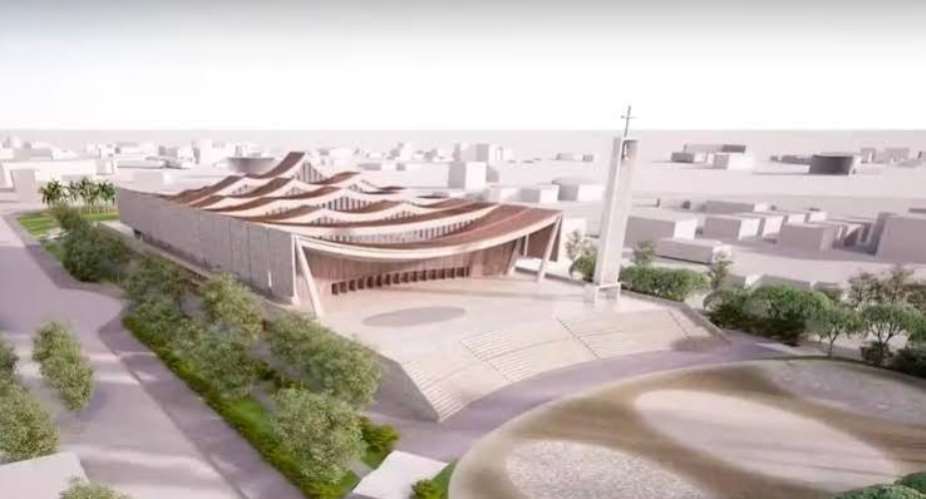
In "Ghana's Graveyard of Good Intentions," I argued that Ghana has developed a troubling habit of conceiving grand national projects with fanfare, only to abandon them halfway when political winds shift. The National Cathedral sits, uneasily, among the headstones in that graveyard: a cleared plot in Accra, hundreds of millions of cedis spent, and a structure that exists mostly in architectural renderings and government press releases. It is tempting, given the scandal and cost overruns that have trailed the project, to write it off entirely as vanity dressed up as piety. That temptation should be resisted, because the case for the Cathedral was never really about religion. It was, and remains, about something Ghana needs regardless of who occupies Jubilee House: a civic monument equal to the weight of the nation's own history.
A National Building, Not Just a Religious One
Strip away the theological framing for a moment and look at what the Cathedral was actually designed to do. Sir David Adjaye's concept was never a church in the ordinary sense, it was conceived as ceremonial infrastructure, a venue for presidential inaugurations, state funerals, and national thanksgiving services, linked by a processional route to Independence Square, the State House, and Osu Cemetery. Ghana currently borrows stadiums, hotel ballrooms, and improvised outdoor grounds for occasions that ought to have a permanent, dignified home. A nation that has produced a Kwame Nkrumah Memorial Park and an Independence Arch understands the value of purpose-built national symbolism; the Cathedral, properly reframed, belongs in that same category of state architecture rather than in the same bucket as a church building fund.
There is also a cultural and economic argument that rarely makes it into the political shouting matches. A landmark of that scale and design ambition, sited in the capital and built around Ghanaian symbols — the stool, the ceremonial canopy, Adinkra-influenced landscaping is heritage tourism infrastructure. Countries that treat their flagship monuments as revenue-generating cultural assets, not just as expressions of belief, tend to recoup a portion of the investment over decades through visitors, events, and the simple fact of putting the country on the map.
What Other Nations Built With the Same Money and the Same Doubts
Ghana is not the first country to pour public attention and money into a religious-national edifice and face exactly the same criticism it is facing now.
The Basilica of Our Lady of Peace in Yamoussoukro, Côte d'Ivoire, was built in the late 1980s at a cost that dwarfed the country's health and education budgets combined, and it drew fierce condemnation as a monument to one president's ego in a country with pressing poverty. Decades later, it is the largest church in the world, a UNESCO-listed landmark, and one of the few reasons international visitors have any reason to route through Yamoussoukro at all. The controversy did not disappear; it simply stopped being the only story people tell about the building.
Barcelona's Sagrada Família has been under construction for more than a hundred years, financed almost entirely by visitor admissions rather than the state, and is now one of the most visited monuments in Europe — an economic engine for the city that long ago outgrew its purely liturgical purpose and became shorthand for Catalan identity itself.
Washington's National Cathedral, despite the name, is formally an Episcopal church, yet it has hosted the funerals of American presidents, national prayer services after 9/11, and civic ceremonies that have nothing to do with any single denomination. Its religious affiliation did not stop it from becoming a piece of shared national infrastructure that the whole country, regardless of faith, treats as its own.
And when fire tore through Notre-Dame de Paris in 2019, the country that rallied to rebuild it within five years was not doing so out of Catholic devotion alone — a majority of the donors and the political urgency came from a secular republic that understood the cathedral as French patrimony first and a place of worship second.
None of these projects were free of scandal, cost disputes, or accusations of misplaced priorities. What they share is that the criticism eventually became a footnote to a building that outlived the argument.
Taking the Opposition Seriously
None of this should be read as dismissing the people who oppose the Cathedral, because their objections are not frivolous. Ghana is a religiously plural society with a significant Muslim population and vibrant traditional faiths, and there is a legitimate constitutional discomfort in having the state bankroll an explicitly Christian edifice rather than a genuinely interfaith or secular civic space. The Auditor-General's findings on unaccounted funds, the review ordered by President Mahama, and the plain fact that construction stalled in 2022 with over two hundred workers laid off are not manufactured grievances, they are the record. In a country still negotiating an IMF programme, still repairing roads and staffing rural clinics, asking citizens to prioritise a cathedral over a hospital is a fair question to put to any government, and one I do not think the Cathedral's boosters have answered honestly enough.
The answer to that fair question, though, is transparency and redesign, not abandonment. A forensic, independently published account of the tens of millions of dollars already spent would do more for the project's legitimacy than any groundbreaking ceremony. Broadening the building's mandate genuinely interfaith prayer spaces, a museum and documentation centre open to all Ghanaians regardless of religion, a mixed public-private financing model that does not lean solely on the public purse would answer the secularism objection without requiring Ghana to demolish nine acres of cleared land and call the whole affair a loss.
The Real Choice
The Cathedral does not have to be either a sacred triumph or a corrupt boondoggle; both framings are doing more political work than architectural or civic work. The honest choice in front of Ghana is whether an unfinished national landmark, sited at the heart of the capital and already partly paid for, gets audited, redesigned for broader civic use, and finished or whether it gets left to join the rusting rail lines and half-built factories that make up the rest of the country's graveyard of good intentions. Other nations have asked themselves the same question about their own contested monuments and chosen to finish the building rather than the argument. Ghana should do the same.
Rexford Adjei Darko
Public Relations Practitioner, Governance & AI Advocate and CSR Researcher


 Anti-galamsey campaigner found dead in suspected suicide at Assin Amoabeng
 National smartphone penetration reached 71.8% as of June 2026 – Communications M...
 It will cost about US$20m to repair fibre cuts this year – Communications Minist...
 Aggressive Big Push road projects responsible for 49% of Ghana’s fibre cuts – Sa...
 How 21-year-old man dies after jumping into Volta Lake as cow struggles in canoe
 Over 12,000 national service personnel demand GH¢41 refund as NSA cites missing ...
 September 7: Cedi sells at GHS12.15 on forex market, GHS11.41 on BoG interbank
 Forex gains accounted for more than 50% of SOE profit margins – Kpessa-Whyte adm...
 Justice Baffoe-Bonnie only stopped short chanting party slogan – Prof Kwesi Yank...

