




There are days when we wish we could reach into the sky, grab the hands of the clock, and turn them backwards. Five years. Ten years. Twenty. Fifty. We imagine ourselves going back to that day when we made the wrong decision, said the wrong words, trusted the wrong person, married the wrong spouse, chose the wrong school, took the wrong job, boarded the wrong bus, moved to the wrong town.
We imagine going back and doing everything differently. But wait. Would we? If the hands of the clock were turned backwards, would our wisdom go with them? Would today's understanding follow us into yesterday? Would the lessons we learned at forty, fifty or sixty accompany the twenty-year-old we once were? Or would we return to the same age, the same circumstances, the same friends, the same pressures, the same temptations, the same ignorance --- and make the same mistakes all over again?
Perhaps that is why life does not give us the privilege of rewinding. Because yesterday's mistakes were sometimes the tuition fees we paid for today's wisdom. Psychologists speak of counterfactual thinking --- that human tendency to imagine how things might have turned out if we had acted differently.
If only I had married someone else. If only I had gone to another school. If only I had accepted that job. If only I had left that town. If only I had listened to my mother. If only I had not trusted that friend.
But there is a danger in living permanently inside the house of if only. You can spend so much time rehearsing an alternative life that you forget to live the one God has given you. The past is a teacher. It was never meant to become your prison.
The young sometimes look at the old and wonder why they made certain decisions. But remember this: You are judging yesterday's person with today's knowledge. That is not always fair. The man who married at twenty-five did not know what the forty-, fifty-, sixty-year-old knows. The woman who chose that husband did not possess the wisdom she possesses today. The young man who abandoned school did not know what education would mean twenty, thirty, forty years later. The girl who trusted the wrong friend did not yet know that some smiles conceal knives.
We grow. We learn. We fall. We rise. And then we look backwards and call ourselves foolish. But perhaps we were not foolish. Perhaps we were simply young. Carl Rogers, one of the great thinkers in psychology, emphasized the importance of becoming rather than merely being.
And becoming is rarely neat. It is messy. It contains wrong turns. It contains disappointment. It contains tears nobody sees. It contains nights when you ask yourself: “How did I get here?” But sometimes you got there because life was taking you somewhere you could not yet see.
And young people, please listen to me. Do not destroy today's happiness because yesterday disappointed you. Do not carry an old betrayal into a new friendship. Do not punish your future spouse for what your former spouse did. Do not reject every opportunity because one opportunity failed. Do not believe that because one door closed, the whole house has disappeared. And please, do not compare your chapter five with somebody else's chapter twenty. Social comparison can make a person feel poor while sitting on wealth, ugly while possessing beauty, unsuccessful while carrying enormous potential.
You look at somebody's car; you do not see the bank loan. You see the mansion, you do not see the family problems. You see the designer clothes; you do not see the tears that fell before the photograph was taken. You see the wedding; you do not see the quarrels behind the bedroom door. You see the politician's convoy; you do not see the enemies he created along the road. You see the professor's title; you do not know who wrote the thesis he proudly defended. You see the chief dancing majestically; you do not know what burdens he carries behind the royal smile.
Laughter is not always evidence of happiness. And silence is not always evidence of sorrow. There are people sleeping tonight in mansions who would exchange everything for one peaceful night. And there are people sleeping tonight in single cardboard rooms, with little food on the table, who will close their eyes with gratitude in their hearts.
Money can buy a kingsize or queensize mattress, it cannot always buy sleep. Money can buy a house; it cannot necessarily buy peace. Money can buy medicine; it cannot purchase immortality. And fame can put your name on everybody's lips while loneliness sits beside you at dinner.
So, young person, do not envy what you do not understand. You do not know the full story of the person whose life you admire. The sociologist Erving Goffman famously described social life in terms of performance --- the roles people present to others.
And perhaps social media has turned the entire world into one enormous stage. Everybody is smiling broadly. Everybody is travelling to distant destinations --- Bali, Switzerland, Dubai, China. Everybody is succeeding. Everybody is eating foreign dishes, not in chop-bars, but in the best restaurants. Everybody is celebrating. Everybody is winning. But behind some of those photographs are people battling anxiety, debt, loneliness, broken relationships, and private disappointments. Do not let somebody else's highlight reel make you hate your own life. You are seeing their display, not their entire existence.
And then there is reincarnation. Sometimes I wonder: If we were given another life, would we choose the same parents? Would a son say, "Yes, give me the same father?" Would a daughter say, "Yes, give me the same mother?" Would we choose the same brothers? The same sisters? The same spouse? The same neighbourhood? The same school? The same friends? We may hesitate. But think deeply. Who would you have become without those very people? Your parents gave you more than a name. They gave you pieces of themselves. Their genes. Their temperaments. Their strengths. Their weaknesses. Their fears. Their stubbornness. Their laughter. Their resilience. The person you became is partly the product of that mysterious fusion between one man called Father and one woman called Mother.
Remove them from your story --- and you remove the person you are today. So perhaps some of the people we complain about were also characters in the making of us. There is a beautiful humility in accepting that we are human. We make mistakes. We misjudge people. We choose badly. We sometimes listen, when we should have walked away. We sometimes walk away, when we should have stayed. We love people who hurt us. We hurt people who loved us.
We chase things that later prove worthless. And sometimes we lose things only to discover later that losing them was God's way of saving us. Psychologist Martin Seligman's work on resilience and positive psychology reminds us that human beings can learn to interpret adversity differently. The event may not change. But the meaning we attach to it can change everything. The broken relationship can become a lesson. The failed business can become experience. The rejection can become redirection. The disappointment can become maturity. The closed door can become protection. Your scar can become your teacher.
So, my dear young people, do not glue your mistakes to your memory. Remember them. Learn from them. But do not worship them. There is a difference between remembering the past and living in it.
Forgive yourself for not knowing what you know now. Forgive yourself for being young. Forgive yourself for trusting the wrong person. Forgive yourself for making the wrong choice. Forgive yourself for taking the longer road. And then --- walk. There is still road ahead.
My three Ps remain: Prayer. Patience. Perseverance. Pray when you do not understand. Be patient when nothing seems to be working in your favour. Persevere when everybody tells you to quit. And above all, keep hope alive.
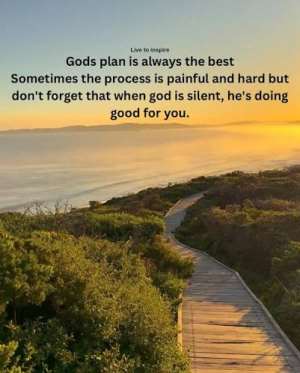
Because sometimes, God delays something not because He has forgotten you, but because you are not yet ready for what you are asking for. We make plans. God makes plans. And we must never forget: God is the best of planners.
The Scriptures remind us that God may decree a thing we dislike while it contains good for us, and that we may love something that is harmful to us. That is the mystery of faith. We see today, God sees yesterday, today and tomorrow.
We see the closed door; God sees what is behind it. We see the unanswered prayer; He sees the consequences of answering it too soon. We see delay; He sees timing. And this is something I keep reminding my children: No one can give you what God has denied you. And neither can anyone take away what God has freely given you.
So do not destroy yourself trying to possess what was never written for you. Do not become bitter because somebody else received what you wanted. Do not mistake another person's blessing for evidence of your own abandonment. Your time will come. And if it does not come in the form you expected, perhaps God has written something different for you. Something better. Something safer. Something more meaningful.
The great Viktor Frankl, who survived unimaginable suffering, argued that human beings can discover meaning even in terrible circumstances. That is a lesson worth carrying into youth. You cannot always choose what happens to you. But you can choose what you become because of what happens to you.
You can become bitter, or better. You can become a prisoner of yesterday; or an architect of tomorrow. You can spend your life asking, “Why me?” Or you can eventually ask, “What can I learn from this?”
One day, you will look back. And perhaps you will discover that the road you hated was the road that made you strong. The friend who left taught you independence. The rejection taught you resilience. The failed marriage taught you yourself. The empty pocket taught you humility. The betrayal taught you discernment. The loneliness taught you how to sit comfortably with your own soul.
And the years you thought God had forgotten you --- may turn out to be the years in which He was quietly preparing you. So stop asking for the hands of the clock to be turned backwards. Let yesterday remain yesterday. You cannot edit it. You cannot delete it. You cannot negotiate with it. But you can learn from it. And tomorrow? Tomorrow is still a blank page. Take your pen. Pray. Be patient. Persevere. And write. Because life is not about having a perfect past. It is about making the best possible use of the present.
And perhaps, that is why every morning is such a beautiful gift. God gives us another sunrise without asking us to explain yesterday. Another morning. Another breath. Another opportunity. Another page. Another chance to become better.
So thank Him. For the children. For the parents. For the mistakes. For the lessons. For the disappointments. For the little victories. For the things He gave us. And even, for some of the things He refused to give us. Because sometimes, His mercy is hidden inside His refusal. And when you cannot understand why your life has taken the road it has taken, trust Him. Keep walking. Keep praying. Keep hoping. For He has a time for everyone. A season for everything. And a purpose for every life. We plan. God plans. And God is the best of planners.
So let us stop trying to turn back the hands of time. Let us turn instead towards the One who holds time itself. And walk. With faith. With gratitude. With patience. With perseverance. And with hope. Always with hope.
FUSEINI ABDULAI BRAIMAH
+233208282575 / +233550558008
[email protected]


 Germany’s far-right AfD landslide winner in key Saxony-Anhalt vote, early result...
 'The height of absurdity' — Ayew Afriye slams BNI over invitation of Efya Royal ...
 US envoys arrive in Moscow to thrash out plan to end war in Ukraine
 'Chief Justice was talking as a citizen; you have to look at the context in whic...
 Mandatory towing to remove broken-down, stationary vehicles from roads to begin ...
 Domelevo backs OSP probe into alleged GH¢70,000 payment to Appiagyei despite den...
 WAEC releases 2026 WASSCE results, cancels entire results of 861 candidates for ...
 Baffour Agyeman-Duah explains why profitability may not be only reason behind SO...
 5-year-old girl dies after falling into water-filled manhole at Winneba
 Sierra Leone ex-president to return after treason case dropped

