




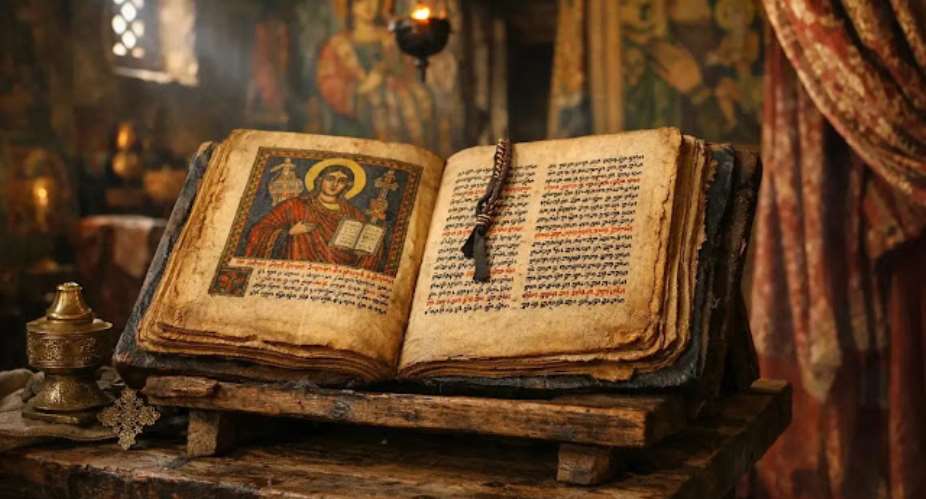
Photo: An ancient Ethiopian manuscript written in Geez displayed inside a traditional monastery.
Ethiopia occupies a distinctive place in world history, not only for its ancient civilization but also for its remarkable written culture and deep Christian heritage. Although the country is not mentioned as frequently in modern news as Egypt, Libya, Syria, or Iran, Ethiopia appears prominently in biblical history and prophecy.
Historically known as Abyssinia, it stands out as one of the few African nations that was never colonized, maintaining its sovereignty even during the height of European imperial expansion. After World War II, Ethiopia became one of the founding members of the United Nations, further cementing its global significance.
The name Ethiopia originates from a Greek compound meaning “people with sunburned faces,” a reference to its ancient inhabitants. As the only traditionally Christian nation in sub‑Saharan Africa, Ethiopia embraced Christianity as early as the fourth century. Situated on the eastern tip of Africa, the country is considered the cultural heir of the powerful Aksumite kingdom, one of the great civilizations of antiquity.
You may also like to read: The legendary Queen of Sheba: Where did she go?
Ethiopia’s uniqueness lies in its ancient written tradition, which developed alongside its early adoption of Christianity. Its Monophysite church, the Ethiopian Orthodox Tewahedo Church, is among the oldest pre‑Chalcedonian Eastern churches, sharing theological roots with the Armenian, Syrian‑Jacobite, and Coptic churches.
Christianity entered Ethiopia during the reign of King Ezana in the mid‑4th century, carried by Syrian merchants and missionaries. Until 1959, the Ethiopian church remained under the jurisdiction of the Coptic Patriarch of Alexandria, whose appointed metropolitans served in Ethiopia.
With the spread of Christianity came the need to translate biblical texts into the language of the ruling elite, the ancient Geez (or Ge’ez). Geez belongs to the northern branch of the Ethiopic Semitic languages and served as the literary and liturgical language of Ethiopia for centuries.
Although Geez ceased to be spoken as a daily language between the 8th and 10th centuries, it remained the primary written language until the 19th century and continues to be used in church services today. Modern Ethiopia’s official language, Amharic, emerged later as the language of the military and political elite in the 13th century.
The earliest Ethiopian books were translations of the Holy Scriptures, both the Old and New Testaments. Biblical quotations appear in monumental inscriptions of Aksumite kings, liturgical texts, and sermons. For Ethiopians, the concept of a “book” was inseparable from sacred writings. The Bible was called mehathaf kydus (“holy book”) or simply metshaf (“book”).
Related biblical article: The African roots of Black Jews: Ethiopia, Igbo, Lemba, and the lost lineages
Interestingly, the Arabic term "mushaf" (intertwined book) was borrowed from Ethiopian, reflecting early Islamic contact with Ethiopia and the use of Ethiopian terminology for Quranic records. Several biblical apocrypha and early Christian writings survive only in Geez, preserved through Ethiopia’s centuries‑long isolation and the conservatism of its scribes.
Traditional ecclesiastical education, often lasting up to 30 years, trained scribes in Scripture, theology, and classical literature. Ethiopian manuscripts, whether royal chronicles, monastic histories, or hagiographies, reveal extraordinary familiarity with the Bible and the writings of the early Church Fathers.
Behind each manuscript lies a rigorous educational system that shaped Ethiopia’s literary culture, its reverence for books, and the distinctive features of its medieval texts. Ethiopia’s independence played a crucial role in preserving its sacred heritage. In 1887, Emperor Menelik II exposed a deceitful treaty crafted by Italian colonizers, preventing the country from falling under foreign rule.
Unlike many African nations, Ethiopia resisted colonization, protecting its ancient artifacts, manuscripts, and religious treasures from foreign looting. This independence explains why the world’s earliest illustrated Christian Bible was discovered not in Europe but in an Ethiopian monastery.
The Ethiopian Orthodox Tewahedo Church also claims to possess the Ark of the Covenant, housed in the Chapel of the Tablet in Axum. Although the Ark has never been publicly displayed, the claim reflects Ethiopia’s profound biblical identity.
Whether the Ark is truly there remains unknown, but one fact is clear: Ethiopia’s survival against colonial aggression ensured that its sacred traditions, manuscripts, and religious heritage remained intact.
More interesting biblical article: The hypothetical scenario of Trump seeking the Ark of the Covenant to invade Ethiopia
Ethiopia’s written culture is therefore not merely a historical curiosity; it is a living testament to a nation that preserved its identity, faith, and literary legacy against all odds. Its manuscripts, languages, and traditions continue to inspire scholars, believers, and historians around the world.


 'The height of absurdity' — Ayew Afriye slams BNI over invitation of Efya Royal ...
 US envoys arrive in Moscow to thrash out plan to end war in Ukraine
 'Chief Justice was talking as a citizen; you have to look at the context in whic...
 Mandatory towing to remove broken-down, stationary vehicles from roads to begin ...
 Domelevo backs OSP probe into alleged GH¢70,000 payment to Appiagyei despite den...
 WAEC releases 2026 WASSCE results, cancels entire results of 861 candidates for ...
 Baffour Agyeman-Duah explains why profitability may not be only reason behind SO...
 Kofi Bentil defends Mahama’s dissolution of nine State Boards
 5-year-old girl dies after falling into water-filled manhole at Winneba
 Sierra Leone ex-president to return after treason case dropped

