




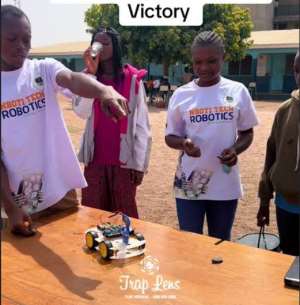
Somewhere in rural Ghana today, there may be a child capable of becoming a brilliant engineer, software developer, robotics specialist, medical technologist or inventor.
The tragedy is not that the talent does not exist.
The tragedy is that the opportunity may never arrive.
While students in some well-resourced urban schools are learning coding, robotics and electronics, many children in rural Ghana still have little or no access to computers, science laboratories, robotics kits or practical STEM education.
This is where Corporate Ghana must step in.
Companies spend millions of cedis every year on Corporate Social Responsibility programmes. These investments support health, education, sanitation, sports and community development. All are important.
But it is time to make rural STEM education a major CSR priority.
Banks, telecommunications companies, mining firms, insurance companies, manufacturers, oil and gas companies and other businesses should consider adopting rural schools and establishing practical STEM laboratories and robotics centres.
Imagine if every major Ghanaian company established just one properly equipped STEM laboratory in a rural community.
Imagine hundreds of children learning to code, assemble electronic circuits, build robots, experiment with renewable energy and use technology to solve problems within their communities.
The impact could last generations.
Initiatives such as Nboti Tech, which is bringing practical technology and STEM education closer to learners in rural Ghana, demonstrate what is possible when opportunity is taken to the child instead of waiting for the child to travel to the opportunity.
But initiatives like these need partners.
A rural STEM laboratory does not have to begin as a multimillion-cedi project. Companies can provide laptops, robotics kits, electronic components, internet connectivity, solar power systems, science equipment and teacher training.
Businesses can also sponsor technology professionals and university students to mentor rural learners.
Most importantly, companies should move beyond simply donating equipment.
A room filled with computers that nobody can maintain or effectively use is not transformation.
CSR programmes should support sustainable STEM centres with trained facilitators, maintenance budgets, reliable connectivity and measurable learning outcomes.
Companies could adopt schools for three to five years and track how many students are trained, projects developed, competitions entered and learners progressing into STEM-related education.
This is not charity.
It is investment in Ghana's future workforce.
The companies that will need engineers, programmers, technicians, scientists, data specialists and technology professionals tomorrow can help develop those talents today.
Government certainly has the primary responsibility for providing quality education. But the scale of Ghana's educational challenge requires partnerships involving government, communities, universities, development organisations and the private sector.
And geography must not determine destiny.
A child in Abomosu, Bunkpurugu, Nkwanta, Sefwi, Keta or any other rural community deserves an opportunity to explore technology just as much as a child in Accra or Kumasi.
Talent does not suddenly appear when a child reaches the city.
Talent already exists in our villages. What is missing is opportunity.
Corporate Ghana has the resources, networks and technical capacity to help close that gap.
Let us therefore rethink CSR.
Alongside boreholes, scholarships, donations and community projects, let us build STEM laboratories. Let us establish robotics centres. Let us connect rural schools to the digital world.
And let every major company consider adopting at least one rural school for practical STEM development.
The next great Ghanaian inventor may already be sitting in a village classroom.
The question is whether we will give that child the tools to discover what he or she can become.
Innovation has no postcode. Talent exists everywhere. Opportunity should too.
Corporate Ghana, take STEM to the villages.


 Accra-Kumasi Expressway to be fully funded without borrowing by end of 2026 – At...
 GRA explains why carrying more than two phones or laptops does not automatically...
 Chief Justice Baffoe-Bonnie is a statesman, not a coward – Anatu Bogobiri Esq bl...
 Minerals Commission suspends underground mining in Gbane over boundary dispute
 A-Plus, Afenyo-Markin make peace; commit to ending Effutu-Gomoa tensions
 Chief Justice is the wrong person to make such comments – Dr. Jabir Mohammed
 September 4: Cedi sells at GHS12.15 on forex market, GHS11.37 on BoG interbank
 Stop touring SOEs and fix issues in the judiciary – Dr. Arthur Kennedy tells Chi...
 Your comments were beneath the dignity of your office – Arthur Kennedy to Chief ...
 FAKE: Deputy Minority Leader returns GHS70,000 received from vetting of Minister...

