




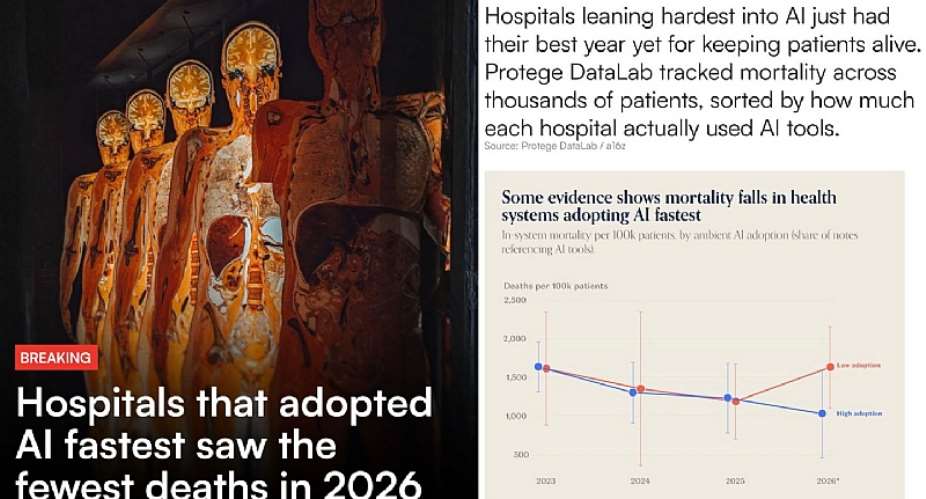
Hospitals adopting artificial intelligence the fastest are seeing fewer patient deaths.
That development should make us in Ghana think seriously about the future of healthcare, because the lesson is becoming increasingly clear: technology is no longer merely about convenience or productivity. In healthcare, technology can mean the difference between early and late diagnosis, between getting blood to a patient in time and getting it too late, and ultimately between life and death.
That is why I keep returning to the vision Dr. Mahamudu Bawumia brought to Ghana’s digitalisation agenda.
Long before the present AI revolution, Bawumia was making a simple argument: Ghana should use emerging technology to solve Ghanaian problems instead of waiting for the developed world to move first.
Zipline became one of the clearest examples of that philosophy.
What is easy to forget today is how fiercely the idea was attacked when it was introduced. The project was described by opponents as a misplaced priority, its cost and procurement were heavily challenged, and some of the rhetoric around it went far beyond ordinary policy disagreement. Bawumia himself later recalled that critics even mocked the idea by suggesting the drones would be used to photograph women in their bathrooms. Parliament saw bitter disagreement over the programme before it eventually went ahead.
Yet the drones flew.
They delivered blood, vaccines, medicines and emergency supplies to health facilities that could otherwise wait hours for them. The system expanded to six distribution centres, serving thousands of health facilities, and was also used to distribute COVID‑19 vaccines.
That is why I find the renewed effort to portray the entire intervention as some kind of mistake disappointing.
The current debate has again focused heavily on the contract and its cost. The Health Minister has raised concerns about the roughly $88,000‑per‑centre monthly payment structure, while the Majority Leader has called for the contract to be cancelled and replaced with a state‑operated drone service. The Chairman of Parliament’s Health Committee has gone further, saying Bawumia “misdiagnosed” Ghana’s healthcare problem and describing Zipline’s presence as a mistake.
Those are legitimate issues to debate. Governments should always scrutinise contracts, costs and value for money.
But there is a difference between reviewing the economics of an innovation and demonising the innovation itself.
If the contract needs renegotiation, renegotiate it. If Ghana can operate parts of the system more cheaply, examine that. If procurement weaknesses existed, correct them.
But do not throw away the underlying idea simply because it is associated with a previous government.
That becomes even more important when we look at the health challenges Ghana is confronting.
We are seeing troubling levels of kidney and liver disease, including among relatively young Ghanaians. Too many patients still enter the healthcare system when disease is already advanced.
This is precisely where the combination of AI, digitalisation and Agenda 111 could have been transformative.
Imagine Agenda 111 not simply as 111 hospitals, but as a digitally connected national health network.
A young Ghanaian walks into a district hospital. Their blood pressure, glucose, kidney function, liver function and medical history are captured electronically. AI systems analyse the results alongside previous records and identify patterns suggesting early kidney or liver disease.
The patient is flagged before symptoms become catastrophic.
A specialist in Accra or Kumasi reviews the case remotely.
Further tests are ordered.
Medication reaches the facility quickly.
Where urgent supplies are unavailable locally, Zipline delivers them.
That is the healthcare system Ghana could have been building.
Agenda 111 provided the physical infrastructure. Digitalisation could have provided the nervous system. AI could increasingly provide the intelligence layer. Zipline could provide the rapid logistics network connecting it all.
Put those together and Ghana could have been positioning itself among the most technologically advanced healthcare systems in Africa.
That is why the broader Bawumia vision deserves to be understood beyond individual projects.
The Ghana Card, digital addressing, mobile‑money interoperability, digital NHIS services, electronic medical records, e‑pharmacy and medical drones were not simply disconnected technological experiments.
They were pieces of infrastructure.
And infrastructure becomes more valuable as technology advances.
The irony is that many of the things that were ridiculed only a few years ago now look increasingly consistent with where the world is heading.
Artificial intelligence will make early detection more powerful.
Telemedicine will extend specialist care.
Digital identity will make longitudinal health records easier to manage.
Automated logistics will move medicines, blood and samples faster.
Predictive analytics will increasingly allow governments to identify disease patterns before hospitals become overwhelmed.
The tragedy would be for Ghana to have laid some of these foundations and then lose momentum just as the technologies capable of taking advantage of them are becoming truly powerful.
That is why the slowdown surrounding Agenda 111 and the renewed political battles over Zipline concern me.
This should not be an NPP‑versus‑NDC question.
A serious country does not abandon useful infrastructure every time government changes.
It improves it.
Ghana should complete Agenda 111, but we should now complete it for the AI era.
Build smart hospitals.
Connect patient records nationally.
Use AI‑supported screening for kidney disease, liver disease, diabetes, hypertension and cancers.
Expand telemedicine.
Develop Ghanaian medical datasets under strong privacy safeguards.
Use Zipline or improved logistics systems wherever they demonstrably get critical supplies to patients faster.
And build a healthcare system in which technology helps doctors intervene before patients arrive at the final stages of disease.
Dr. Bawumia was heavily criticised when he pushed Ghana towards medical drones and broader digitalisation.
History may ultimately judge that what looked excessive to some at the time was actually an attempt to prepare Ghana for a world that was arriving much faster than many realised.
My regret is that the momentum appears to have stalled.
My hope is that it has only stalled temporarily.
Because Ghana has demonstrated before that Africa does not always have to wait.
We can move first. We can innovate. And we can build systems that others eventually come to study.
The future of healthcare is becoming digital, predictive, connected and intelligent.
Ghana had already started walking in that direction.
We need to get back onto that path of forward movement — and finish what we started.
 ‘Neither East nor West, but forward together’ – Ghana's President renews Nkrumah...
 Ghana records GH¢46.1bn trade surplus in Q1 2026 despite real-term deficit
 Dollarisation of rent: Commissioner accuses BoG of ignoring Rent Control’s call ...
 Gold Coast customers hit streets today over locked-up funds
 Bright Simons explains why SIGA’s GH¢19.8bn SOE profit claim is 'bizarre'
 Election defeat can be life-saver – Former MP
 COCOBOD settles outstanding 2026 DDEP obligations with GH¢2.3bn payment
 OSP has delivered little to Ghanaians despite huge spending – Adomako-Kissi
 My petition seeking removal of Kissi Agyebeng is very strong, it cannot be dismi...
 AI can replace only lazy lawyers – Justice Asante

