




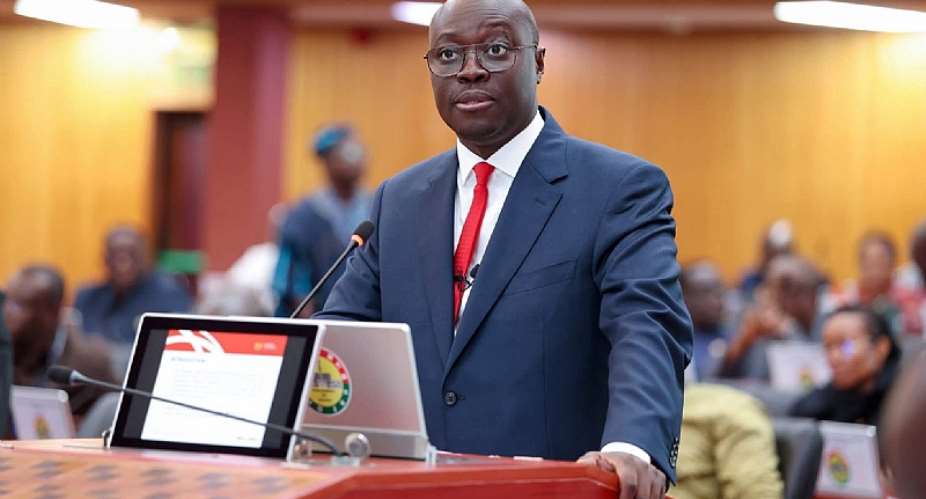
The Government is set to issue a new four-year Treasury bond on September 1, 2026, as it seeks to raise funds from the domestic market and build financial buffers ahead of major debt repayments expected in the coming years.
The bond, which is expected to mature in 2030, will settle on September 7, 2026.
The planned issuance comes amid improving fiscal conditions, although government revenue continues to fall short of budget projections.
According to the Bank of Ghana’s July 2026 Monetary Policy Report, total revenue and grants amounted to GH¢99.4 billion in the first half of 2026, falling about GH¢11 billion short of the GH¢110.4 billion budget target.
Tax revenue also underperformed, missing its target by 10.1%.
Despite the revenue shortfall, government expenditure remained significantly below projections. Total spending stood at GH¢109.4 billion, representing 24.9% less than the budgeted GH¢145.7 billion.
The lower expenditure was largely supported by reduced interest payments and capital spending.
Consequently, the fiscal deficit narrowed to GH¢10 billion, equivalent to 0.6% of GDP, compared with GH¢21.4 billion, or 1.5% of GDP, recorded during the corresponding period a year earlier.
Government also recorded a primary surplus of GH¢11.5 billion during the period.
However, public debt increased from GH¢641.1 billion at the end of December 2025 to GH¢719.5 billion by June 2026, with domestic borrowing accounting for much of the increase.
Domestic debt consequently rose to GH¢391.1 billion.
The Bank of Ghana explained that the increase was linked to the government’s strategy of building financial buffers to meet future debt-servicing obligations, particularly bonds issued under the Domestic Debt Exchange Programme (DDEP) that are due to mature in 2027 and 2028.
The new four-year bond is expected to support this strategy while allowing the government to raise funds at relatively lower borrowing costs as interest rates continue to decline.
The Monetary Policy Rate currently stands at 14%, while the yield on the 364-day Treasury bill has fallen to 11.3%.
The bond issuance is also being undertaken against the backdrop of stronger economic conditions.
Ghana’s economy expanded by 6.4% in the first quarter of 2026, while inflation stood at 5.3% in June.
The country also recorded a trade surplus of US$8.8 billion during the first half of the year, while gross international reserves reached US$12.9 billion, equivalent to about five months of import cover.

 Attorney-General appeals ruling halting trial of former Buffer Stock CEO, wife
 NAIMOS destroys 1,970 changfans, 863 Illegal mining structures in three months —...
 Let's see how Asiedu Nketia becomes NDC flagbearer with same people he conspired...
 Asiedu Nketiah opts out of NDC chairmanship race amid flagbearership speculation
 NDC insists Nkwanta North elections will proceed despite court injunction
 'My side of the story will shock you; I'm waiting for court days' – Obuasi SHTS ...
 Obuasi SHTS sexual abuse: 'GES must distant itself, allow the law to work' — For...
 Upper East: Fear grips nine Kusaug communities over mysterious fish deaths in da...
 NDC suspends Amasaman Communications Officer over 'irresponsible' remarks on Obu...
 Parliament secures religious leaders’ support to end witchcraft accusations


